Guimarães is the city where the Kingdom of Portugal was founded in 1128 by the man who would become its first king, Afonso Henriques. For history lovers, and especially anyone drawn to Portugal’s origins, it’s an essential stop. If you’re already in Porto, even better—it’s only about a 45-minute drive away.
This northern Portuguese city, known for its often gray and rainy weather, has preserved its medieval character, with narrow lanes and historic buildings. It’s a wonderfully distinctive and pleasant place to explore. Rising above the town are two major landmarks: Guimarães Castle and the Palace of the Dukes of Braganza, one of the most remarkable buildings in all of Portugal. A day trip is enough to get a strong feel for Guimarães and see most of its key sights. It suits travelers of all ages, including kids, who will likely be especially drawn to the castle and the cable car.
The surrounding area is lush and wooded, and you can ride a cable car straight from the city up to the park on the mountain above. At the top, among the groves and enormous rock formations, you’ll also be treated to wonderful views over the city and the surrounding region.
How much time should you spend in Guimarães?
One full day is enough to see most of Guimarães’ must-see sights. You can also stay overnight as a base for a rural trip into the mountains and to the archaeological site of Citânia de Briteiros, or combine it with Braga on a day trip from Porto.
Click here to find a place to stay in Guimarães…
Click here for a full day trip from Porto to Guimarães and Braga…
10 must-see sights and things to do in Guimarães
- Guimarães Castle and climbing its walls | Castelo de Guimarães
- The cable car to Penha Mountain, where you’ll find trails among massive boulders | Teleférico de Guimarães
- Palace of the Dukes of Braganza | Paço dos Duques de Bragança
- Largo da Oliveira – the heart of the old town | Largo da Oliveira
- The beautiful São Francisco Church | Igreja de São Francisco
- Alberto Sampaio Museum with exhibits tied to Portuguese heritage | Museu de Alberto Sampaio
- The green gardens of Largo da República do Brasil | Largo da Republica do Brasil
- Toural Square and the sign that reads “Portugal was born here” | Largo do Toural
- Modern art at the José de Guimarães Museum | CIAJG
- Citânia de Briteiros, an archaeological site near Guimarães | Citânia de Briteiros
How to get to Guimarães
Guimarães is in the Braga district. It’s about a 25-minute drive from Braga and roughly 45 minutes from greater Porto, which makes it very easy to reach for anyone traveling through northern Portugal. Getting around the old town is best done on foot, since it isn’t very large. There are some gentle uphill stretches, but they usually run through charming streets that make the climb worthwhile.
Flights to Guimarães
The international airport serving Guimarães is Porto Airport (OPO).
Click here to search for accommodations in Guimarães…
Getting to Guimarães by car
Guimarães works well as a day stop on the way to the rural northern reaches of Portugal, or as a day trip from Porto. It also pairs easily with nearby Braga in a single day.
Parking
Parking can be a bit tricky around the old town, and there aren’t really any large parking lots there.
You can park uphill near the castle (Castelo de Guimarães parking), or a little below it at Parque Público Condessa Mumadona, then walk a few minutes downhill to the old town.
Another large parking area, closer to the old town than to the castle, is near the Consolação Church (Parque estacionamento Largo das Hortas).
Click here for a list of highly popular day trips from Porto…
Getting to Guimarães by public transportation
Train
The most convenient way to reach Guimarães by public transportation is by train. Trains leave from Porto’s Campanhã station roughly once an hour. The ride from Porto to Guimarães takes about 1 hour and 10 minutes, with several stops along the way. It’s a bit slower than the bus, but the train service is very comfortable, so it’s generally the better option.
If you’re coming from Lisbon, you’ll need to change trains in Porto.
Guimarães train station is at the end of the line, so you can’t miss your stop. The station is on Av. D. João IV in town. From there, it’s about a 10-minute walk to the city center, but it’s uphill, so taking a local bus or taxi is the easier choice.
Bus
Buses to Guimarães from Porto also leave from Campanhã station. Be sure to board a direct bus, which takes about 50 minutes to 1 hour and 15 minutes depending on traffic.
Guimarães’ main bus station is next to the shopping mall (GuimarãeShopping), west of the old town center. From there, it’s about a 10-minute walk uphill to the old town, though a local bus or taxi is more comfortable.
Click here for an excellent day trip from Porto to Guimarães and Braga…
about Guimarães
Guimarães is a city of 150,000 people in the Braga district of northern Portugal. It sits at an elevation of 600 meters above sea level. Rainy and therefore green, it stays cool in winter without freezing, and warm in summer without becoming scorching or dry.
Its importance lies in the fact that this is where the Portuguese nation was born—a country that in the 21st century takes pride above all in its achievements in soccer, but also has a rich heritage and a legacy that helped shape world history.
Afonso I (Afonso Henriques) was born in 1109 to parents from the royal family of León in Spain and the counts of Portugal. After the death of his father, Henry of Burgundy, in 1112, his mother Teresa entered a romantic relationship with the count of neighboring Galicia. When Afonso came of age, he was outraged by his mother’s ties to the Galician count and went to war against them.
The struggle was decided in Afonso’s favor at the Battle of São Mamede, fought in the area around Guimarães. After winning the battle—one of the defining moments in Portugal’s founding—he exiled his mother and declared the creation of the Kingdom of Portugal, which until then had been a county. To mark that moment, you’ll now find an intriguing inscription in central Guimarães stating that “Portugal was born here.”
Today, Guimarães lies in one of Portugal’s most densely populated regions and is an industrial city with a strong economy. It’s also known as a highly cultural city, with not only major museums but also many galleries scattered through its streets.
It’s easy to include it in a day trip from Porto together with neighboring Braga.
On the culinary side, the city is famous for its sugary pastries, especially Toucinho do céu, which help give the body the energy it needs to stay warm through the cool winters of northern Portugal.
Click here for a lovely day trip from Porto to Guimarães and Braga…
Attractions and interesting places in Guimarães
Guimarães Castle | Castelo de Guimarães
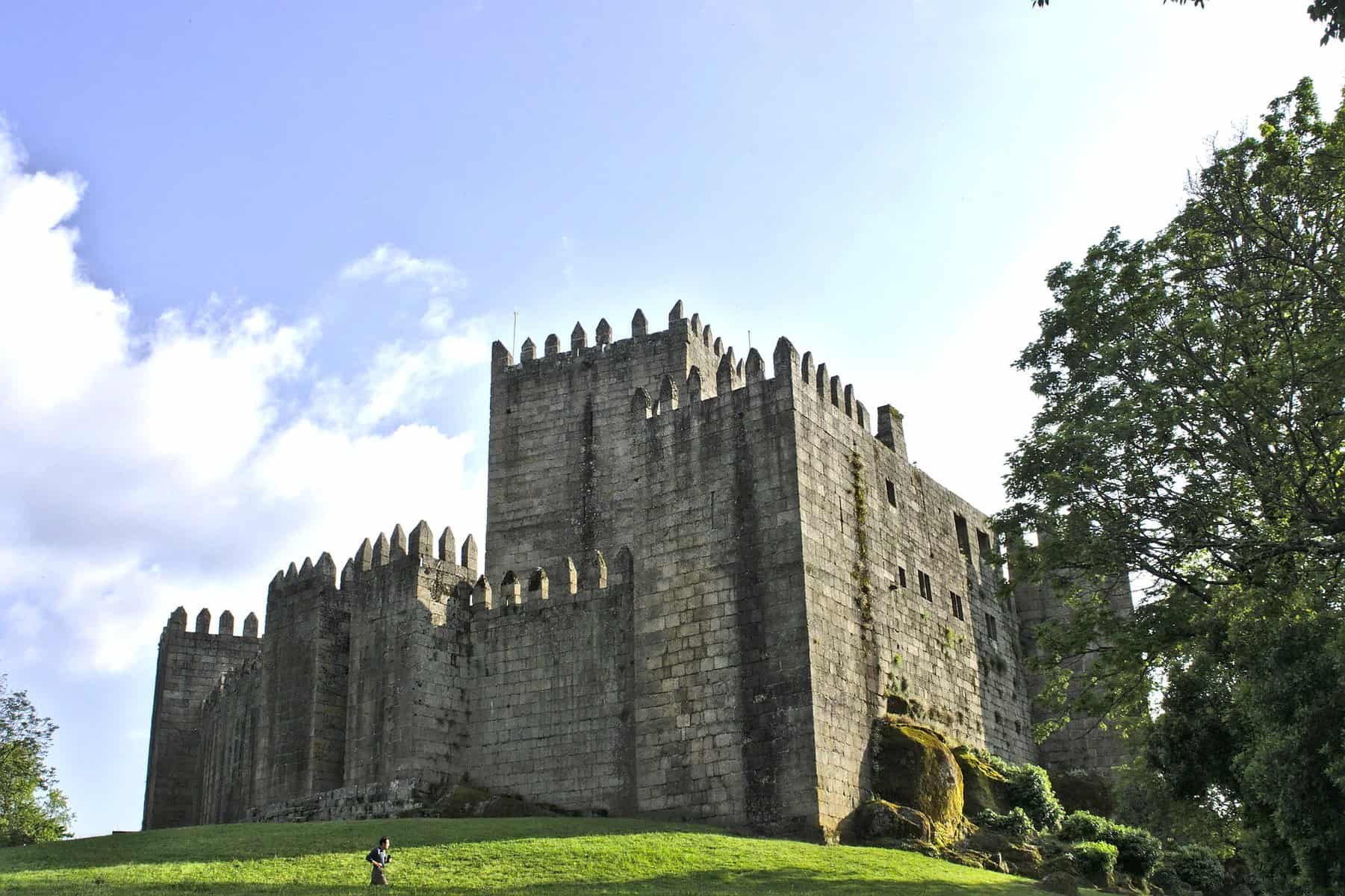
Guimarães Castle is one of the finest examples of a medieval castle in Portugal. On gray, rainy days—which are common in Guimarães—it can look strikingly like the famous English castles shrouded in mist.
The castle was built in the mid-10th century by order of Mumadona Dias, a Galician noblewoman and Countess of Portugal, who ruled the area together with her husband. From the 15th century onward, as the Kingdom of Portugal became more established and Guimarães was no longer near a vulnerable frontier, the castle was no longer truly needed and fell into neglect. In the late 19th century, it was designated a national heritage site and restored, and work still continues to preserve and reconstruct it as a national treasure.
Facing the castle at the heart of the garden stands the small and ancient São Miguel Church (Igreja de São Miguel do Castelo). Although the church dates to the 13th century, tradition holds that this is where Portugal’s first king, Afonso Henriques, was baptized in the 12th century. The church has a simple, modest look, but one that is carefully proportioned and quietly elegant. It was damaged over the years, yet restored in the 19th century, and today it looks almost exactly as it did 800 years ago.
Palace of the Dukes of Braganza | Paço dos Duques de Bragança
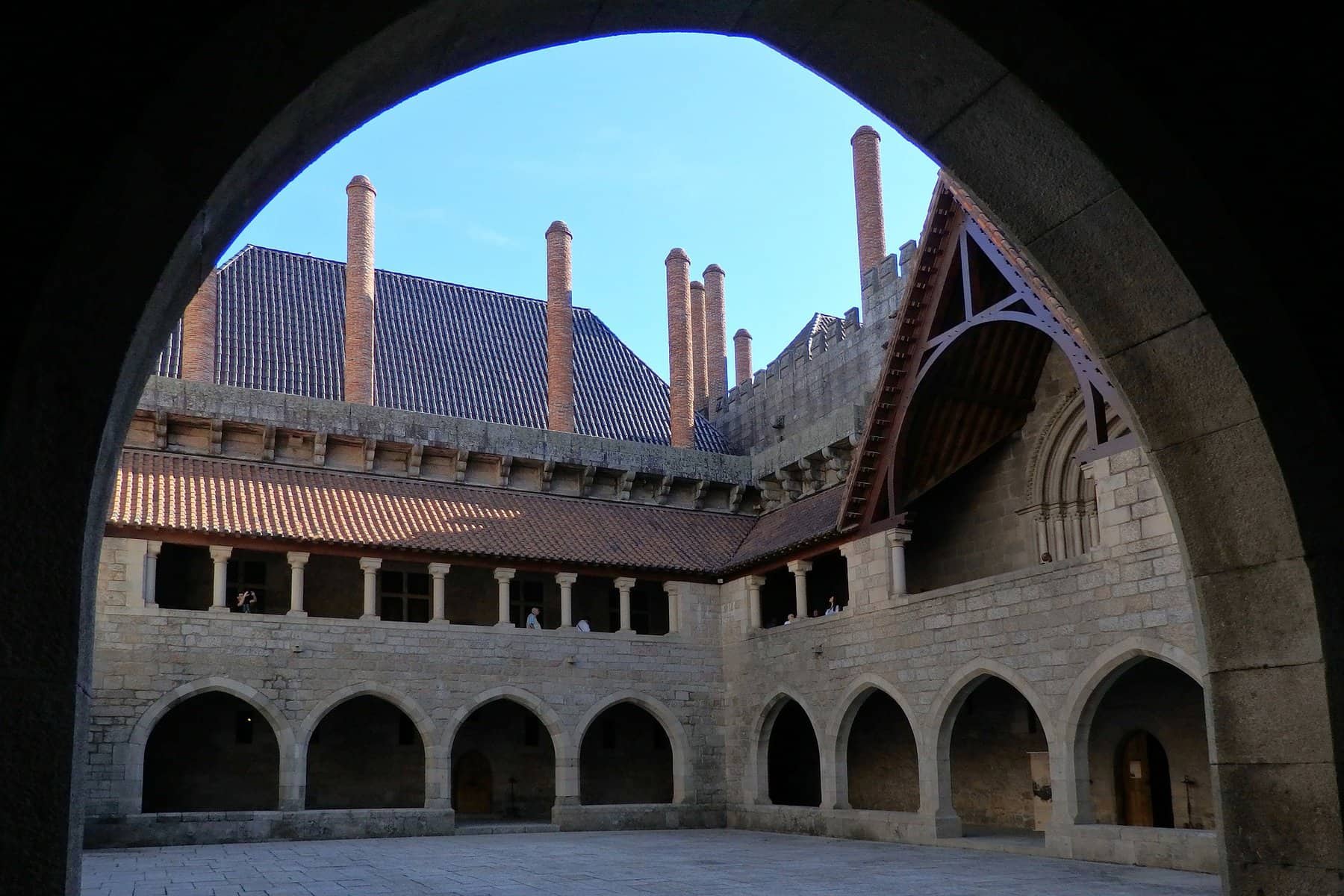
The palace near Guimarães Castle is the city’s most impressive and distinctive building. Surrounded by parkland, it now also serves as a museum displaying works of art, tapestries, furniture, and old weapons. There is also a small contemporary art wing featuring, among others, works by local artist José de Guimarães.
Designed in the style of a French manor house, the palace is defined by its large inner courtyard with Gothic arches and second-floor balconies, along with the many chimneys rising from its steep gray roof. Inside, the most striking features are the high wooden ceilings and the fireplaces connected to those chimneys you can see from outside.
Still, the palace chapel with its stained-glass windows stands out above all the rest.
Construction of the palace began in 1420 under Afonso de Barcelos (D. Afonso de Barcelos), the illegitimate son of King João I. As a kind of consolation prize, Afonso received the title Count of Braganza from his nephew, who had become king. Later, after the Restoration War with Spain, João IV—who held the title Count of Braganza—became king in 1640. The House of Braganza then became the most powerful family in Portugal, and from that point on, “Count of Braganza” became one of the titles associated with the Portuguese monarchy.
Later, the residence of the Count of Braganza moved to the town of Vila Viçosa in Alentejo, in central-southern Portugal. The building in Guimarães was neglected and in the 19th century even became a military base. In the 20th century, however, because of its importance to Portuguese heritage, it was restored and renovated, and in 1959 it was inaugurated once again—exactly 831 years after the Battle of São Mamede, after which Portugal was founded.
An interesting detail is that the upper floor of the palace served as the official northern residence of President Salazar during Portugal’s 20th-century dictatorship.
Next to the palace stands a small chapel in the middle of a green lawn that once served its residents, called Santa Cruz Chapel.
Click here to find a place to stay in historic Guimarães…
Alberto Sampaio Museum | Museu de Alberto Sampaio
The museum was established in the 1920s inside a former monastery whose origins go back to the time of Mumadona Dias, Countess of Portugal, in the 10th century. It is named after Alberto Sampaio, a Portuguese historian.
Its collection includes frescoes, paintings, and sculptures gathered from churches and monasteries in the surrounding area, dating from the 13th to the 18th century. There are also displays of period clothing and garments, along with gold and silver jewelry from earlier centuries.
The museum’s highlight is a surcoat (tunic) worn by King João I at the Battle of Aljubarrota in 1385. In that battle against Castile, the Portuguese defeated the Castilians and secured Portugal’s independence.
As you leave the museum and walk downhill, the tree-lined Largo da República do Brasil stretches ahead, with its beautiful gardens leading toward Igreja de Nossa Senhora da Consolação.
Click here for a full day trip from Porto to Guimarães and Braga…
Consolação Church | Igreja de Nossa Senhora da Consolação
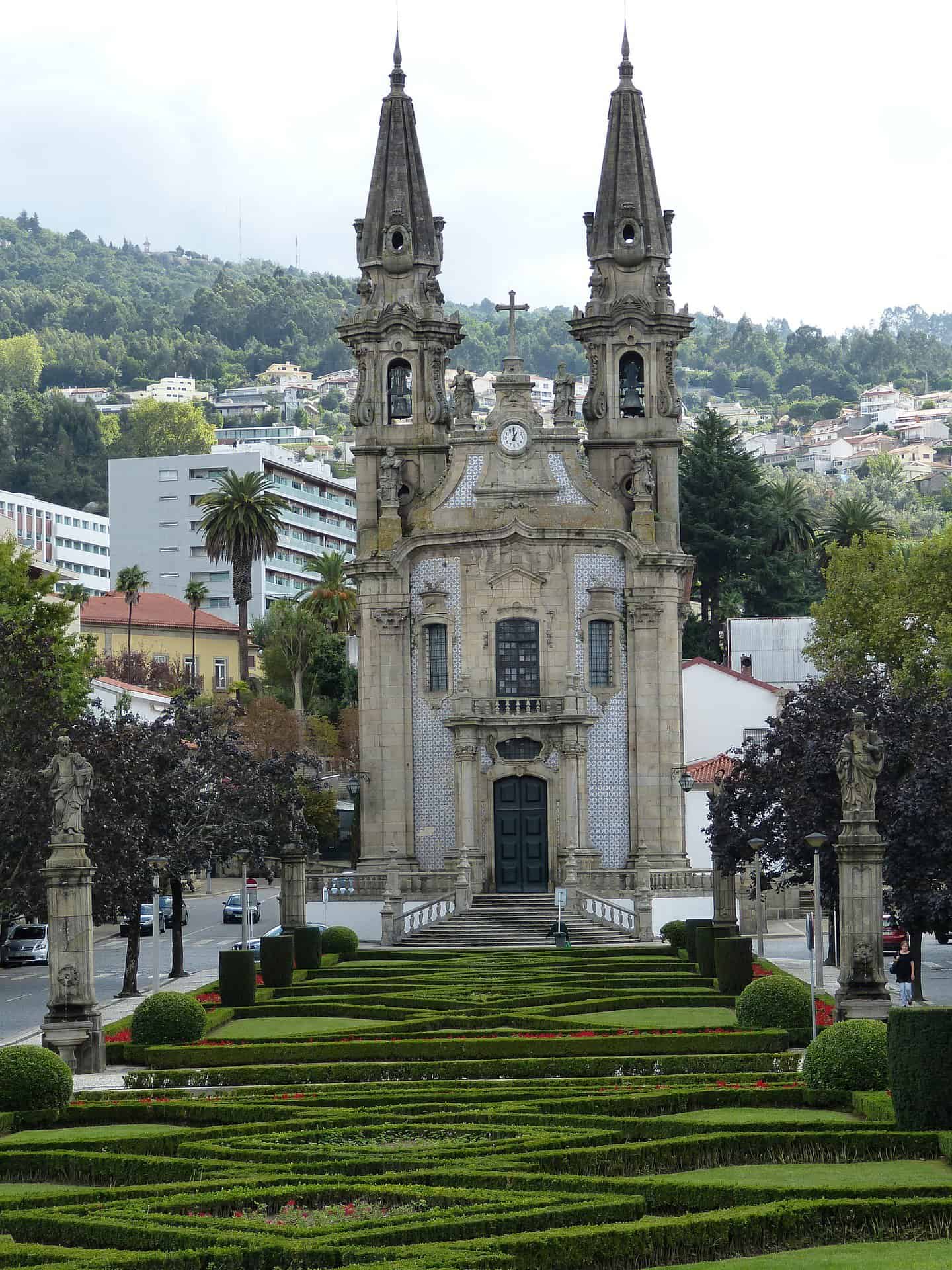
The first impression of the church comes from the approach along the broad Largo da República do Brasil, with its green gardens running down the middle. The slender church, with its two tall towers, is dedicated to Our Lady of Consolation—Consolação.
It was built in the 18th century, while the towers were added later. The façade is Baroque, and the interior is entirely Neoclassical. As mentioned, much of its impact comes from the outside, where it forms a graceful end point to the leafy boulevard.
During the holiday season (Christmas), it is beautifully decorated, and if you’re in town at that time, it’s well worth seeing it illuminated in the evening.
José de Guimarães Art Museum | CIAJG
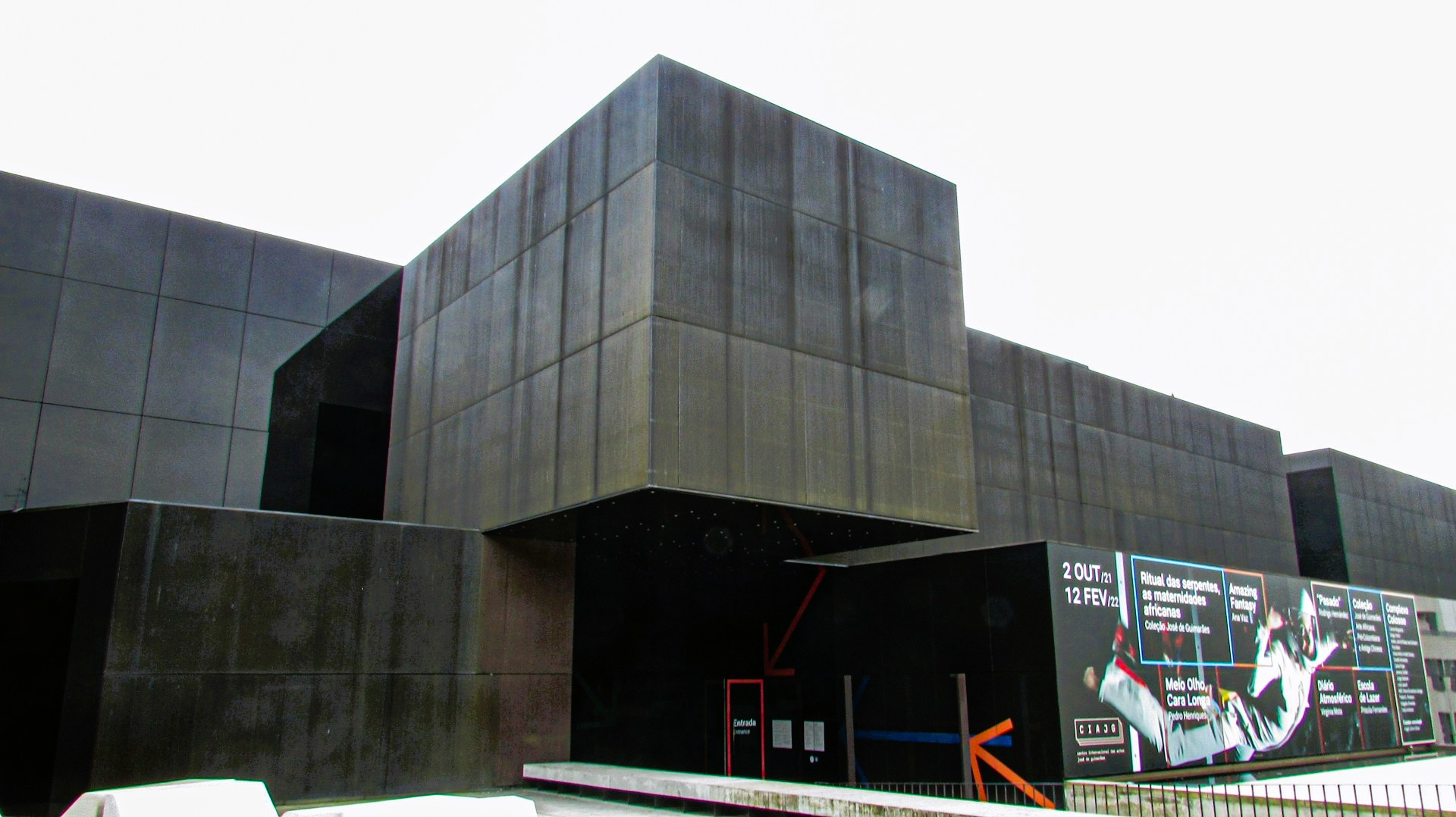
This contemporary museum stands just southeast of the old town. It is named after local artist José de Guimarães (Centro Internacional das Artes José de Guimarães) and showcases both his private collection and his own works.
The museum focuses on contemporary art and also hosts rotating exhibitions by other artists, along with various cultural events. Born in 1939, the artist collected African art, pre-Columbian South American art, and Chinese art objects over the course of his life, and donated them to the center that bears his name for permanent display.
He is especially known for his large modern sculptures and is considered one of the most important Portuguese visual artists of the modern era.
Click here to search for accommodations in Guimarães…
São Francisco Church | Igreja de São Francisco
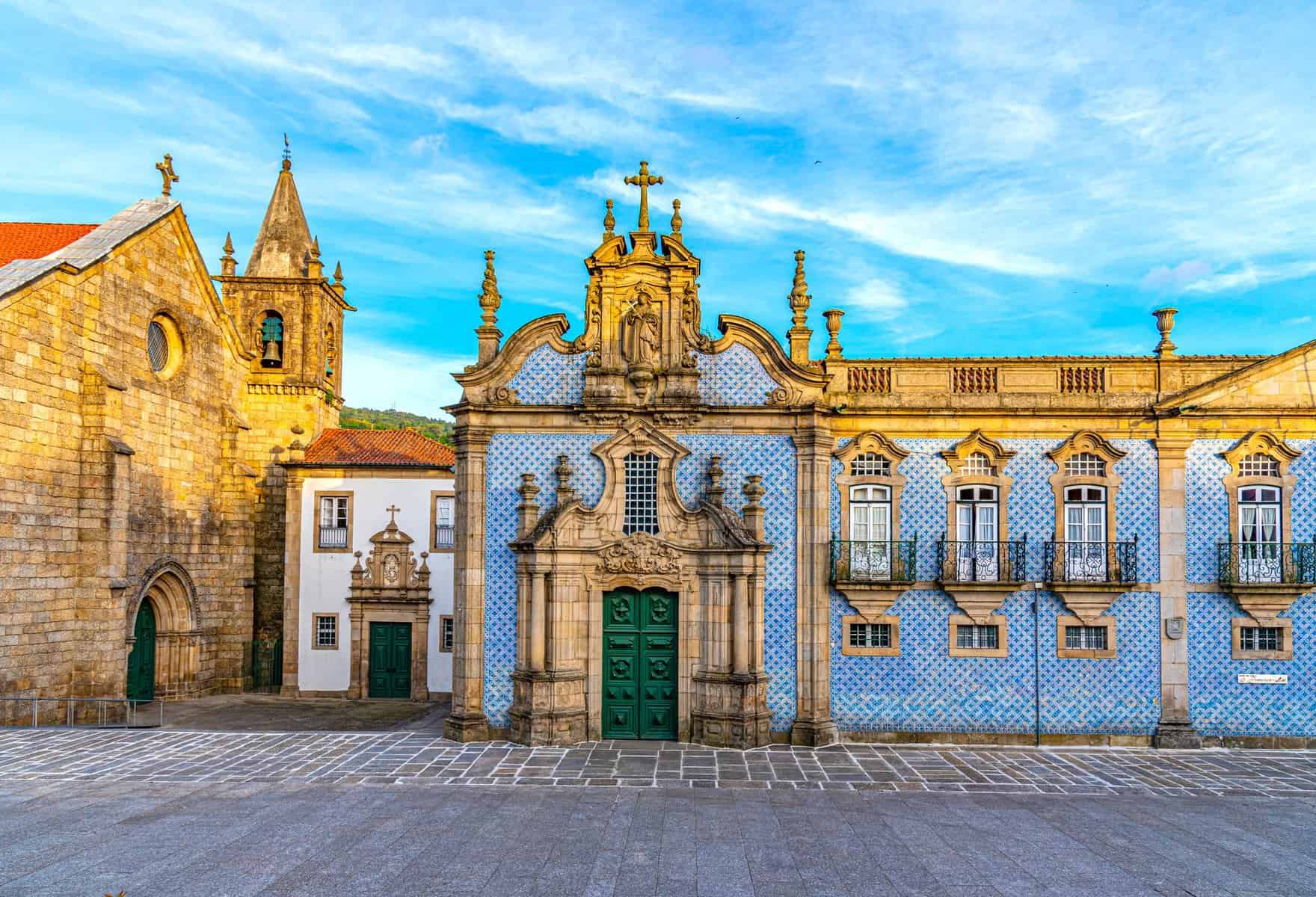
Although the Braganza Palace is the city’s most unusual building—and its design is unlike most of what you typically see in Portugal—many would say São Francisco Church is the most beautiful building in Guimarães. The combination of stone-framed doors and windows with blue-and-white wall tiles is simply stunning.
Step inside and the azulejos continue up the church walls almost to the ceiling, while the enormous Baroque altar gleams in gold and lavish ornament.
The Gothic church and monastery have stood here since 1400, though there was already a Franciscan building on the site in the 13th century. Most of the church’s dazzling decoration was added in 1746, when it underwent a major renovation that lasted several years. That was also when the azulejos and the ornamentation around the altar were added.
The church lies between the city’s two main sightseeing areas—those around Toural Square and those beginning at Largo da República do Brasil and climbing toward the heart of the old town. Between them are the Almada Gardens, which divide the roadways and create a lovely passage between these neighboring parts of the city. That makes the church an easy and worthwhile stop for a quick look at this design gem while moving between Guimarães’ main landmarks.
Leather and textile processing site | Tanques de couros
Behind São Francisco Church, among the lovely surrounding buildings, are the remains of an industry that thrived in Guimarães until fairly recently. These tanks—more like small, shallow pools—were used until the mid-20th century by Portugal’s extensive textile industry, of which Guimarães was a central part.
They were used for processing leather and dyeing cloth and wool, and the city chose to preserve them as part of its history.
It’s an easy stop of 10 to 15 minutes after admiring the exterior of São Francisco Church and before continuing on to Toural Square or nearby Largo da República do Brasil.
Click here to find a place to stay in Guimarães…
Toural Square | Largo do Toural
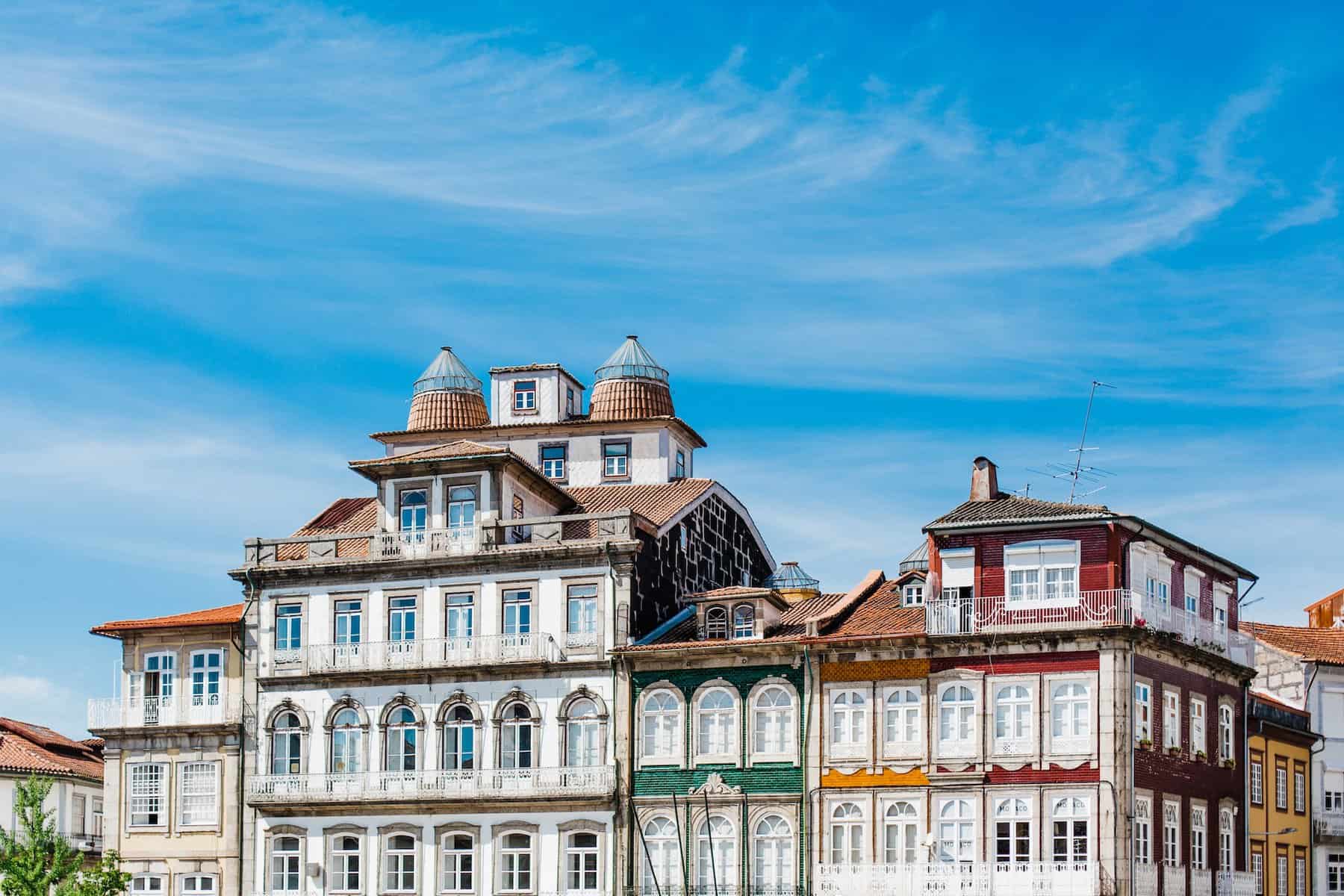
Toural Square is a central square in the city and without a doubt the most beautiful square in Guimarães.
The square and its surroundings are lined with shops and restaurants, and it’s a very pleasant place to stroll. Old buildings with colorful trim surround it, giving it a distinctly European feel. It is, in fact, the city’s main square, while Largo da Oliveira is the heart of the old town.
It connects with the historic central Largo da Oliveira via Rua Rainha Dona Maria II, a charming paved street in its own right.
At the entrance to the square, there is signage on a remnant of the old city wall that reads: “Portugal was born here” (Aqui Nasceu Portugal). At first glance, it’s easy to miss that this is an ancient wall fragment, since cafés sit below it and Neoclassical buildings surround it.
Many people—especially Portuguese visitors—make a kind of pilgrimage here to photograph the sign, because Portugal truly was born here in Guimarães 800 years ago. It was the beginning of a country that became a maritime power with colonies stretching from Brazil in the west through Africa and as far as Macau in the east, and that today is a wonderful country in Western Europe.
The Main Squares – Largo da Oliveira and Largo de São Tiago
These two squares form the heart of the old town and are an excellent place to begin exploring Guimarães’ main sights. They’re also a wonderful spot for lunch or coffee in the calm atmosphere of northern Portugal.
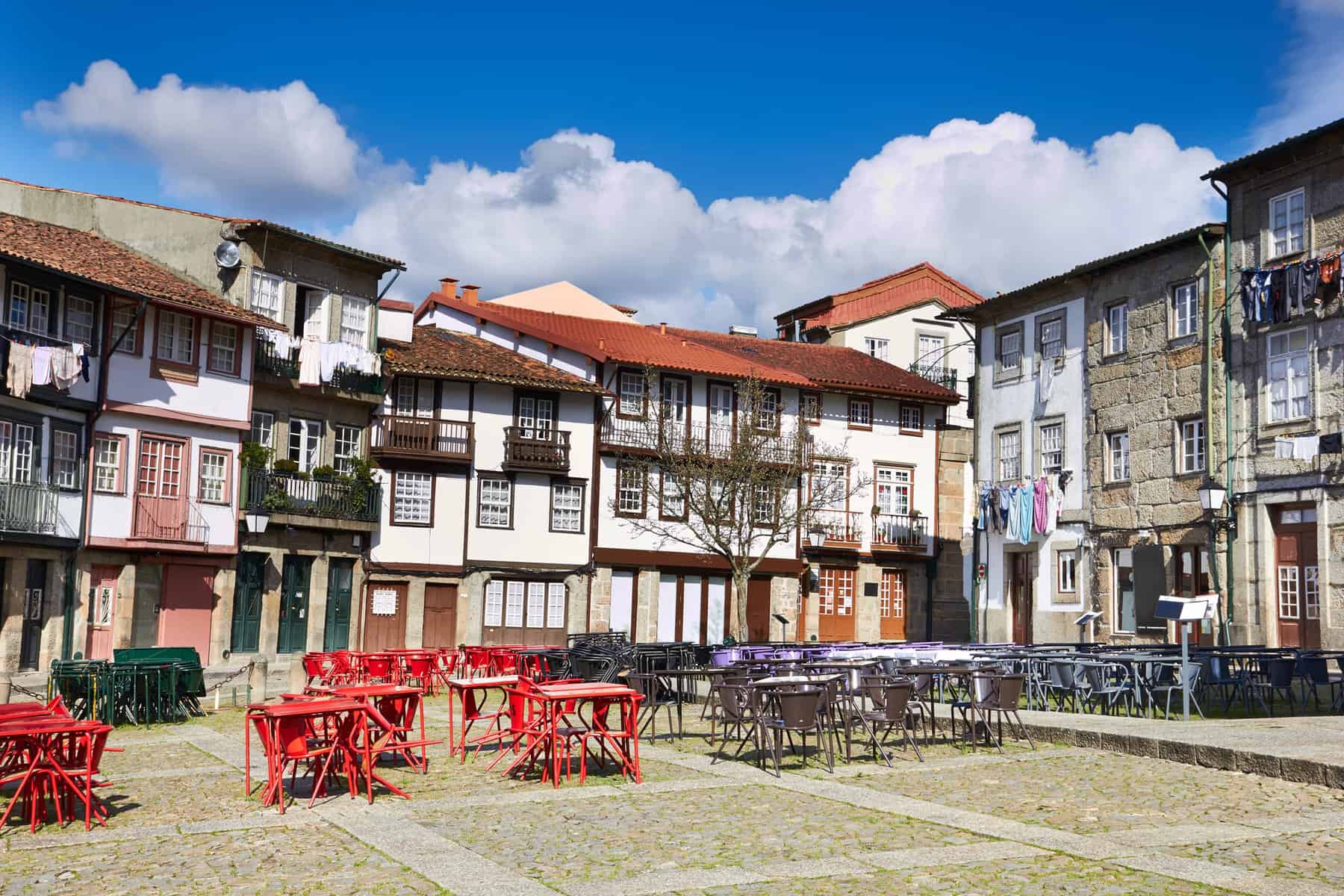
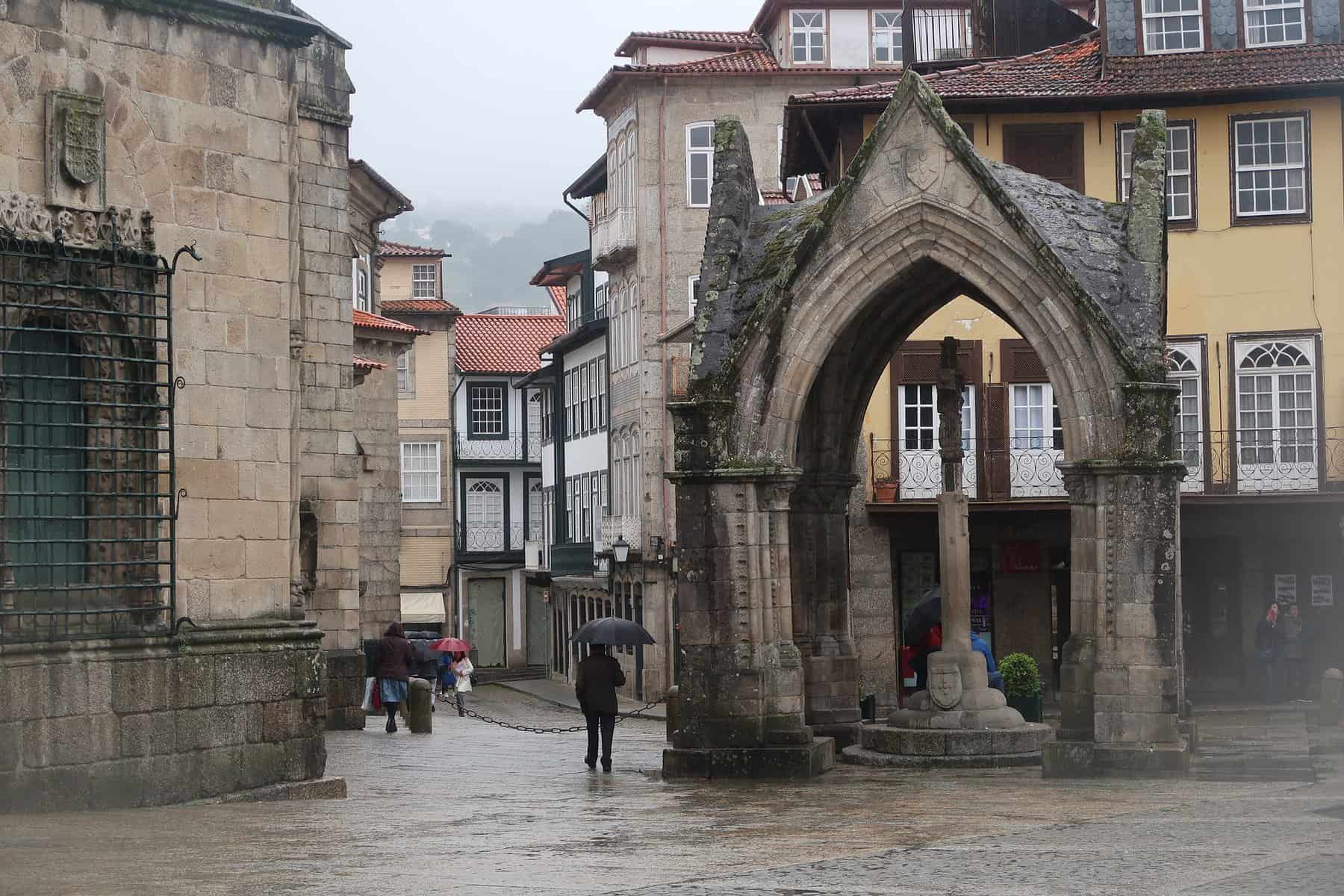
Largo da Oliveira takes its name from the ancient olive tree that has grown there for centuries. It is framed by photogenic buildings typical of northern Portugal, while its entire eastern side is occupied by the large church dedicated to Our Lady of the Olive Tree.
Beyond the tree, its second major landmark is a structure that looks like a Gothic skeleton known as Padrão do Salado. It commemorates the Battle of Salado, where the Portuguese and Castilians defeated the Moors in 1340.
The last building standing above the arcade leading to Largo de São Tiago is the old town hall from the Middle Ages, topped by a statue that has become one of the city’s symbols.
Largo de São Tiago sits right beside Largo da Oliveira, and you can reach it either through the narrow alley or beneath the arcades on the northern side of Largo da Oliveira. It too is lined with beautiful colorful buildings, and on some of them you can still see ancient wooden balconies that have survived the centuries—a testament to the skill of the craftsmen who built them hundreds of years ago.
On the northern side of Largo de São Tiago you’ll find the city’s tourist information center. From here begins the thousand-year-old Rua de Santa Maria. Rua de Santa Maria is one of the city’s earliest streets, if not the very first. It is lined with historic buildings and forms the main axis for exploring the old town. As you continue uphill, you arrive at the area of the castle and the Braganza Palace.
Click here to find a place to stay in Guimarães…
Oliveira Church | Igreja de Nossa Senhora da Oliveira
In Largo da Oliveira stands the church around which the city developed. A church was already built here in 949 at the initiative of Mumadona Dias, Countess of Portugal from Galicia. From the beginning, it was dedicated to Mary and became a regional pilgrimage site.
After the victory at the Battle of Aljubarrota in 1385, which ensured the survival of the Kingdom of Portugal, King João I decided to enlarge and renovate the church. The result is the Gothic structure we see today, to which the front tower was added about a century later, in 1513, in the Manueline style.
The church underwent another major renovation in the 17th century, but the early Romanesque elements—such as the arches supporting the interior ceiling—remained in place and still hold up the roof today. The large paintings and current altar decorations were added in the 18th century in the Baroque style.
In 1801, the olive tree that had long stood directly in front of the church was moved by decision of the city council, much to the dismay of the residents. Today, an olive tree has been replanted in the square, though in a different location, preserving the old devotion—Oliveira, Our Lady of the Olive Tree.
Martins Sarmento Archaeological Museum | Museu Arqueológico Martins Sarmento
The museum is on the street that runs north from lovely Toural Square. It stands about 30 meters away in a building you can’t miss, a little before the contemporary José de Guimarães Art Museum. It is one of Europe’s leading museums for the presentation of pre-Roman culture in the western part of the continent. The museum is housed in the 14th-century Gothic structure of São Domingos Church, mainly around its cloister.
It displays finds primarily from Castro culture, many of them discovered by the 19th-century local archaeologist Martins Sarmento. Beyond the archaeological exhibits, the medieval building itself is worth admiring, and there is also a small collection of contemporary art on display.
The museum’s standout object is a stele known as the “beautiful stone” (Pedra Formosa), around 3,000 years old, which Sarmento himself found during his excavations.
Click here for more articles and information on Northern Portugal…
The cable car to Penha Mountain | Teleférico de Guimarães
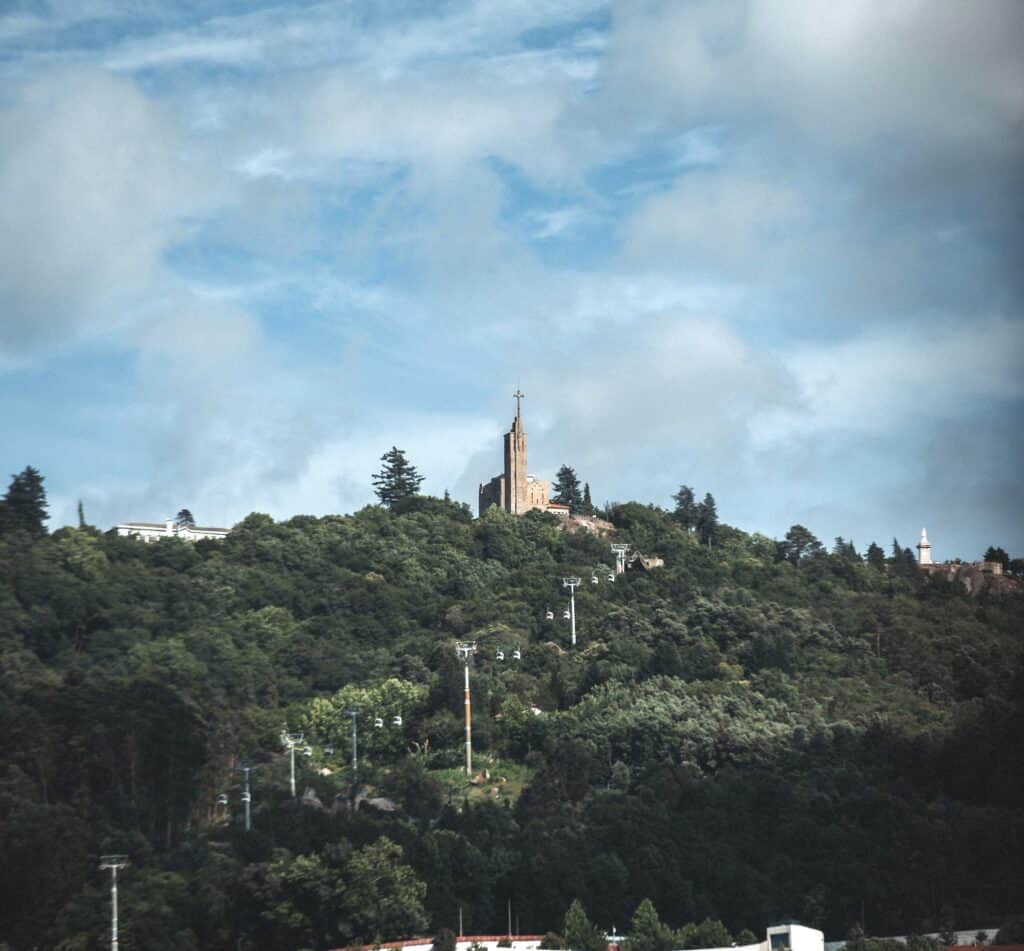
The 1,700-meter cable car rises from the city of Guimarães to the summit of Penha Mountain above it. At the top, you’ll find both attractions and excellent views. Riding the cable car is one of Guimarães’ great experiences for kids, though certainly not only for them.
The lower station is near Jardim das Hortas, about a 3- to 4-minute drive uphill from the old town. There’s plenty of parking near the cable car station. You can also walk there, and certainly bike there too, though it is uphill.
Some of the cable car cabins are designed to carry bicycles, so you can ride back down into the city through Penha Park afterward. Up on the mountain, there are also biking trails through forests, among giant boulders, and across the open land beyond, making it ideal for cycling enthusiasts.
As noted, though, it’s a wonderful attraction for anyone visiting Guimarães.
Click here to find a place to stay in Guimarães…
Penha Mountain and Park | Montanha da Penha
The mountain above the city (Montanha da Penha) brings together three areas of interest. First, there is an impressive religious monument, Santuário da Penha. Facing it is a giant cross spread across the square in front, formed by four narrow water basins lined with flowers.
Second, the park surrounding the summit on all sides is made up of trails and planted greenery alongside dramatic rock formations and rounded boulders jutting from the ground. It’s a very enjoyable place for walking or for slightly more adventurous biking.
The mountaintop also has restaurants, bars, attractions for children, and even a campground—all set against a backdrop of forest and huge boulders emerging from it.
Beyond the activities themselves, the views from the mountain are excellent, and it’s easy to spend several hours here combining a walk, a look at the unusual rock formations, and a quiet sense of wonder at the lush green scenery.
Football in Guimarães
Guimarães’ Football club is called Vitória de Guimarães | Vitória de Guimarães, and it plays regularly in Portugal’s top division. After the big three (Os Três Grandes)—Benfica, Sporting, and Porto—Vitória draws the highest number of spectators.
Guimarães’ stadium is named after Portugal’s first king, Afonso Henriques | Estádio D. Afonso Henriques. It holds around 30,000 people and attracts an average of 20,000 fans to the team’s home matches. Guimarães supporters are famously devoted, even though the club rarely wins titles.
The stadium is close to the old town, just to its north. It is relatively modern, having been renovated ahead of the European Championship held in Portugal in 2004, and the stands sit close to the field. The most passionate supporters’ section is behind the south goal, in a square-shaped stand in the style of English stadiums.
The best Football experience in Guimarães is the derby against nearby Braga—a city with similar characteristics. The rivalry is known as the Minho Derby | Dérbi do Minho , named after the region and nearby river in northern Portugal. Matches against Porto or against the two big clubs from Lisbon are also the most talked-about events in town that weekend.
Attractions and points of interest around Guimarães
The archaeological site of Citânia de Briteiros | Citânia de Briteiros
This site lies roughly halfway between Guimarães and Braga and is of major archaeological importance. Most of it remains undeveloped—it is essentially an open area with archaeological remains scattered among the trees and up the hillside. It’s worth checking Google and viewing a satellite image to appreciate the symmetrical outlines of the ruins that remain.
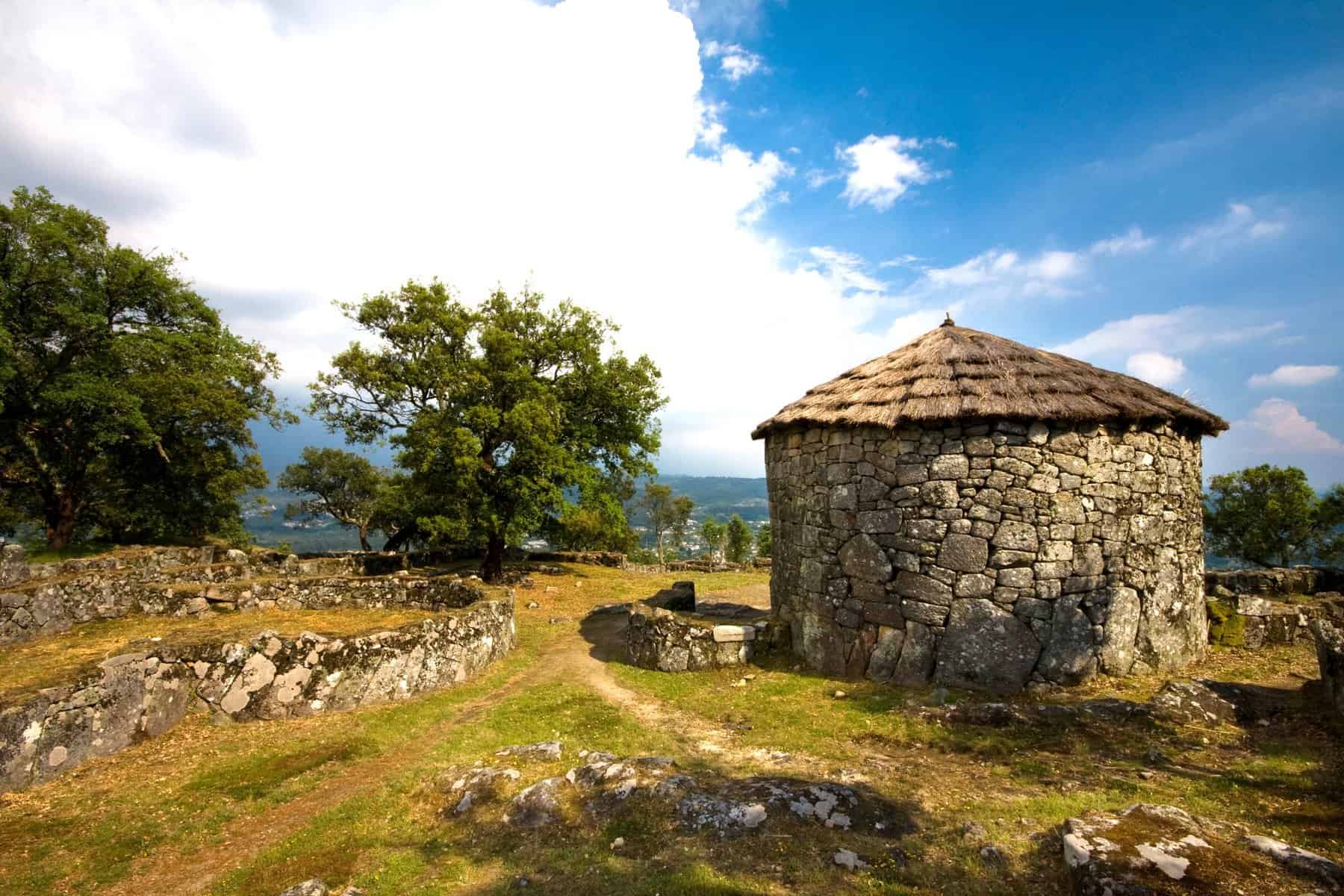
Right at the entrance, you can begin to appreciate the citânia settlement, which first developed at the top of the hill—the acropolis. Around the acropolis are mostly residential structures, along with public buildings such as communal baths.
The site, first excavated in the late 19th century by Portuguese archaeologist Francisco Martins Sarmento, presents the remains of a settlement from Castro culture (in Portuguese, Cultura Castreja).
This material culture emerged in the first millennium BCE along the Douro River (Rio Douro), which flows from Spain into northern Portugal. It later spread north into Galicia and Asturias, regions with which it is still associated today. With the arrival of the Romans in Iberia, the culture declined, but its remains can still be found across northern Portugal and northwestern Spain.
Citânia de Briteiros is a late example of a town of roughly 700 to 1,500 inhabitants belonging to the ancient people of northern Portugal, who were largely Celtic. The finds here date to the 2nd and 1st centuries BCE, and excavations continue to this day, inspired by Sarmento himself, who was so captivated by the site that he founded an association to purchase the land on which it stands—and that association still owns it today.
Part of the wall and two houses on the site were reconstructed by Sarmento and his team to show visitors exactly how they looked more than two thousand years ago.
Click here to find a place to stay in Guimarães…
Click here for a full day trip from Porto to Guimarães and Braga…