Évora, the capital of Alentejo, is one of the most fascinating cities in all of Portugal. About a 90-minute drive east of Lisbon, it’s an essential stop for anyone traveling through Alentejo. Although it’s a little removed from Lisbon, Évora still works well as a day trip from the Portuguese capital if you set out early in the morning. The city began as a Roman settlement and, from the 16th century onward, also became an important center for the kings of Portugal, some of whom even lived here. Today, Évora is home to a vast old town filled with historic landmarks and narrow, picturesque streets. It lies inland in the heart of a broad agricultural region, and its summers are among the hottest in Portugal. The surrounding area is dotted with groves and open countryside, along with several prehistoric sites that offer further evidence of early settlement on the Iberian Peninsula. That makes it easy to pair a visit here with some time in nature as well. Even children are likely to find plenty to enjoy, and if not, the many ice cream shops Évora is known for—especially around Praça do Giraldo—should do the trick.
How many days should you spend in Évora?
One full day is enough to see most of the highlights in Évora’s large and distinctive old town. That said, anyone who wants to soak up more of historic Alentejo’s capital can easily stay for a night or two—enjoying the city at a slower pace and exploring the prehistoric sites out in the surrounding countryside.
Click here to find a place to stay in Évora…
Click here for a day trip from Lisbon to Évora and the prehistoric sites nearby…
7 must-see sites and things to do in Évora
- The Roman Temple in the heart of the city | Templo Romano de Évora
- Central Praça do Giraldo — perfect for ice cream or coffee | Praça do Giraldo
- Évora Cathedral, especially the terrace above it | Catedral de Évora
- The dark Chapel of Bones in the Monastery of São Francisco | Capela dos Ossos
- The Aqueduct of Évora — worth driving under its arches | Aqueduto da Água de Prata
- Évora Museum — the Frei Manuel art museum, a perfect escape on a hot day | Museu do Évora
- Visit one of the prehistoric sites near Évora — or all of them
How to get to Évora
Flights to Évora
The international airport serving Évora is Lisbon Airport (code LIS). The drive from Lisbon Airport to Évora takes about 1 hour and 20 minutes. Near the city, there is also a small airfield used mainly by firefighting aircraft and light planes.
Click here for a day trip from Lisbon to Évora and the prehistoric sites nearby…
Getting to Évora by rental car
Arriving in Évora by rental car is the preferred way to explore both the city and the Alentejo region. The city is about an hour and a half from Lisbon, and it’s a must-see for anyone heading into Alentejo. Still, because Évora is old and compact, parking can be a challenge.
Parking in Évora
Évora’s old town is fairly large and contains almost all of the city’s main points of interest. Parking inside it is nearly impossible, so in practice you’ll need to park outside the walls and walk in.
On a hot day that can feel a bit tiring, but the narrow streets are usually shaded, which helps. Any visit to Évora involves plenty of walking anyway, so an extra 5 to 10 minutes from the parking area to the main sights won’t spoil your time in this wonderful city.
There are plenty of free parking areas around the old town. We’ll mention two convenient zones, though there are of course other options as well.
The parking lot north of the old town near the aqueduct is the most convenient, since it gives you the quickest access into the city without crossing a road. If it’s full, there’s another parking area nearby.
South of the old town, the Évora Arena parking lot is also convenient, as it leads into the city through the park. It’s relatively close to Évora’s main attractions too.
Public transportation to Évora
Bus
One of the advantages of arriving by bus is that Évora’s central bus station is close to the old town—about a 7- to 8-minute walk away. The station lies west of the old town, near Porta de Alconchel. For that reason, the bus is usually the better public transportation option for getting to Évora. The ride from Lisbon takes about an hour and a half, and most buses leave from Oriente Station | Estação do Oriente.
Train
The train ride from Lisbon also takes about an hour and a half if you take a direct train from Entrecampos. There are several such direct trains each day. Anyone planning a day trip from Lisbon—which can be fairly tiring—will need to catch the earliest one in order to fit in a respectable number of sights in Évora.
Évora train station is south of the old town, about a 15-minute walk away. You can also take a local bus from outside the station to Porta do Raimundo, but in most cases it’s easier to just walk rather than wait for the bus.
Click here to search for accommodations in Évora…
Good to know about Évora
- Évora is a historic city in central-southern Portugal with a large and impressive old town. The city and its wide rural surroundings have a population of about 55,000.
- The historic center is a UNESCO World Heritage Site, and once you arrive, you’ll quickly see why.
- It’s worth knowing that Évora is a very popular tourist destination, so it can get crowded on holidays and weekends, especially in summer.
- Évora like it's neighbor Beja sits in the heart of Portugal’s Alentejo region, so it has a continental climate. That means the best time to visit is during the shoulder seasons, especially spring. Winter nights can be very cold, particularly in December and January.
- Summers in Évora can be extremely hot and sunny, and the city is affected by heat waves almost every year. Even so, summer is the busiest tourist season here, just as it is across Portugal.
- Exploring Évora is best done on foot. Its narrow streets usually provide welcome relief from the blazing sun.
- Click here for a guided tour of central Évora, including skip-the-line entry to the Chapel of Bones…
- Historically, Évora became a city during the Roman period as early as the 1st century BCE. The flat land around it, with enough rainfall for grain cultivation, made it an important urban center with a broad rural hinterland even in Roman times. After the Romans, the city declined, but with the arrival of the Muslims it began to develop again as a commercial center for the large agricultural region around it.
- Under Muslim rule, Jews also returned to the city and built a vibrant community in their own quarter, until the period of the Inquisition, which was especially harsh in Évora.
- After the establishment of the Kingdom of Portugal, the city began to grow and reached its peak during the reigns of Manuel I and João III in the first half of the 16th century. King João even lived in Évora for extended periods.
- During the Peninsular War and the invasions by Napoleon’s armies in the early 19th century, Évora suffered a blow from which it did not fully recover until the late 20th century. In 1808, the French captured the city in the Battle of Évora | Combate de Évora, killing thousands of Spanish and Portuguese soldiers as well as residents.
- Today, Évora has become an important tourist destination in central Portugal, with most visitors arriving from Lisbon.
- The city still has a large agricultural hinterland and is famous for its excellent cheeses that bear its name. Queijo de Évora are semi-hard to hard sheep’s milk cheeses.
- Several important and fascinating prehistoric sites lie around the city, offering yet more evidence of ancient settlement on the Iberian Peninsula.
- Click here for a day trip from Lisbon to Évora and the prehistoric sites nearby…
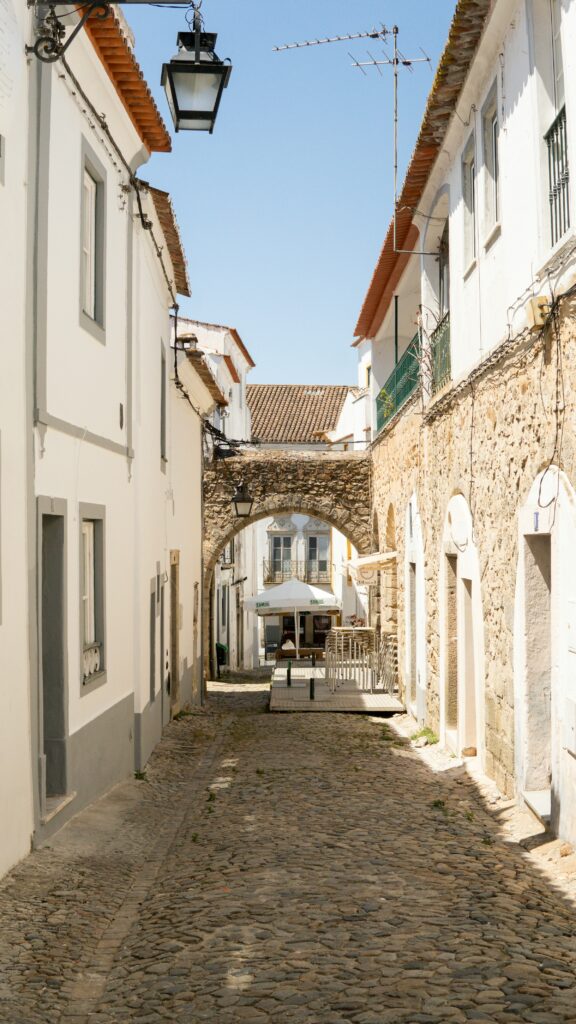
Attractions and interesting sites in Évora
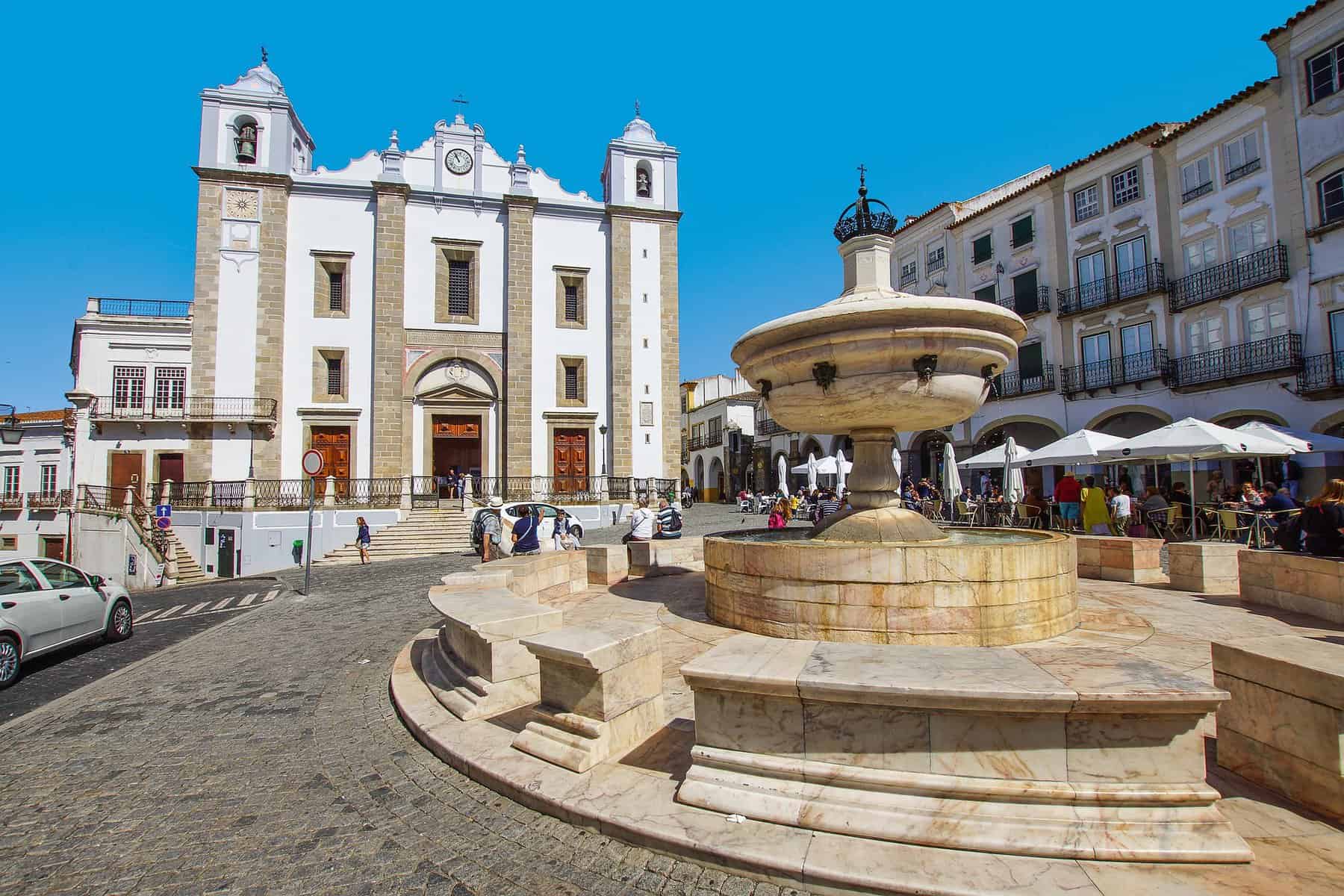
Praça do Giraldo
Praça do Giraldo is the city’s main square, and most visits to Évora begin here.
The square is lined with charming white buildings and arcades with low arches beneath them. It’s a lovely place to sit at a café or restaurant, whether during the day or in the evening. There’s also a tourist information center here, and if you follow the alley beside its entrance, you’ll end up right by the cathedral and the Roman temple.
At the center of the square stands a large white marble fountain with eight spouts that lends a refreshing feel during the hottest summer days. Facing the fountain is the Renaissance Church of Santo Antão | Igreja de Santo Antão. Its highlight is the painting “The Souls of Saint Michael” by Jerónimo Corte Real, the Portuguese poet and painter who spent his final years in the city and was buried here in 1588.
Click here to find a place to stay in Évora…
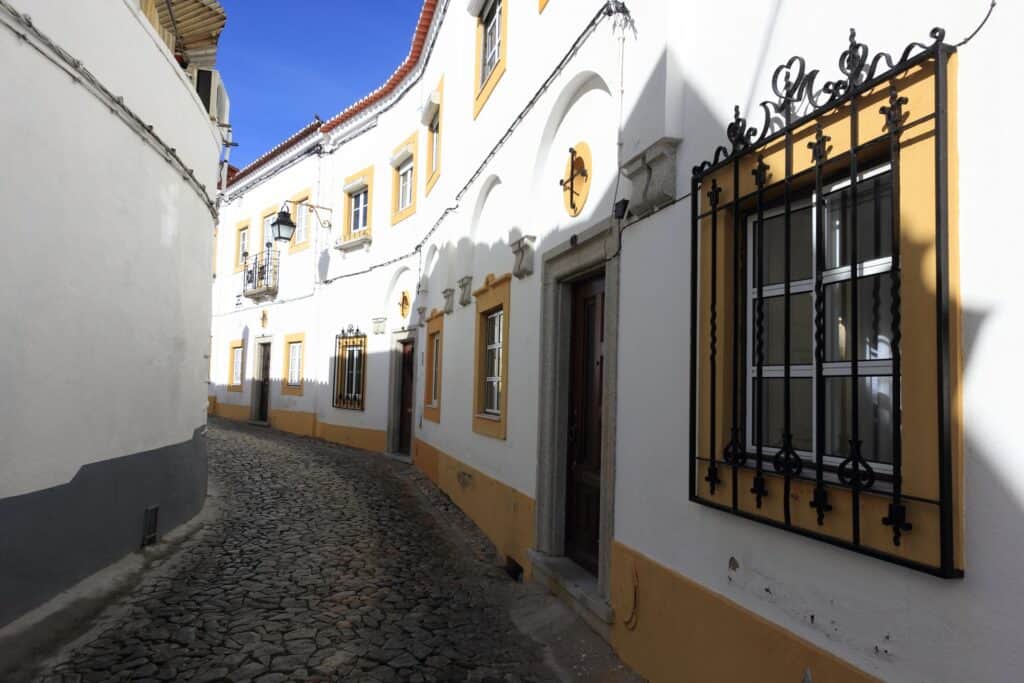
5th of October Street | Rua Cinco de Outubro
Rua Cinco de Outubro extends west from Praça do Giraldo between two blocks of buildings. This narrow, paved pedestrian street is lined with shops and businesses, and beyond serving as a route between Évora’s main sights, it’s also simply a pleasant, mostly shaded place to stroll.
Along Rua Cinco de Outubro, you’ll find souvenirs typical of Alentejo, along with places to sit down for a meal or a coffee.
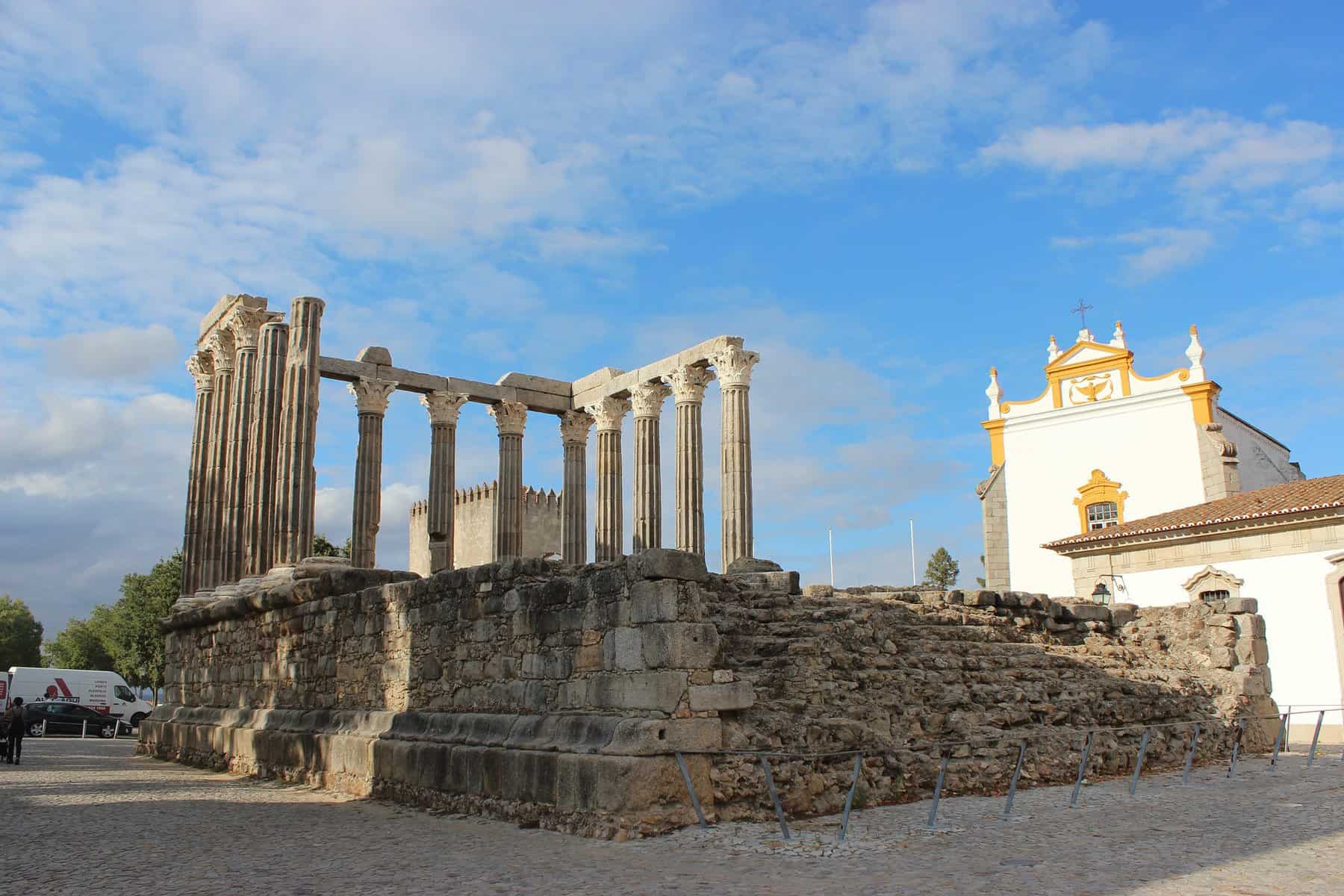
The ancient Roman Temple | Templo Romano de Évora
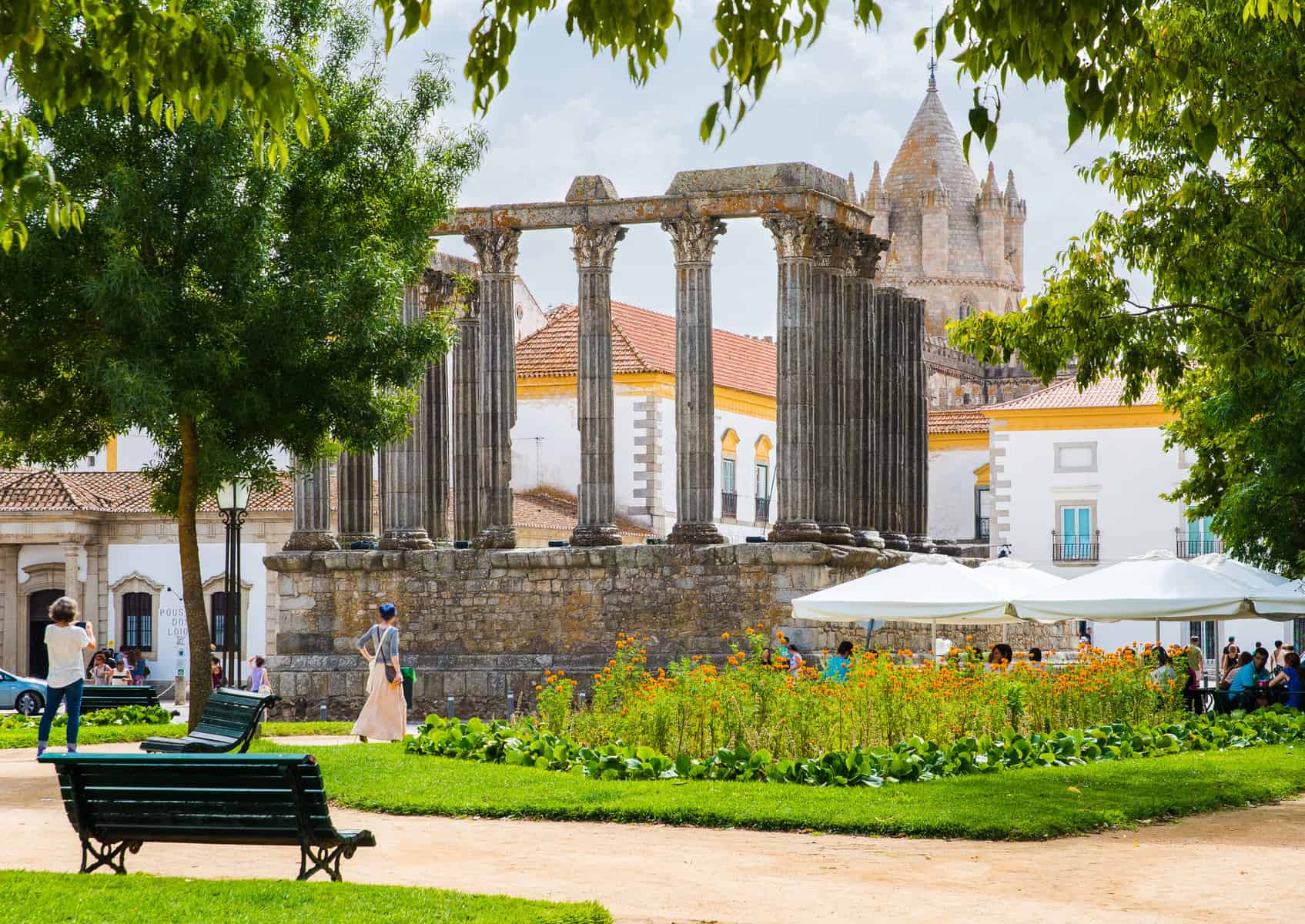
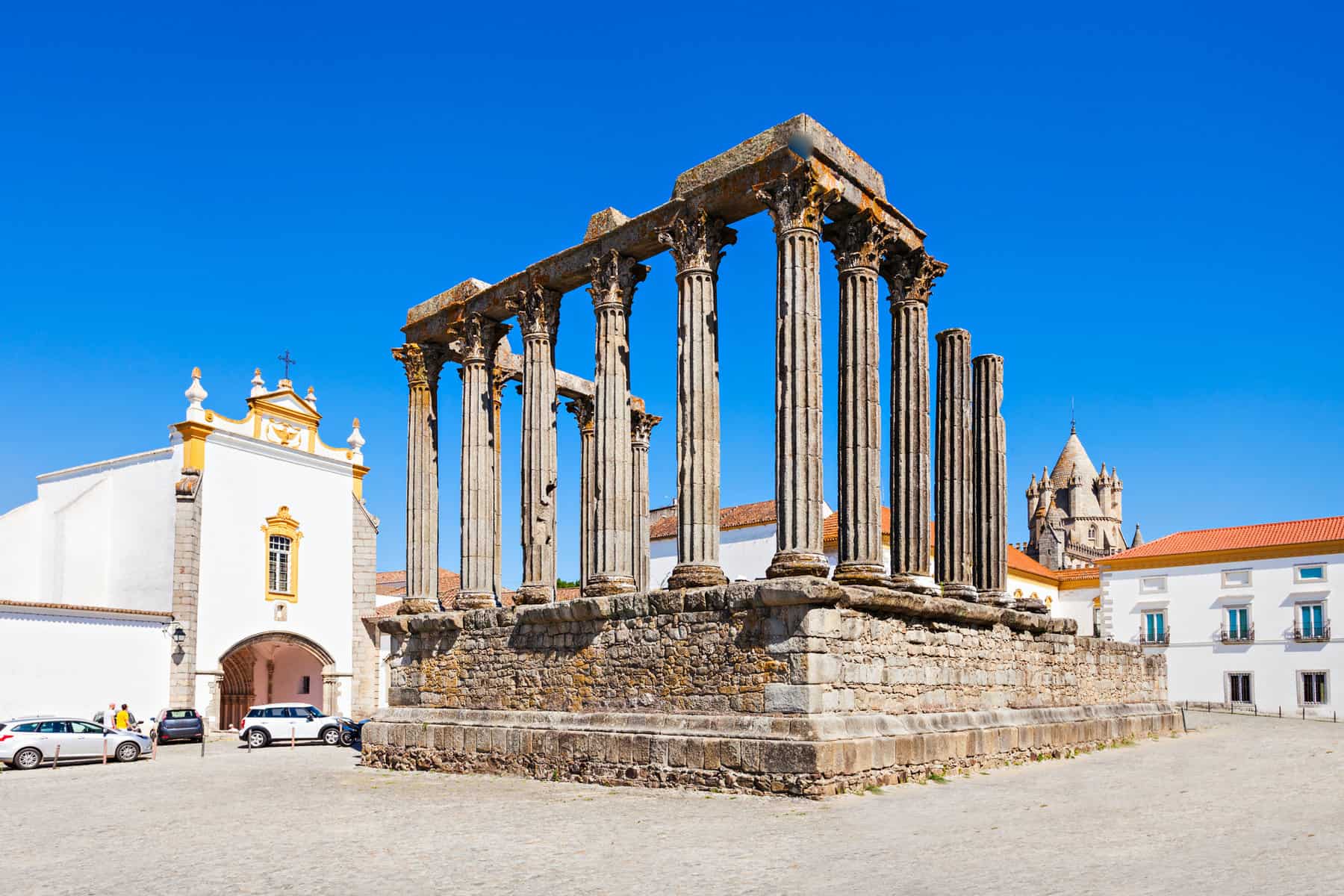
This is Évora’s most iconic landmark and one of the most important archaeological sites in all of Portugal. It is also known as the Temple of Diana.
This open-air site stands right in the center of the old town. On one side of the temple is a lovely garden set over the ruins of the Roman forum, making it an excellent shaded stop on hot summer days. On the other side are the Frei Manuel Museum and, behind it, the city’s large and impressive cathedral.
The temple was built in the 1st century during the reign of Emperor Augustus and was restored in the 19th century during one of the earliest archaeological excavations in Portugal. It was part of the forum of Roman Évora, which was then an important city in the province of Lusitania. Excavations revealed that the temple was originally surrounded by a colonnade and shallow reflecting pools, which must have made it look even more impressive.
The temple closely resembles the Temple of Diana in Mérida, Extremadura | Templo de Diana Mérida, not far across the border in Spain. It’s another reminder that for much of history, the Iberian Peninsula functioned as a single whole—and there is indeed a strong resemblance between Portugal’s Alentejo region and the Spanish region of Extremadura on the other side of the border.
Click here to find a place to stay in Évora…
Convent of St. John the Evangelist | Convento dos Lóios
Located right next to the Roman temple, this convent has stood here since the 15th century, though it was badly damaged in the 1755 earthquake and nearly rebuilt from scratch. Its church—Church of São João—is still the burial place of members of the Cadaval ducal family and is also shared with their neighboring palace.
The convent buildings around the inner courtyard (cloister) have been turned into a boutique hotel in a perfect location, Pousada Convento Évora, preserving as much of the historic atmosphere as possible while incorporating modern amenities.
Cadaval Palace and Church of São João | Igreja de São João, Palácio Cadaval
The palace stands along one side of the square by the Roman temple and can be seen from both the temple and the gardens beyond it. Palácio Cadaval still belongs to the ducal family of Cadaval (Duque de Cadaval).
The noble title was granted in the 17th century by King João IV to his cousin Nuno Álvares Pereira de Melo, who became the first Duke of Cadaval. He received the title after showing bravery in battles during the Portuguese Restoration War against the Kingdom of Spain. Even before that, the family was already prominent, descending from the Count of Braganza.
Members of the family still live in the palace. Parts of it, however, are open to the public and well worth visiting—especially since it sits right in the heart of the city near many of Évora’s main sights. The palace also hosts cultural events and private functions set against its beautiful gardens and buildings.
The Church of São João, which stands between the palace and Convento dos Lóios, is one of the most beautiful churches in Portugal. It is also open to visitors and is truly striking inside. The entire nave is covered from floor to ceiling with stunning azulejos.
These ceramic tiles were painted in the early 18th century by António de Oliveira Bernardes, Portugal’s greatest azulejo painter.
The church was restored in the 1950s and is so beautiful that one could honestly say it is reason enough on its own to come to Évora.
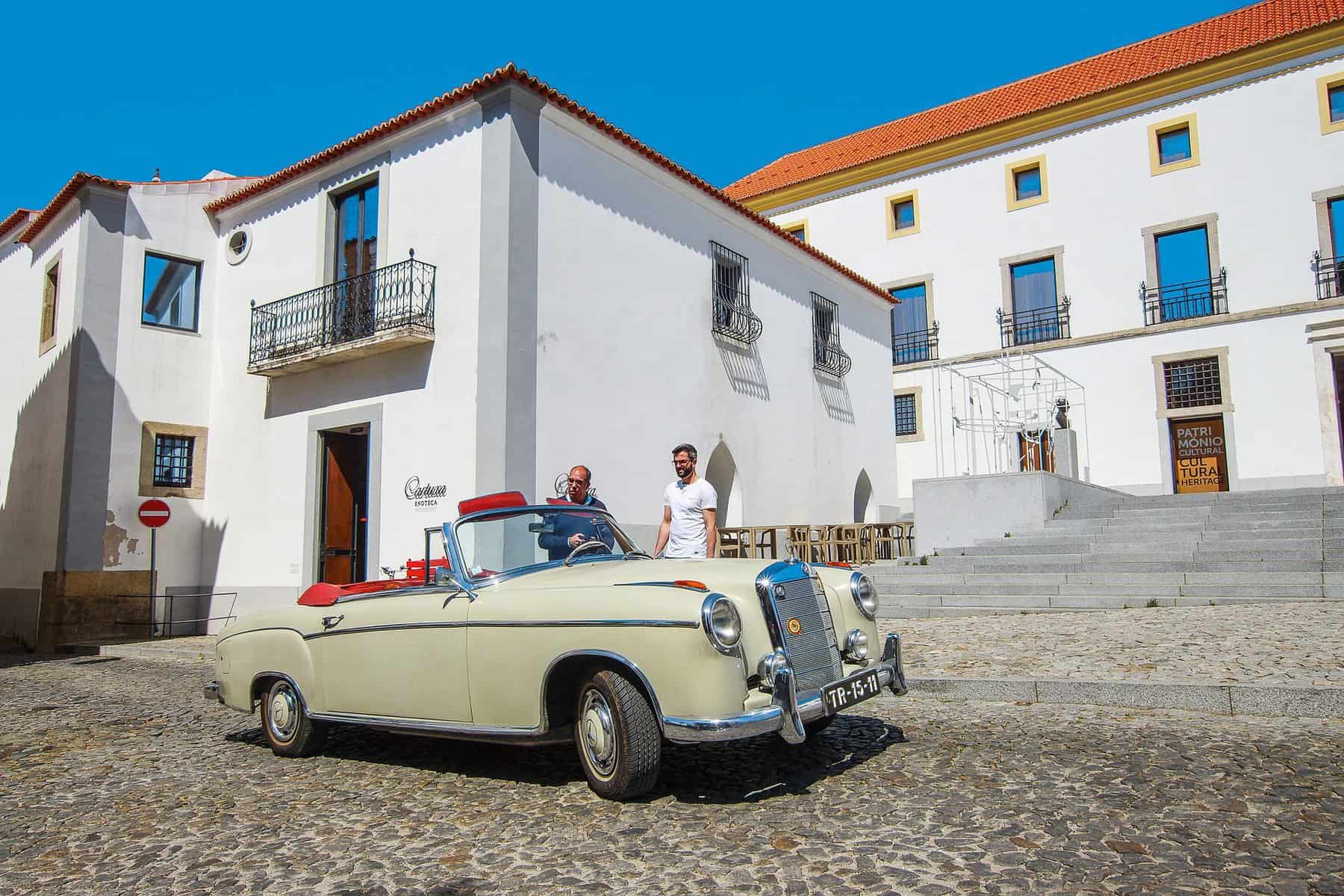
University of Évora building | Universidade de Évora
The university building is painted, as so often in Évora, white with yellow trim. It stands behind and below Palácio Cadaval and the Church of São João.
The building is fairly large, but its main appeal is the spacious Tuscan-style inner courtyard with a fountain at its center and arcades all around it, fully lined with refreshing azulejo tiles | Pátio dos Gerais.
The university was founded in 1559 and operated continuously for 200 years, until the Marquis of Pombal closed it because of its ties to the Jesuit order, which had been suppressed at the time. It reopened in the 1970s and has since been a public university.
As is common in Catholic institutions, the university also has a church, the Church of the Holy Spirit (igreja do espirito santo), which is very beautiful in its own right. The best way into the university complex is through the entrance by the Church of the Holy Spirit, which leads directly to most of its most interesting spots.
A visit to the university can easily be combined with nearby sites such as the Roman temple or the cathedral, and it doesn’t take too long since much of the impression comes from the exterior spaces. If you have more time, you can also try to visit its beautiful old library.
Click here to find a place to stay in Évora…
Chapel of Bones | Capela dos Ossos
This is Évora’s most famous site, drawing curious visitors from around the world.
In a side section of the Church of São Francisco | Igreja de São Francisco is this mysterious, unusual, and unsettling chapel, which for many is the main reason to visit Évora.
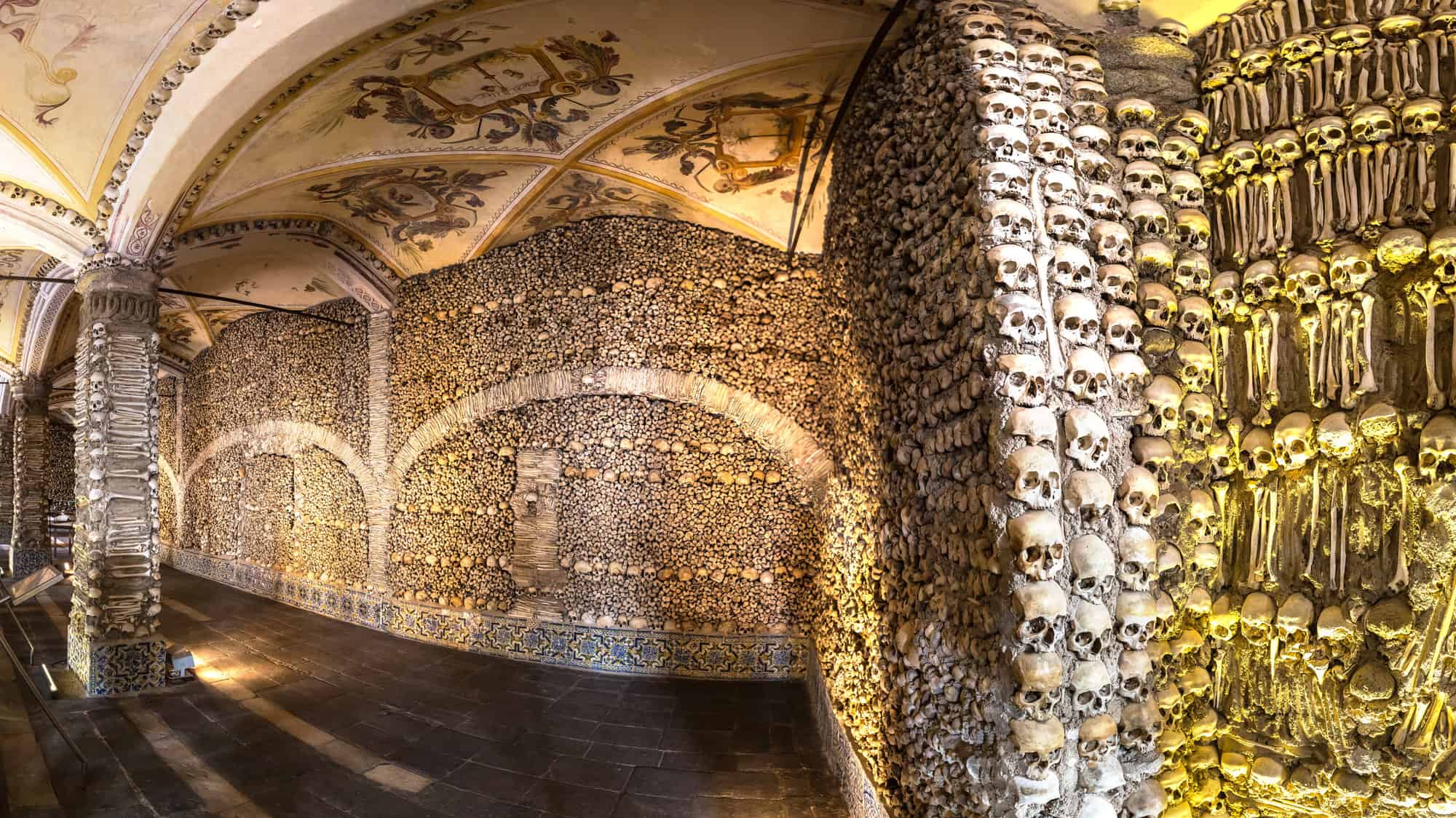
The Chapel of Bones gets its name from the fact that all its walls and the columns supporting its ceiling are covered in human skulls and bones. According to estimates, the walls are lined with the remains of more than 5,000 people, arranged in patterns by the Franciscan monks of the monastery.
In the 17th century, three of the Franciscan monks decided to line one of the monastery’s chapels with human skulls and bones as a way of showing that life and death are only a brief part of the human journey toward heaven or hell. The bones of ordinary people, most of whom died in the Middle Ages, were brought here from cemeteries around the city, partly to free up space in burial grounds that were already full.
The bones and skulls were fixed in concrete onto the walls and ceiling of the chapel. Paintings related to death were also added to the ceiling, along with several dark inscriptions and quotations—all intended to explain, according to the monks’ beliefs, that death is only a comma in human life. Very little light enters the chapel, which adds to its gloom and mystery.
Whether this was pure cruelty or a relic of the monks’ dark and mystical beliefs in the Middle Ages is something every visitor can decide for themselves. For those interested in similar chapels, the city of Faro, the capital of the Algarve in southern Portugal, also has a Chapel of Bones, though a smaller one.
Click here for a guided tour of central Évora, including skip-the-line entry to the Chapel of Bones…
The public park | Jardim Público de Évora
Évora is repeatedly ranked among the cities with the best quality of life in Portugal, and the public park surely plays a part in that.
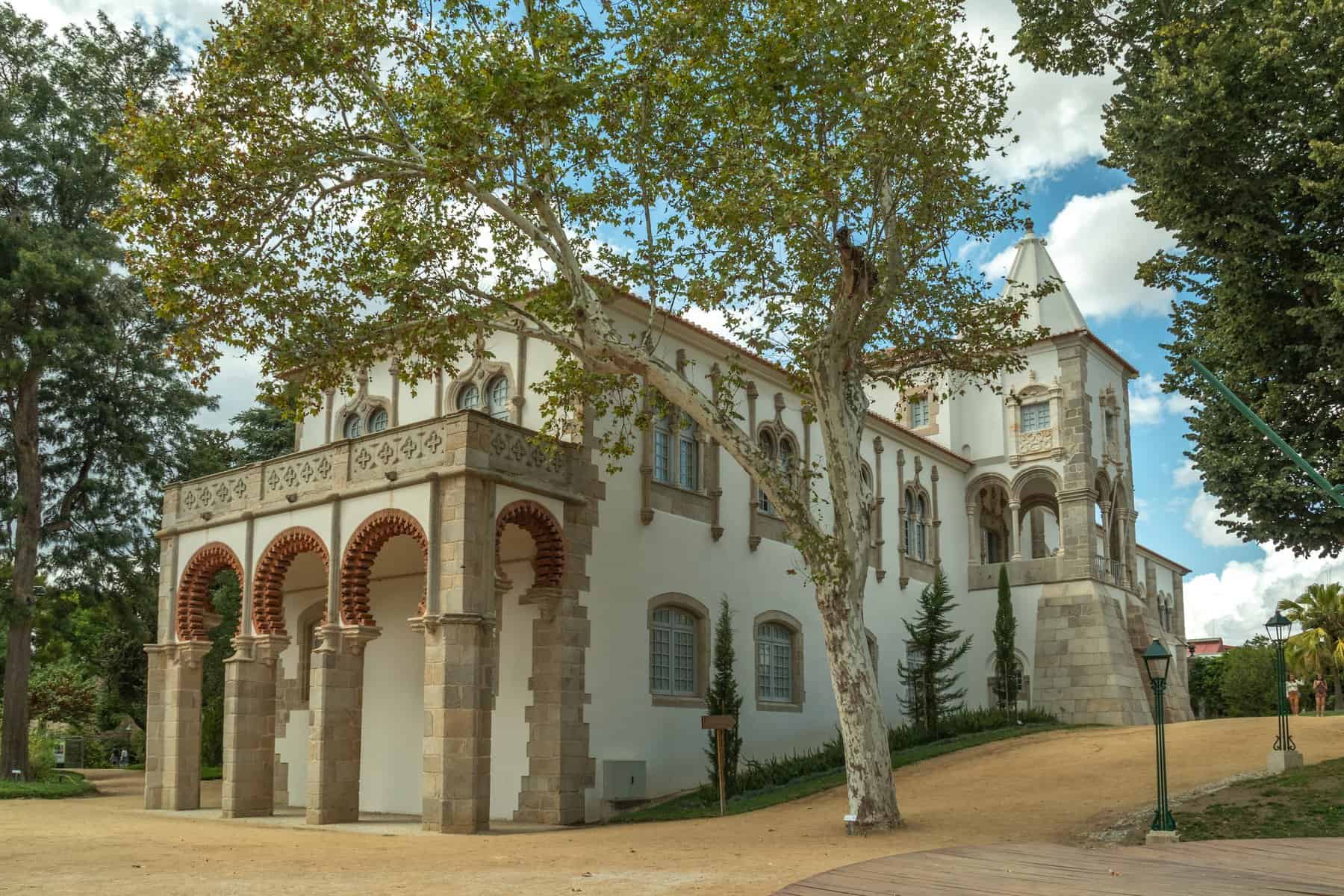
The park sits right beside the historic center, beginning behind the Chapel of Bones, and alongside its landscaping it also contains several historic structures. It was once the vegetable garden of the royal palace and was transformed in the 19th century into an Italian-style public park.
The two historic buildings in the park are the Palace of King Manuel I | Palácio de Dom Manuel I, and the more unusual so-called “fake ruins” (Ruínas Fingidas).
These are structures designed to look ancient, but in fact they were built during the 19th-century conversion of the garden into a city park. Even so, they were constructed using archaeological remains found in the area, so they are not truly fake—just “pretend,” which is closer to the proper translation from Portuguese.
There are also several remnants of the city’s medieval walls within the park.
Today, the park is a wonderful place to escape into cooling shade on a hot summer day. Along with its gardens and ornamental ponds, peacocks roam freely here. Many cultural events are also held in the park, especially in the concert hall within its grounds.
The lovely Church of Graça | Igreja da Graça
The beautiful Church of Graça is in the southern part of the old town, not far from Praça do Giraldo. It was built in the early 16th century during the reign of King João III “the Pious.”
The architect chosen for the project was Miguel de Arruda, who designed it in the Palladian style before many buildings of this kind had spread across Europe and the wider Western world. That is one reason the structure is considered so distinctive.
Its double façade above the entrance is the most striking feature from the outside, and it’s worth noticing the four mythological Atlas figures fixed to its corners. Inside, the Estremoz marble windows stand out.
Click here to search for hotels and vacation rentals in Évora…
Évora Cathedral | Catedral de Évora
The cathedral stands in the center of the city, directly beyond the Roman temple and behind the Frei Manuel Museum building.
Évora Cathedral is the largest medieval cathedral in Portugal. It is not enormous like some of the cathedrals in neighboring Spain, but it is still an impressive building whose initial construction was completed in 1250. Many wings and decorations were added over the centuries, and the structure we see today has stood largely as it is since 1746—no small feat considering the earthquake that destroyed Lisbon in 1755, though Lisbon is far enough from Évora.
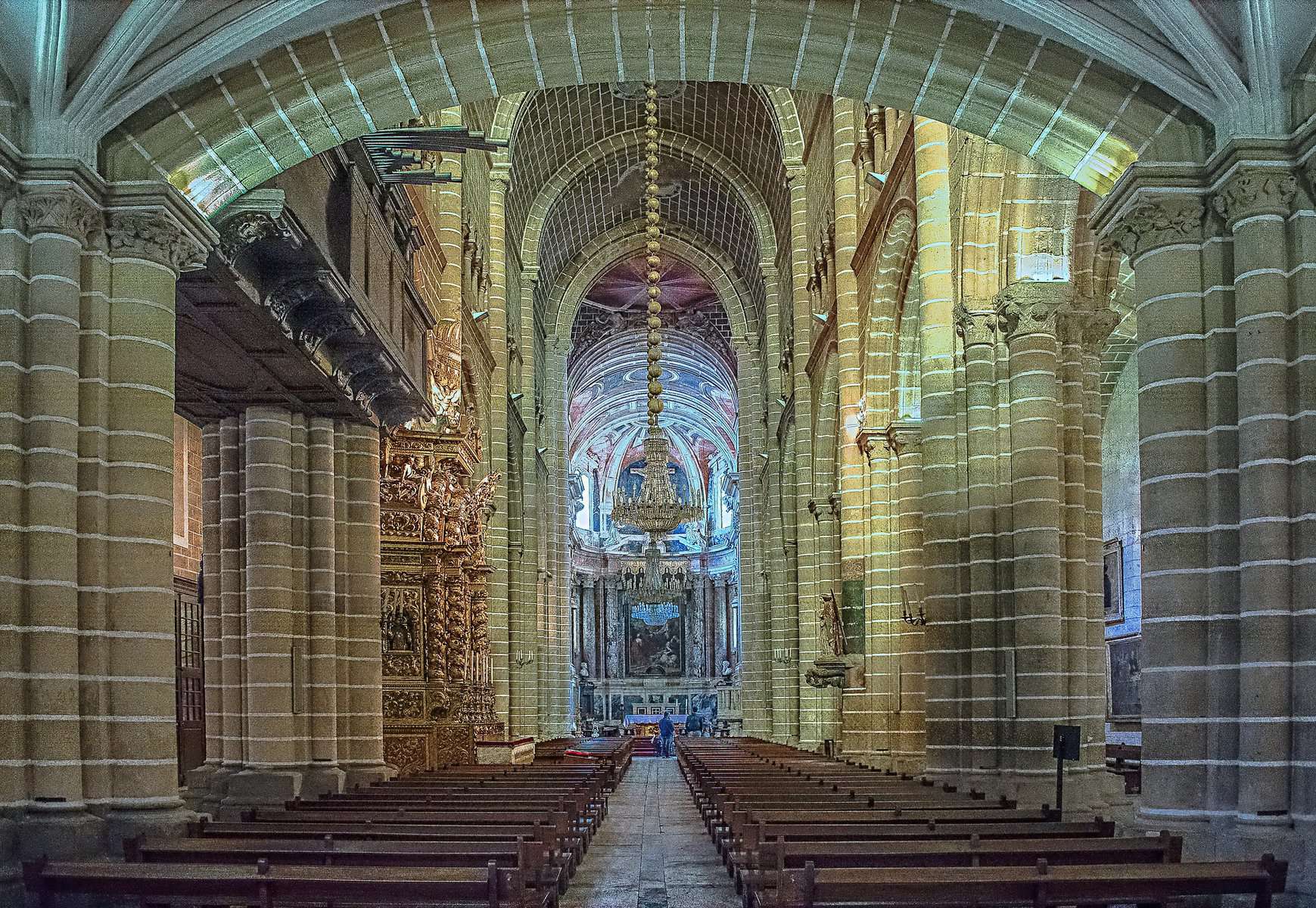
The cathedral’s main entrance is through a doorway beneath Gothic arches supported by statues of the apostles. Inside, the nave runs for about 80 meters, and its high dome is unquestionably the architectural highlight of the building.
The Baroque altar chapel, made of Estremoz marble—the famous Alentejo marble from the nearby town of Estremoz—is the work of the German-Portuguese architect Ludovice, who worked in Portugal in the 18th century. His masterpiece is the Palace of Mafra | Palácio de Mafra, not far from Lisbon.
There are many more works of art and gilded wood decorations inside, making the cathedral a real feast for the eyes. In the north tower, there is also a small art museum with priceless works.
After visiting the interior, it’s worth heading into the cloister and from there up to the terrace overlooking the city. The cathedral already stands at the highest point in Évora, so the view from the terrace is excellent.
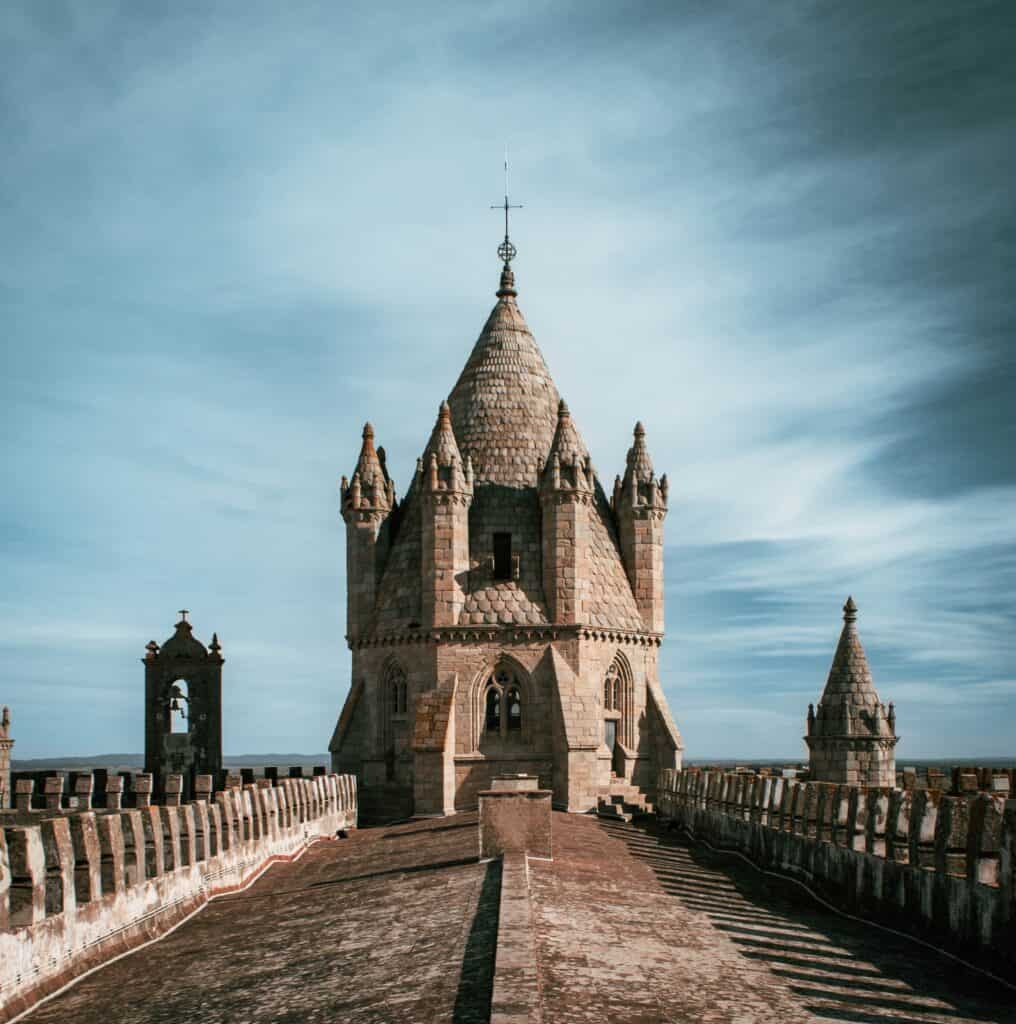
The ancient walls of Évora | Muralhas de Évora
Évora’s old town was once completely enclosed by walls. They were built in several stages, with the earliest being Roman and relatively modest. The Muslims strengthened and expanded them in the 8th century. Later, as the city grew in the Middle Ages after the Kingdom of Portugal was established, the walls were enlarged and improved again.
By the 14th century, when they were still intact, they included 40 watchtowers and 10 gates. Ahead of the Portuguese Restoration War in the 17th century, the walls were reinforced once more. Since the Napoleonic Wars and the French invasion of Évora in the 19th century, the city as a whole began to decline, and parts of the walls were destroyed as well.
To get a sense of what remains today, you can drive around the city and see stretches of the walls from almost every side of the old town.
The most complete and impressive surviving section, however, is the western stretch of the walls—the side where the road from Lisbon arrives. The main gateway into the old town, Porta de Alconchel, still stands almost as it once did, and anyone arriving by bus can simply walk toward it in a fairly straight line from the bus station.
The northern gates near the parking areas also remain largely intact—Porta Velha da Lagoa and Nova Porta De Aviz.
If you’d like to take a short walk along the walls, you can start at Porta Velha da Lagoa and continue to Porta de Alconchel, or the other way around. The route follows the outer perimeter, meaning outside the walls, and takes about 10 minutes. This stretch is landscaped, and the walls here are also a little taller.
Click here to find a place to stay in Évora…
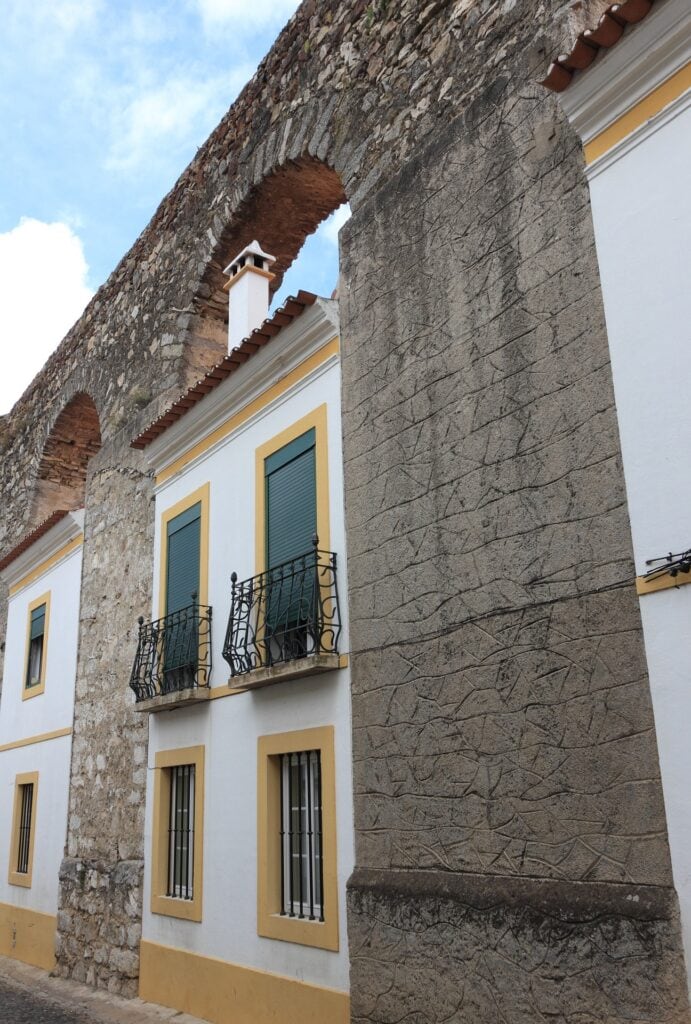
The Aqueduct | Aqueduto da Água de Prata
Construction of the aqueduct was completed in 1530, and it was designed by Francisco de Arruda, who is better known as the architect of Belém Tower in Lisbon. The aqueduct enters the old town from the north and, naturally, continues toward the hills beyond the city.
One of the best places to see it within the old town is on Rua do Cano, where houses were built using the aqueduct’s foundations as walls and seem almost attached to it. As a result, there are cafés and shops tucked right beneath the arches.
A little outside the city, when heading onto the road toward Convento da Cartuxa, you can also see the aqueduct in all its glory on the right-hand side. About five minutes from town, you reach a point where it crosses above the road, whose lanes become narrower and split apart so that each one passes beneath a different arch.
One of the most interesting spots to see the aqueduct is on the road that circles Évora’s old town, near the large public parking area between the city gates Nova Porta De Aviz and Porta Velha da Lagoa. There, the road divides into four single lanes, each passing under a different arch of the aqueduct.
There is also a walking or cycling route along it, though it’s best suited to experienced walkers. More information is available from the tourist office in Praça do Giraldo.
Évora Museum | Museu Nacional Frei Manuel do Cenáculo
An art and archaeology museum with several important masterpieces by Portuguese artists. The museum is also known as Évora Museum | Museu do Évora.
It stands directly opposite the Roman temple ruins and can be a wonderful place for a brief break from Évora’s summer heat.
The museum is made up largely of the private collection of the 18th-century writer, clergyman, and intellectual Frei Manuel do Cenáculo. Alongside Flemish artworks and sculptures he collected, the museum also displays antique furniture and jewelry, and it has occupied this site for well over a century.
Click here for more information and opening hours…
Clock Museum | Museu do Relógio – Pólo de Évora
An intriguing and unusual museum right in the heart of the city near Praça do Giraldo. The Clock Museum in Évora is actually a branch of the larger clock museum in Serpa, farther south in the Alentejo region.
The Évora branch displays more than 600 antique clocks. It can be a wonderful place to show children how people told time in the not-so-distant past, before the smartphone was invented.
Click here to search for accommodations in Évora…

Évora Cemetery | Cemitério de Évora
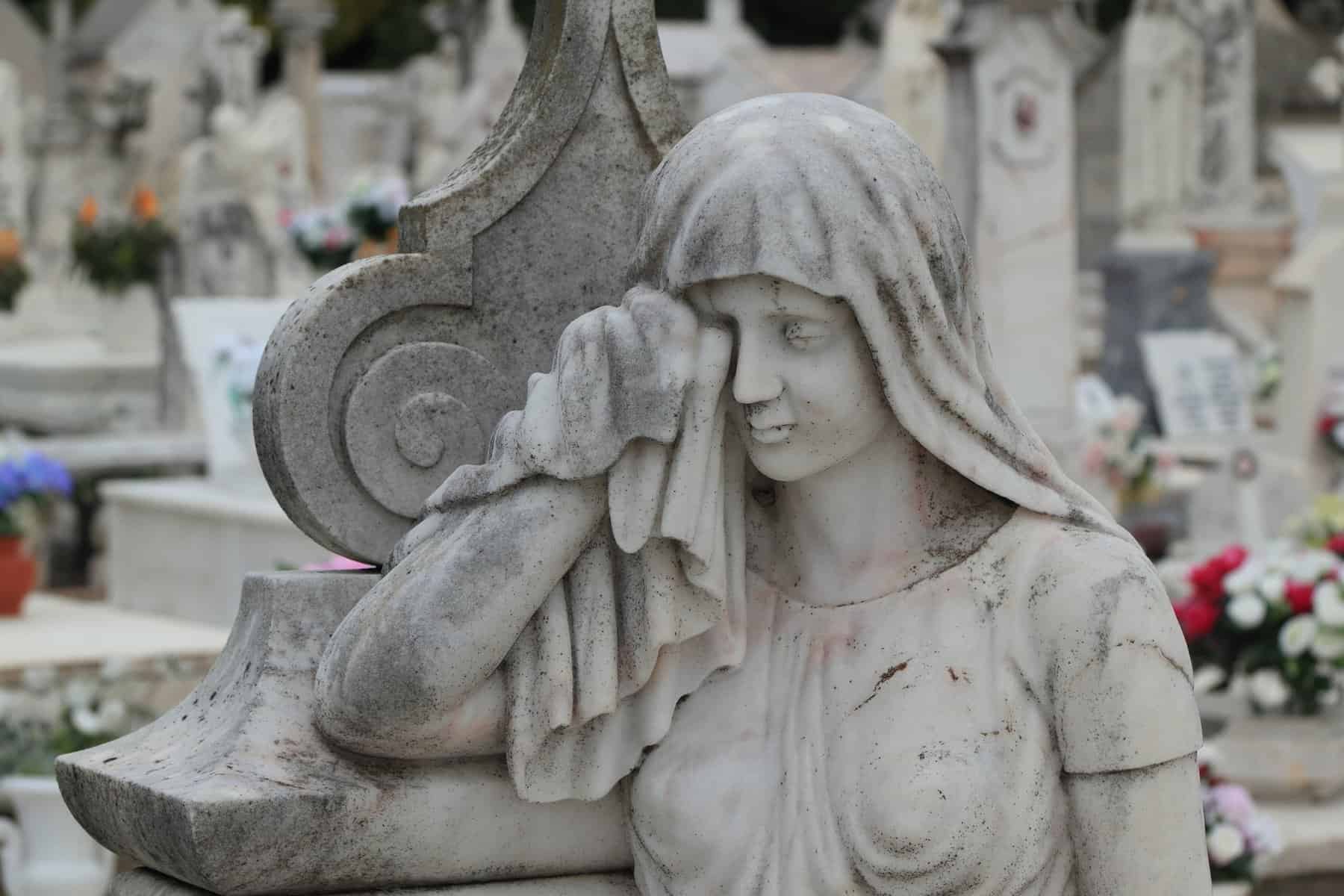
It would be hard to call the cemetery one of the city’s main attractions in a place so full of landmarks, streets, and history. Still, if you found yourself drawn to Évora’s famous Chapel of Bones, it may also be worth stopping by the cemetery to see some of its unusual gravestones.
The cemetery is also very easy to reach, with its entrance directly opposite Porta de Alconchel, the gate that leads to the main street of Serpa Pinto inside the city. Its far end is right next to Évora’s central bus station, so if you have a little time before your bus arrives, it’s worth a quick look.
This is a standard Catholic cemetery, but it does have several large and ornate tombs with interesting sculptures.
Jewish heritage in Évora
Jews likely arrived in Évora as early as the Roman period, but the community grew and flourished under Muslim rule. In the Middle Ages, Jewish life in Évora thrived and maintained strong ties with the great communities of Andalusia, which were not very far away. Sadly, however, the history of Évora’s Jews is deeply tragic.
During the reign of King Manuel I in the early 16th century, most of Évora’s Jews were forcibly converted to Christianity. At that time, the city’s great synagogue was also destroyed by the Christian mob. Many Jews continued to live in the city as conversos, maintaining Jewish practices in secret.
Yet even the conversos were shown no mercy, and over the next two centuries, show trials against them (Auto de fé) continued from time to time. Tragically, Évora was home to the most fanatical Inquisition in all of Portugal.
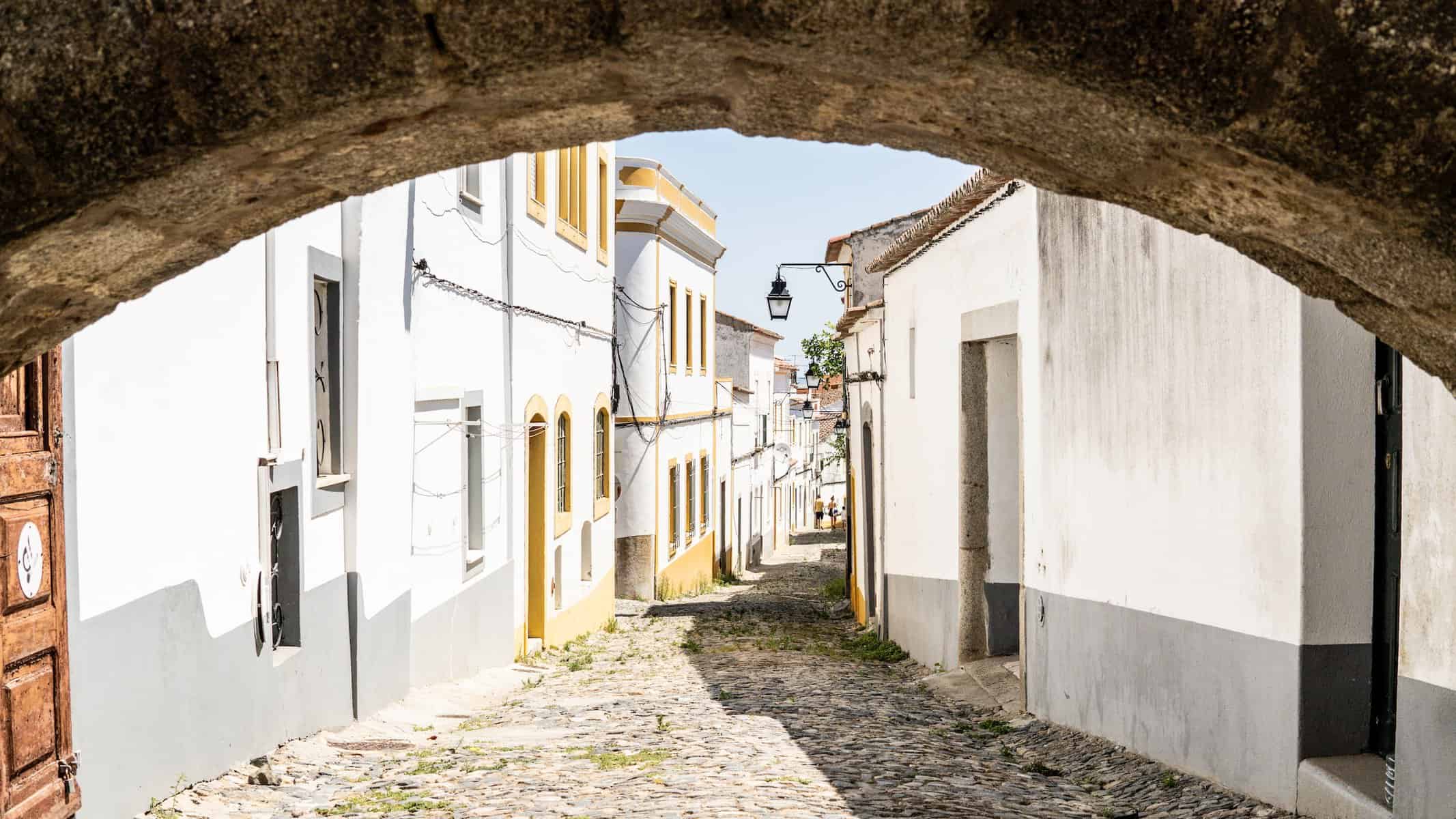
Today, not much remains of the city’s Jewish buildings. Still, the former Jewish quarter was located in the western part of the city, throughout the area southwest of central Praça do Giraldo and extending toward the walls.
There are two streets in the old town where you can look for old Jewish traces such as mezuzah marks:
- Rua da Moeda — at its junction with R. de Alcoutim, you can see a mezuzah mark on a doorway. Farther on toward Praça do Giraldo was the house of Évora’s rabbi.
- In the middle of Rua dos Mercadores stood Évora’s old synagogue, again more or less near its junction with R. de Alcoutim.
Between the two, you can try spotting other Jewish traces in the quarter.
Click her for the full guide to Belmonte – the Jewish town of Portugal…
The prehistoric sites around Évora
The Neolithic site of Cromeleque dos Almendres | Cromeleque dos Almendres
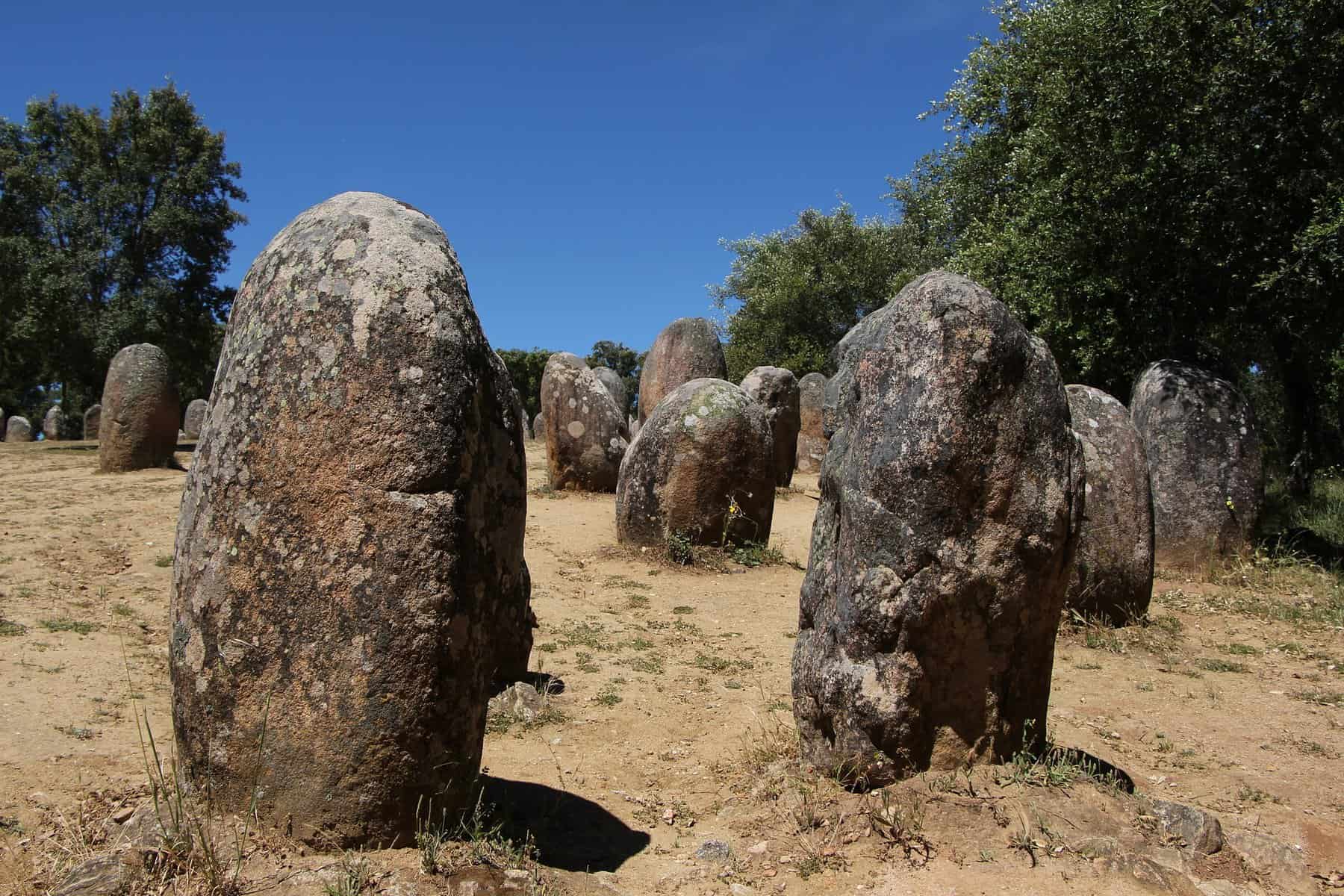
About 15 kilometers west of Évora, among cork oak woods, lies a Neolithic site. This is the most important megalithic site on the Iberian Peninsula, where large stones stand arranged in patterns likely connected to ancient astronomy. It is somewhat reminiscent of the famous Stonehenge in England, though the stone formations are different.
The site contains around 95 large granite stones, some of them carved with ancient engravings. The stones were likely arranged in different periods, but their purpose remained the same: they were used for rituals at specific times of the year. They stand in a kind of forest clearing with sand between them, making it easy to walk among them and examine them up close.
About 2.5 kilometers before reaching the cromlech, there is a sign pointing to a single giant standing stone 4 meters high (Menir dos Almendres). To reach it, you’ll need to leave the road and walk a few hundred meters, and it stands near a farm.
Beyond the site itself, the drive there through the cork oak groves is wonderful.
Click here for a day trip from Lisbon to Évora and the prehistoric sites nearby…
The prehistoric burial site of Zambujeiro | Anta Grande do Zambujeiro
This prehistoric burial site is about a 20-minute drive west of Évora. It is not far as the crow flies from Cromeleque dos Almendres, but reaching it requires a different road.
The site dates to the 4th millennium BCE and is also the largest of its kind on the Iberian Peninsula, making it highly important for the study of the Neolithic period.
It was discovered in the 1960s by Portuguese archaeologists, and a shelter was built above it for protection. In essence, it is an artificial cave constructed from enormous stones.
The site lies near the village of Valverde and, like the others, is set among hills dotted with cork oaks typical of Alentejo.
Escoural Cave | Gruta do Escoural
Another prehistoric site, about a 25-minute drive from Évora, in the same general area as the Cromlech and Zambujeiro sites, among cork oak forests.
Although it is close to the other two prehistoric sites in a straight line, by car they are farther apart, since the roads are minor ones and you usually have to return to the main roads before taking the route to the next site.
This is a very ancient cave that, according to the findings, was already inhabited 50,000 years ago during the Stone Age. It also contains later burial remains and, most importantly, cave paintings dated to around 13,000 years ago, giving it a significance almost comparable to Lascaux in France.
Entry to the cave is by guided tour only, and the visit lasts about an hour. Advance booking is required.
Click here to find a place to stay in Évora…
Click here for a day trip from Lisbon to Évora and the prehistoric sites nearby…