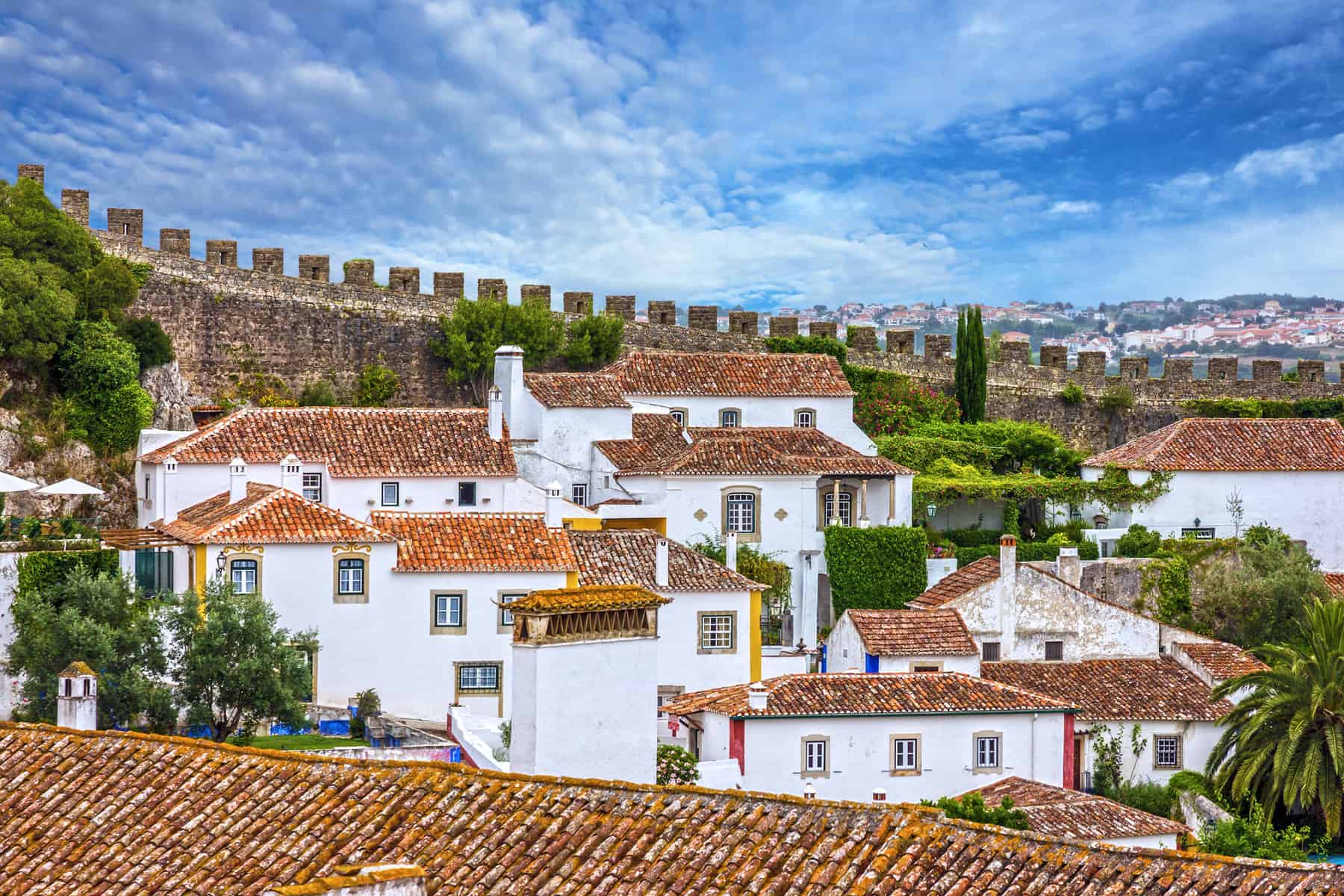
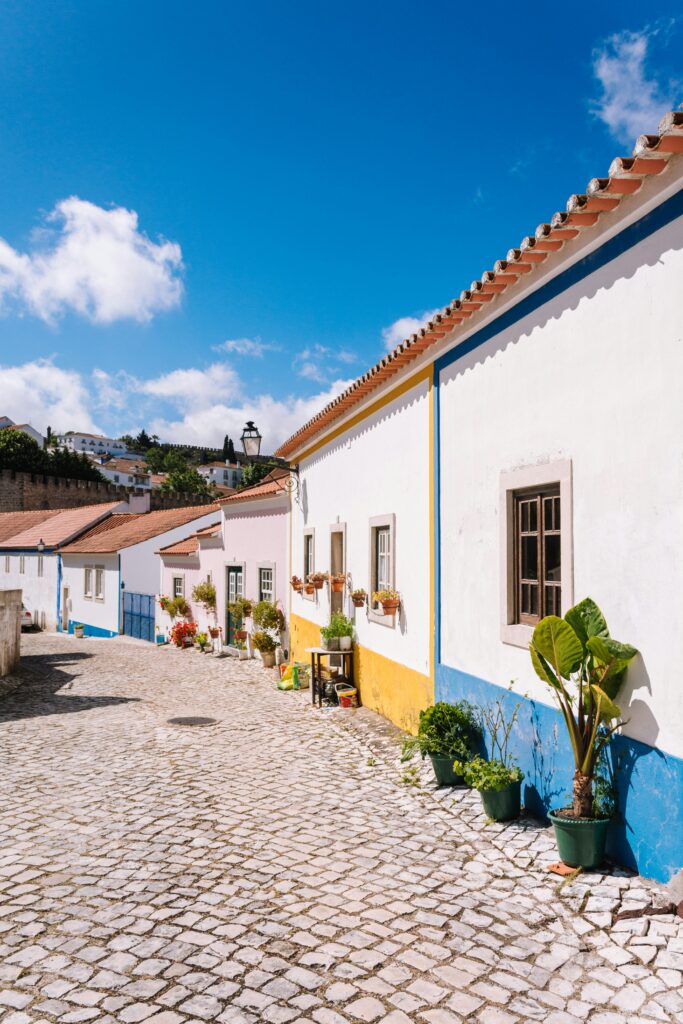
Óbidos is a small walled town about an hour north of Lisbon by car. Its maze of narrow streets is filled with tiny squares, cobbled lanes, and plenty of inviting little shops. The houses in Óbidos are painted white, trimmed in blue or yellow, with geranium pots hanging above some doorways and climbing plants bursting into bloom in spring.
Óbidos suits just about any kind of trip and is especially enjoyable for kids, particularly during the annual Chocolate Festival and Medieval Festival. Simply wandering through the streets of walled Óbidos is a unique attraction in itself. In fact, the entire old town is essentially one large tourist site enclosed by its walls. You can walk along the walls (carefully), and at one end stands the castle. Outside the walls, you can keep exploring nearby sights, such as the surprising Buddha Eden garden park.
How many days should I spend in Óbidos?
Half a day is enough to experience Óbidos fully. You can also plan to stay overnight in one of the town’s romantic boutique hotels, then continue to your next destination in the morning. Óbidos already sits at the beginning of Central Portugal, making it a natural first stop on the way from Lisbon to the towns along the Portuguese coast all the way to Porto. It’s also easy to visit Óbidos as a day trip from Lisbon, and it’s one of the most popular choices for exactly that.
Click here for a full-day trip from Lisbon to Óbidos and other sites along the way…
Click here to find a place to stay in medieval, romantic Óbidos…
7 must-see sights and things to do in Óbidos
-
- The town gate — Porta da Vila with its rare azulejo decorations | Porta da Vila
- The Óbidos wall walk (fairly challenging) | Muralha de Óbidos
- Óbidos Castle at the top of the hill the town was built on | Castelo de Óbidos
- Walk along Direita Street and through the town’s narrow, charming streets | Rua Direita
- Try Ginjinha, the local cherry liqueur served in a chocolate cup
- Buddha Eden garden park fifteen minutes from town | Jardim da Paz Buddha Eden
- Óbidos festivals — chocolate, medieval, or Christmas
How to get to Óbidos
Flights to Óbidos
The airport serving Óbidos is Lisbon Airport (LIS), about a 50-minute drive away.
Click here for a list of 7 charming hotels in Óbidos…
Getting to Óbidos by rental car
The best way to reach Óbidos is by rental car, since it lets you stop at other interesting sites and attractions nearby. Since Óbidos is very small and functions more as an attraction than as a regular town, public transportation options are limited.
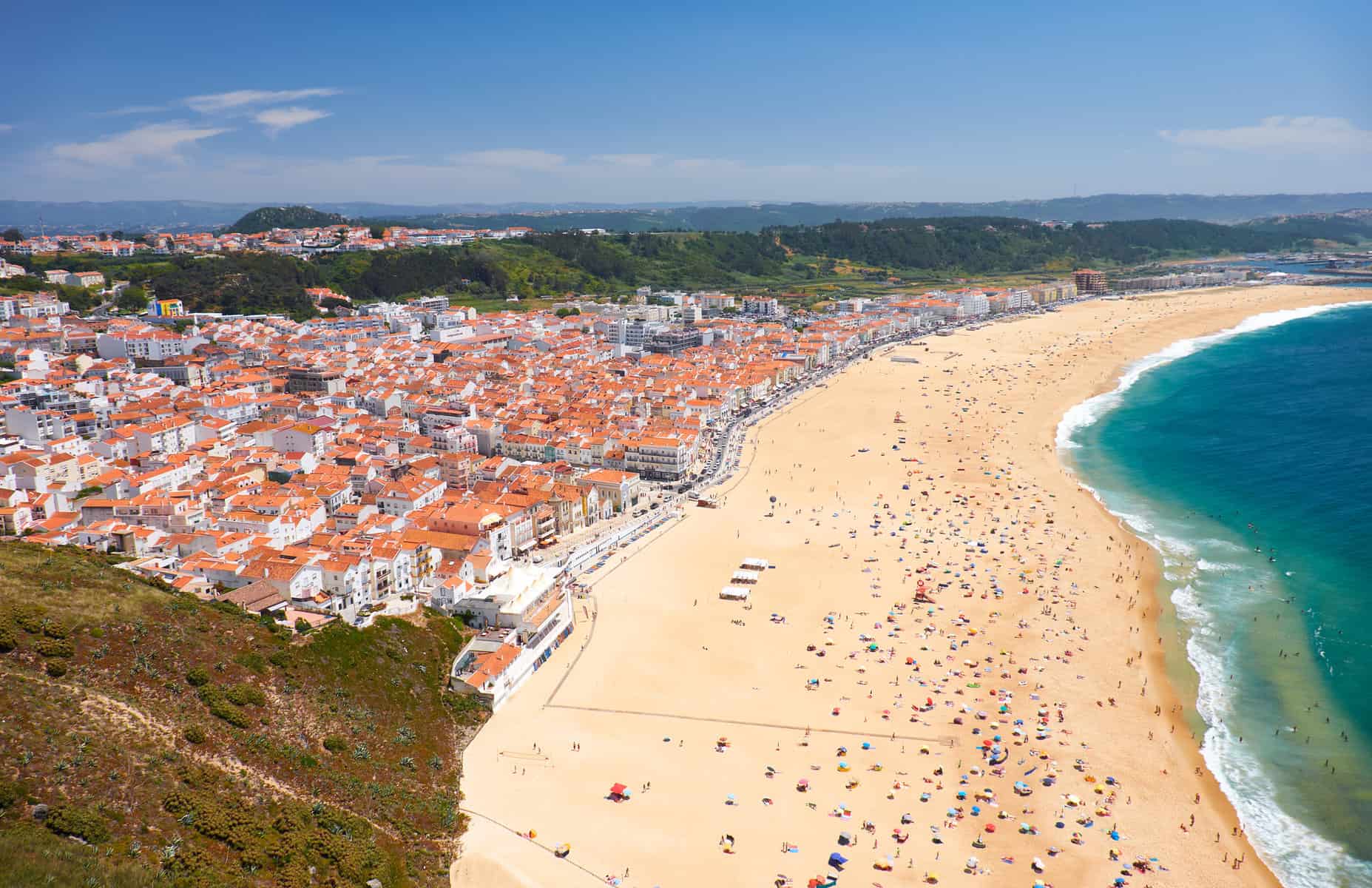
Óbidos is about an hour from Lisbon by car, and it’s already close to the surf town of Peniche (25 minutes) and the lovely town of Nazaré, famous for its enormous waves (35 minutes).
Click here for 15 wonderful stops between Lisbon and Porto…
Parking
At the entrance to town, near the aqueduct, you’ll find several very large parking lots, most of them free. From there, it’s about 300–400 meters to the town gate, Porta da Vila.
Click here for a day trip from Lisbon to Óbidos…
Public transportation to Óbidos
Óbidos doesn’t really have a train station or central bus station in town, because it’s essentially a small historic site rather than a city. The station lies below the hill where the walled town stands, and from there it’s about a 15-minute walk uphill on a route that isn’t especially convenient.
So while it is possible to get there by public transportation, it’s not very comfortable. In any case, to reach Óbidos this way, you need to travel to the nearby city of Caldas da Rainha (Caldas da Rainha) and from there take a short train ride to Óbidos.
Click here for a list of 7 charming hotels in Óbidos…
About Óbidos
Óbidos can get very crowded on weekends, especially during its festivals, so it’s worth keeping that in mind when planning your visit. This matters even more if you arrive hungry, since most restaurants are small and lines at lunchtime are common.
Óbidos as we know it today developed in the 13th century after King Dinis gave it to his wife Isabel as a gift. From then until 1883, it remained under the ownership of Portugal’s queens. That is also why so many beautiful churches and public buildings were built here.
There was already a settlement here before Roman times, but the Romans were the first to establish a guard post on the site, around which the town later developed, as happened in many places across the empire. Óbidos stands near the sea on a hill overlooking the surrounding land, which made it important for protecting roads and valuable in general to the Romans. They were also drawn to the nearby hot springs in the area of Caldas da Rainha, which helped drive further development.
During the Visigothic period, the area declined, and when the Muslims arrived, they renewed the fortifications on the hill.
Portugal’s first king, Afonso Henriques, pushed the Muslims out of the area in the 12th century, and since then the town has remained in Catholic hands. Óbidos was badly damaged in the famous 1755 earthquake centered in nearby Lisbon. Several of the town’s oldest buildings were lost, though some were later restored or rebuilt.
Óbidos is also known as one of the places where conspirators gathered ahead of the Carnation Revolution that brought down Portugal’s dictatorship in 1974.
The weather in Óbidos is similar to that of the coastal cities of Central Portugal. It is never too hot or too cold, with dry summers and most rainfall in fall and winter, fall being the wettest season.
Óbidos is a great option for a day trip from Lisbon.
It also works well from nearby Peniche and Nazaré, or even from Ericeira if you came to surf and the waves aren’t cooperating.
Click here to find a place to stay in Óbidos…
Attractions and interesting sights in Óbidos
Walking the walls of Óbidos | Muralha de Óbidos
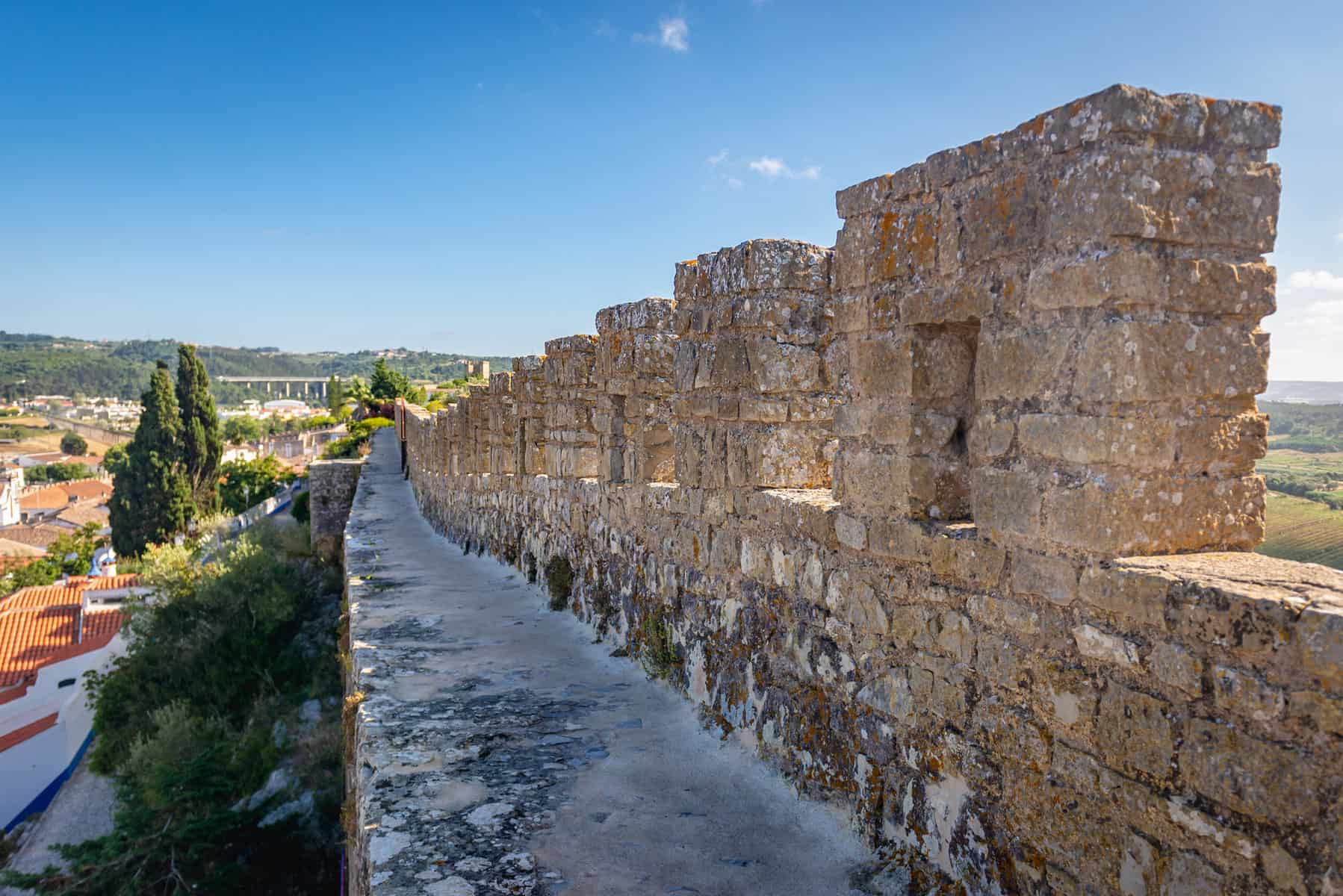
The walls are the town’s most prominent landmark and the main attraction in Óbidos. Walking the ancient walls is a must here and one of the experiences that draws crowds to town. The route stretches for about a mile, with steps to climb along the way and lovely views over the town and surrounding countryside, making it a unique and memorable experience.
That said, safety regulations were not exactly a priority in the Middle Ages, and the route is narrow, with no railing on the side facing the town. In other words, the wall walk is dangerous and not suitable for children, anyone unsteady on their feet, or especially those with a fear of heights.
If you’re visiting Óbidos with children, it may be best to skip the wall walk from the outset, rather than start and then disappoint them by having to turn back because it feels too dangerous.
Just after passing through Porta da Vila, you’ll see a narrow, steep staircase leading up to the wall route. There are several more staircases along the walls, so you can get on or off whenever you like without having to complete the full circuit.
Despite the relative danger, the experience of walking the walls is wonderful. At worst, you can start and simply come back down if it doesn’t feel right.
Important: people walk the walls in both directions, so if someone is coming toward you, it’s best to give them the right of way, press close to the wall, and let them pass. The other side is completely exposed, so there’s no point taking unnecessary risks.
Access to the walls and the walk itself is free
Click here to stay in medieval, romantic Óbidos…
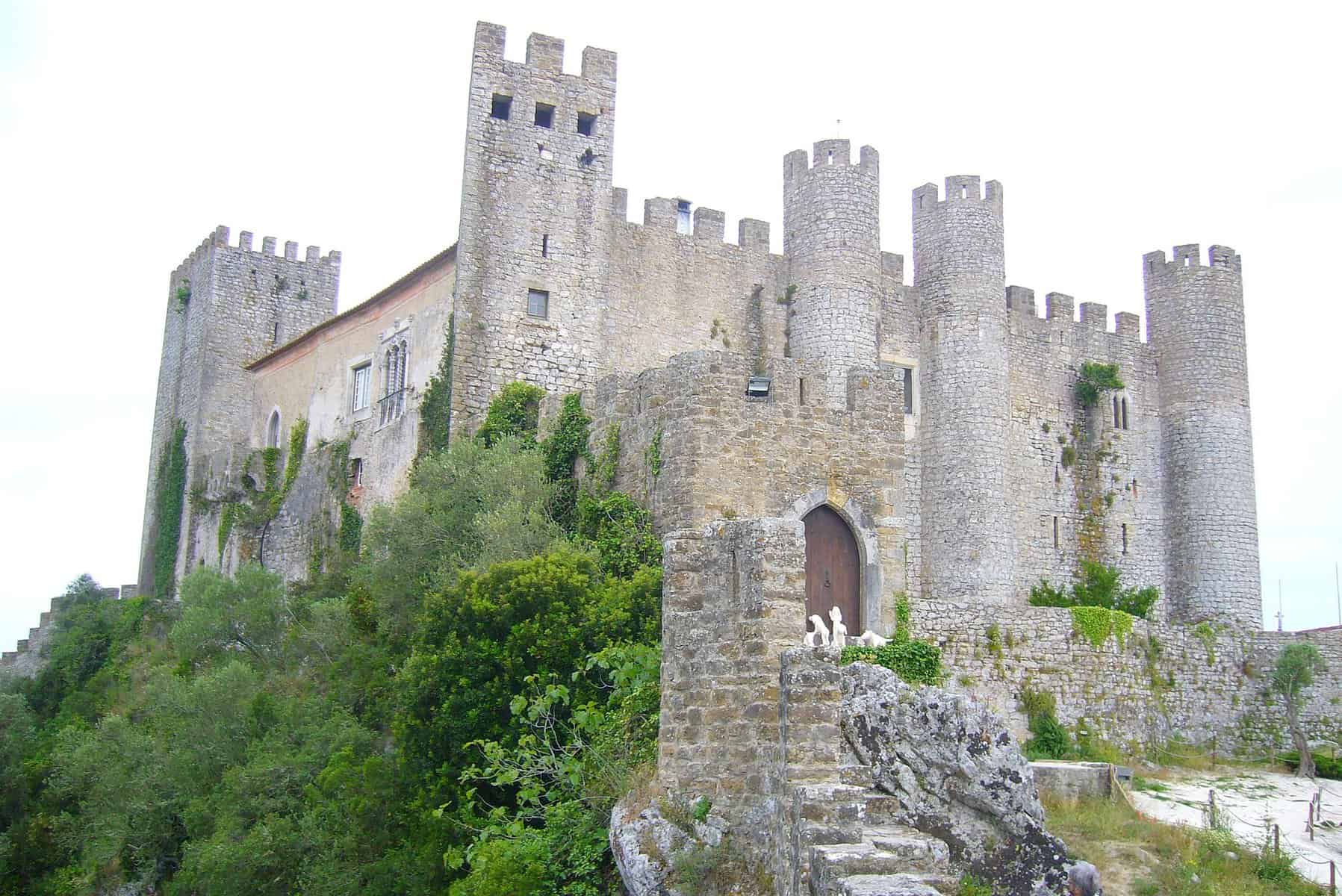
Óbidos Castle | Castelo de Óbidos
The castle stands at the far end of the old town, in a commanding position over the surrounding landscape. Two thousand years ago, this was also the site of the town’s Roman forum, though the fortress itself was built during the Muslim period. Most of the improvements visible today were made after the reconquest, with the founding of the Kingdom of Portugal, and especially later in the 14th century.
Behind the castle at the edge of town, there is an open square and a small amphitheater where many festival events take place. Even outside festival season, it’s worth walking around to the back of the castle — first for a great photo angle, and second for the beautiful views over the rural surroundings.
Today, the castle serves as a luxury Pousada hotel | Pousada, part of a category of upscale hotels housed in palaces and castles across Portugal.
Click here for a full-day trip from Lisbon to Óbidos and other sites along the way…
The bookstore inside São Tiago Church | Livraria de São Tiago
This bookstore sits directly opposite the castle. It’s worth stepping in for a few minutes, or at least peeking inside. What makes it especially interesting is the sight of books arranged on modern shelves amid the church’s old decorative details.
Óbidos is known as a town where people read a lot, especially in the gloomy winter months, which only deepen its medieval atmosphere.
Porta da Vila — the gateway into town | Porta da Vila
Portugal is full of azulejo decoration, and in nearby Lisbon you’ll even find the National Tile Museum showcasing it in all its splendor.
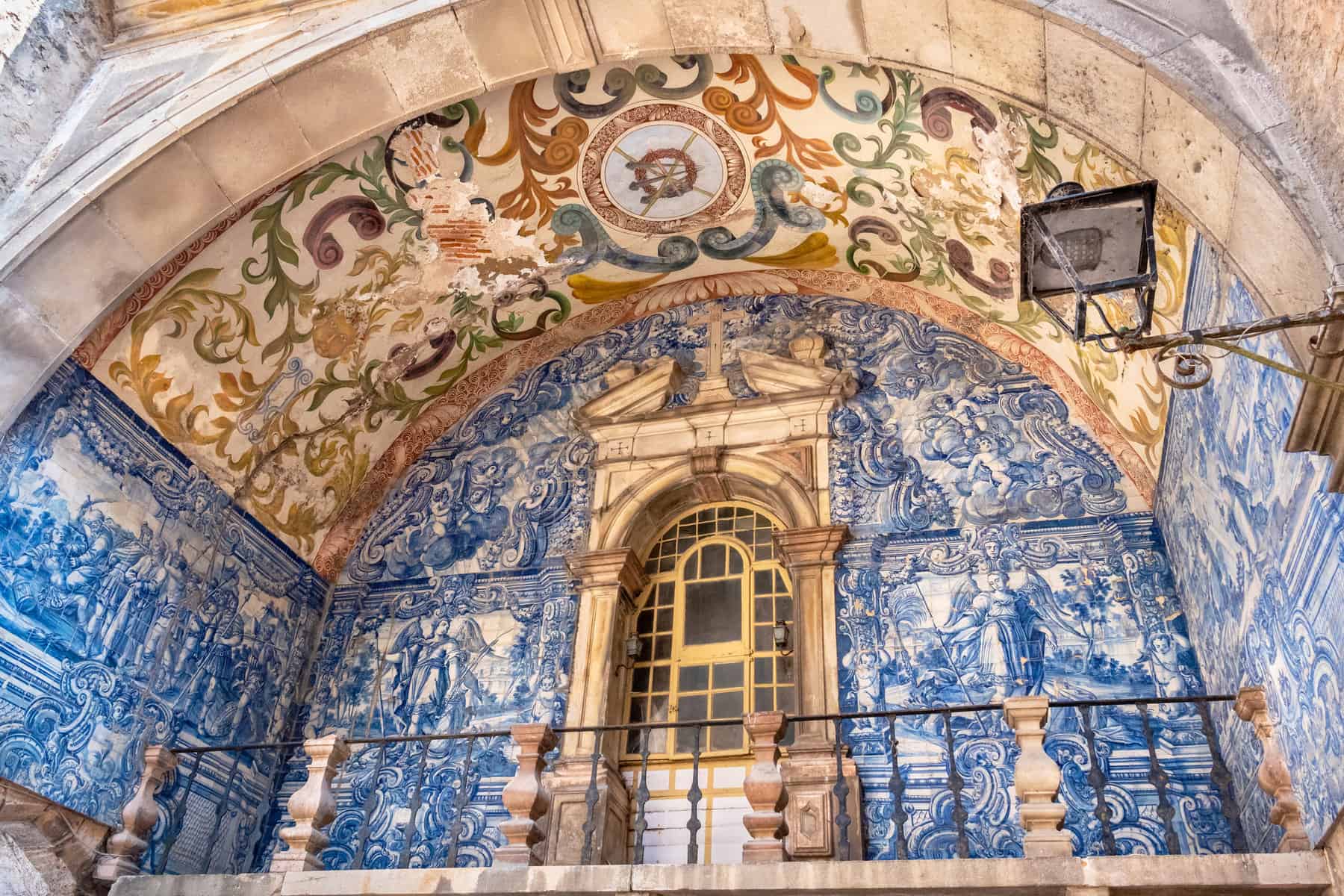
But here at Porta da Vila in Óbidos, you’ll find one of the finest azulejo masterpieces in the entire country. These tile paintings were added to the structure in 1740 and depict the Passion of Christ and the life of Mary. The upper part of the town gate, with its small balcony, once served as a platform for public announcements.
In the past, the gate was closed every night. As you pass through it, notice that, like other medieval fortifications, it was designed so that entering the town required a sharp 90-degree turn, making it harder for horsemen and carts to charge straight in at speed.
Once through the gate and after taking in the remarkable azulejos, you arrive at the main pedestrian street of the old town: Rua Direita.
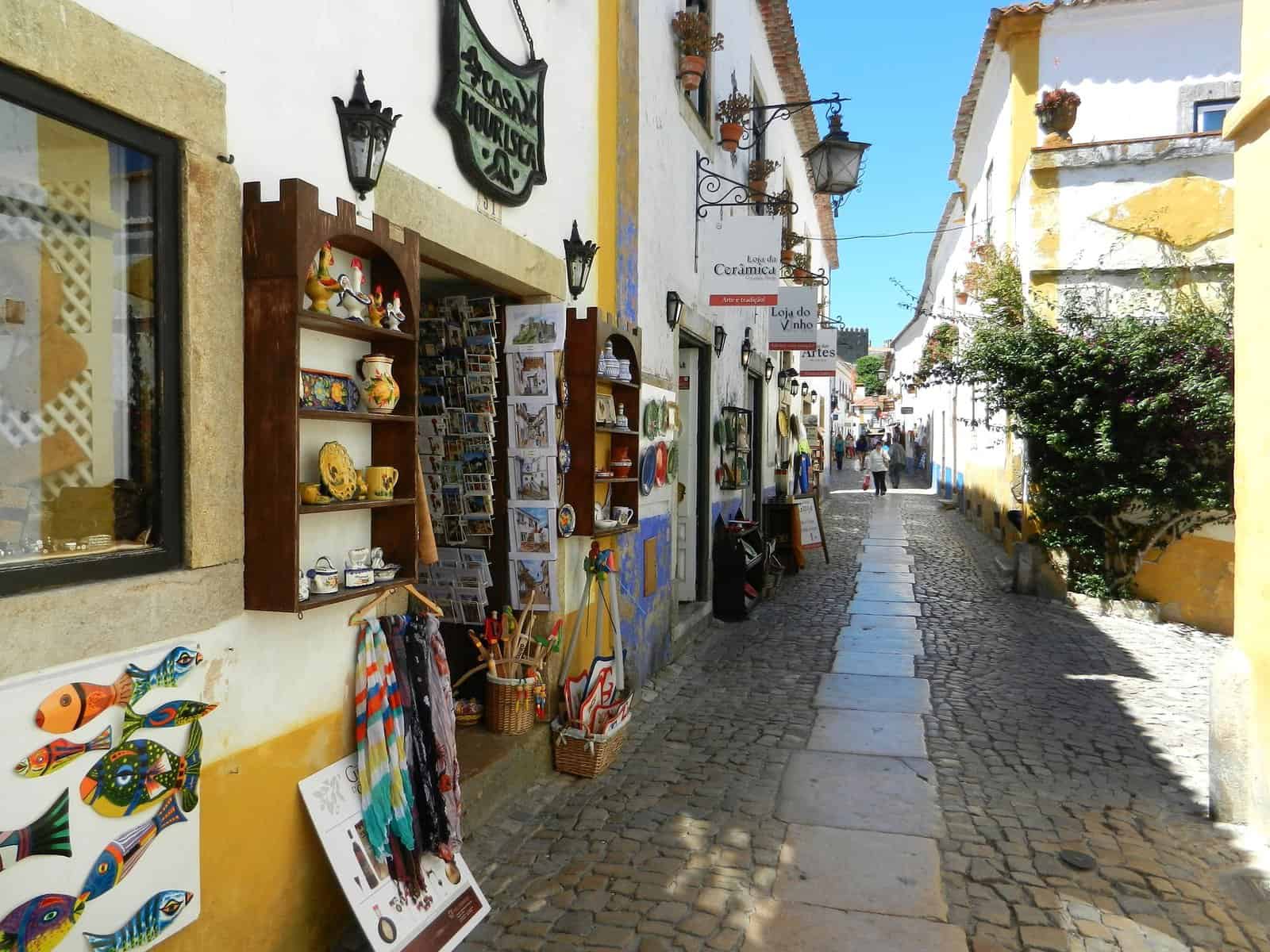
Direita – The main street within the city walls | Rua Direita
Rua Direita is the main street inside the walls, beginning the moment you pass through the stunning entrance gate into town. Beyond its obvious charm, it’s also one of the main places to shop for the chocolates that Óbidos is famous for.
A stroll along Rua Direita is a must in Óbidos, leading toward the castle and other sights in the old town. It isn’t a long street, but it usually takes a while to get through it all, since you’ll likely stop along the way to take photos, browse, eat, and more.
Click here to look for a stay in one of Óbidos’s picturesque, romantic hotels…
The side streets of Óbidos and Torre de Maneys | Torre de Maneys
Rua Direita may be the main thoroughfare and home to most of the town’s key sights, but part of the charm of this medieval town lies in its very narrow, ancient side streets. It’s well worth letting yourself get a little lost in them.
Just turn right or left off Rua Direita and keep walking — chances are you’ll eventually end up back on the main street, since the town is very small.
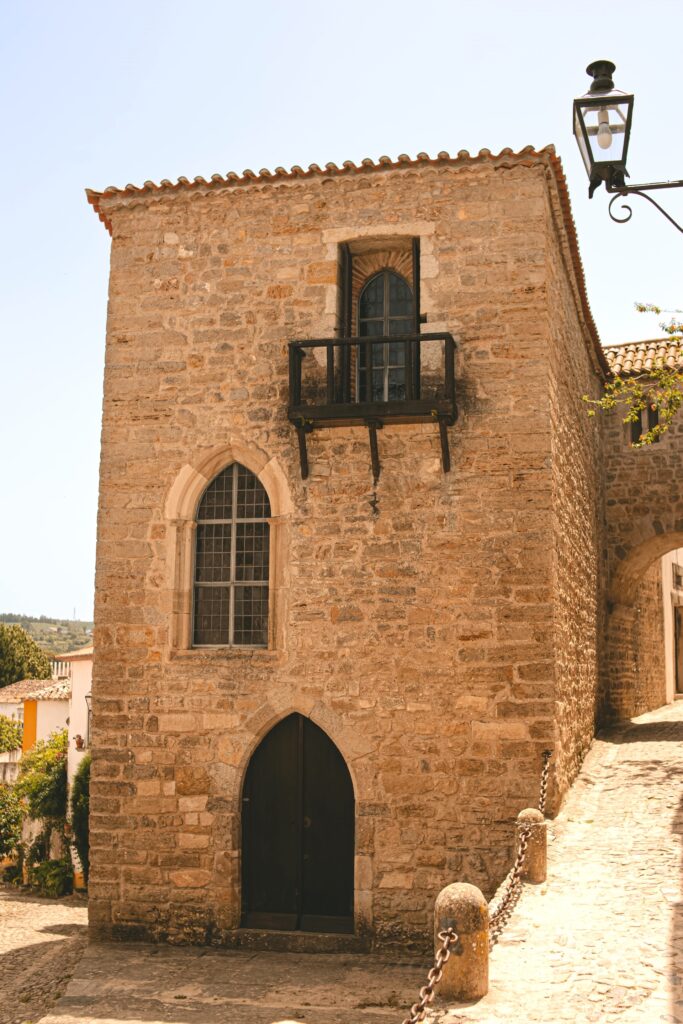
One of the more romantic corners of Óbidos lies on a side street branching off roughly from the middle of Rua Direita, where you’ll find Torre de Maneys.
The tower and the little square in front of it are among the most photogenic spots in Óbidos. Built in the 16th century, the tower probably once served as storage for the castle. When you get there, look out for the small arched bridge connecting the tower to the neighboring house, allowing passage between them.
A few years ago, the building underwent a major restoration and now operates as a hotel while preserving its historic character.
Click here for more information about the beautiful tower…
The Óbidos / Usseira Aqueduct | Aqueduto de Usseira
Construction of the aqueduct began in 1570 by order of Queen Catherine of Portugal, wife of João III. It carried water almost all the way to the town entrance at Porta da Vila. From there, the water flowed through underground pipes, mainly beneath Rua Direita, toward the castle area.
You can see the aqueduct’s arches right at the entrance to town, beside the huge parking area where most visitors leave their cars. There’s no real need to make a special trip to see it, since you’ll almost certainly come across it anyway when you park near the entrance.
That said, there is a route that follows it away from the old town. The trail is roughly a kilometer long, with sections of road, paved path, and clay ground. If you enjoy this kind of walk, it’s well worth going on foot or by bike along the not-very-tall aqueduct, which is built on hundreds of arches.
The end of the aqueduct and the route is in a grove where it once connected to the ground-level section. That stretch carried water from the area around the village of Usseira, about two kilometers south of Óbidos. That’s why it is also known as the Usseira Aqueduct.
Click here for a list of 7 charming hotels in Óbidos…
The Hand of Óbidos | Mão de Óbidos (Pomba de Óbidos)
This hand sculpture by the Portuguese modernist sculptor José Aurélio (José Aurélio) stands against the backdrop of a large paved plaza that serves as the town’s cultural square.
The white sculpture, shaped like either a hand or a dove depending on what you see when you look at it, often serves as a gathering point before heading up into the old town. It stands outside the walls near the large parking lot behind it.
Click here for a full-day trip from Lisbon to Óbidos and other sites along the way…
Municipal Museum of Óbidos | Museu Municipal de Óbidos
The museum sits near the end of Rua Direita in an 18th-century manor house.
It displays a small collection of religious art gathered from the town’s churches and other religious buildings. Most of the works are paintings and sculptures from the 15th to the 18th centuries, including pieces by the Portuguese Baroque painter of Spanish descent Josefa d'Óbidos (Josefa d'Óbidos).
Click here for more information and opening hours…
Church of Santa Maria | Igreja de Santa Maria
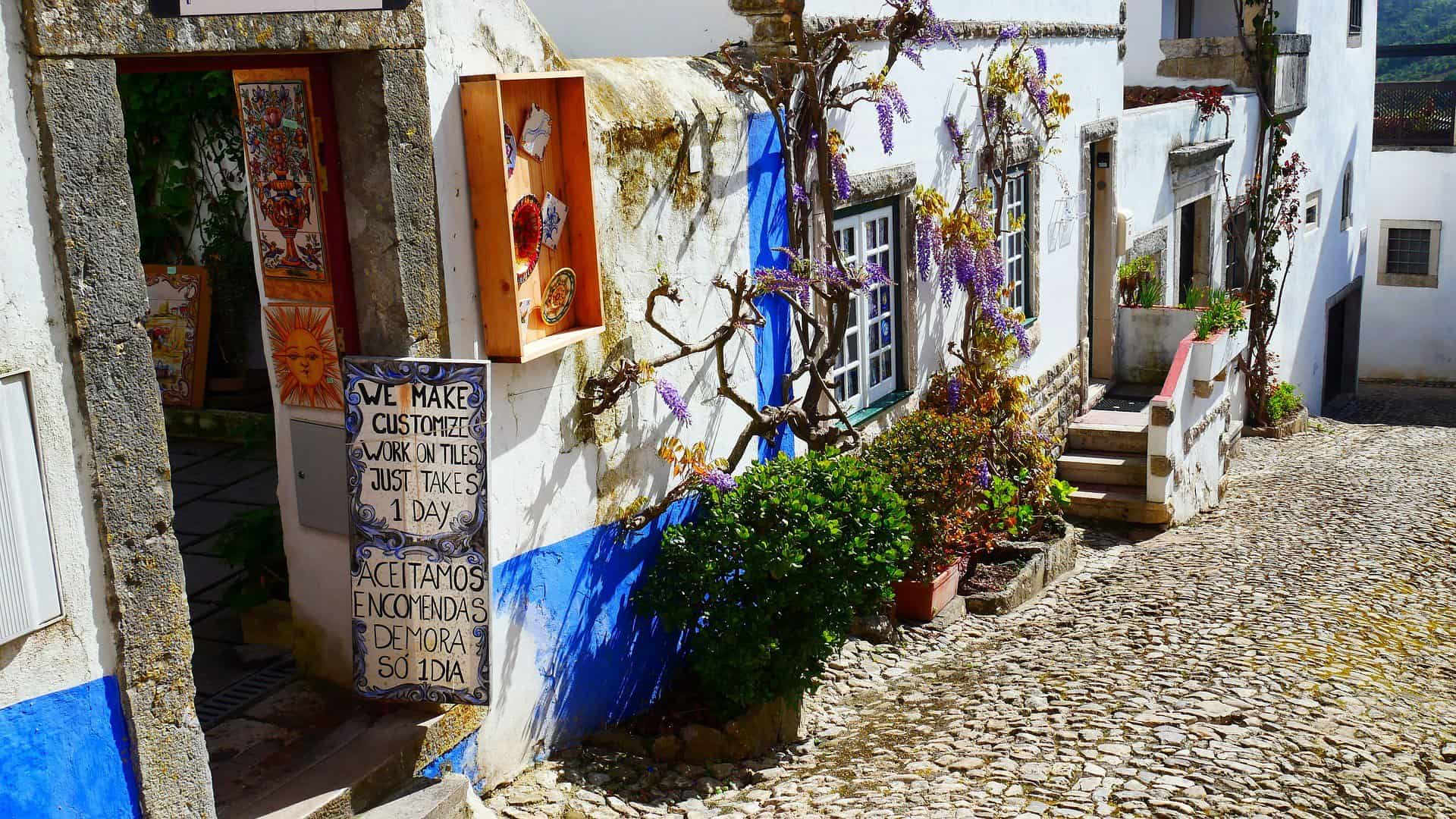
At the end of Rua Direita, the town’s main street, stands the town’s principal church: Santa Maria.
There was already a church here in the Visigothic period, later turned into a mosque during the Muslim conquests. But since the reconquest of Óbidos by Portugal’s first king himself — Afonso Henriques in 1148 — this church has stood on the site and has been closely tied to the Portuguese royal family.
One of the more curious facts about Santa Maria Church in Óbidos is that it was the site of the marriage of King Afonso V and his cousin Isabel, when they were just 10 and 8 years old respectively.
The square in front of the church is especially pleasant, shaded by large trees that are decorated with lights and holiday symbols around Christmas.
The current building you see today dates in fact from the late 16th century, when the church underwent extensive renovation.
The church façade features a Mannerist entrance portal topped by an image of the Virgin.
The church interior is not large, but it feels like one great work of art.
The church is decorated from floor to ceiling with 17th-century azulejo tiles. Inside are important Renaissance and Baroque artworks, including many oil paintings. There are also sculptures and the tomb of a local notable made of carved marble. The marble carving is attributed to the renowned French-Portuguese sculptor Nicolas Chantereine (Nicolas Chantereine), whose works can be found across Portugal.
The Prison Arch | Arco da Cadeia
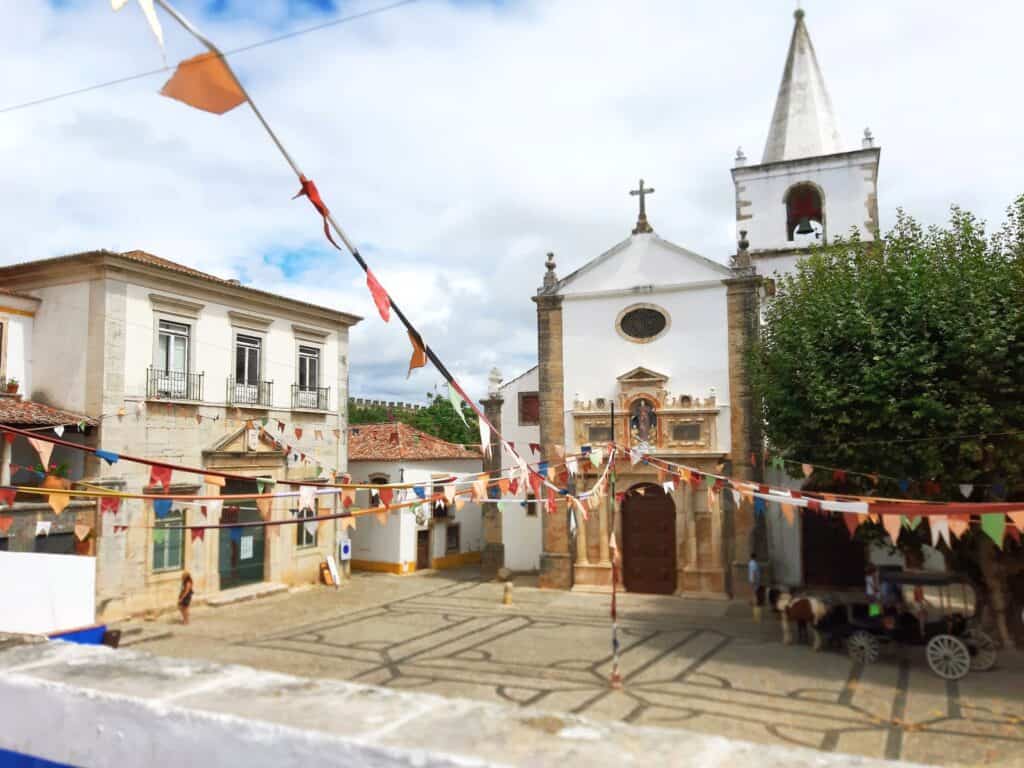
Arco da Cadeia is another wonderful example of Óbidos’s medieval architecture. Many visitors come to this little arch spanning a narrow alley to take photos in one of the town’s most magical corners.
There is also a small museum here dedicated to the 20th-century Portuguese painter Abílio de Mattos e Silva (Museu Abílio de Mattos e Silva).
The arch is located behind the square of Santa Maria Church, with its large trees, and near Misericórdia Church.
Misericórdia Church | Igreja da Misericórdia de Óbidos
This small church, so close to the much larger Santa Maria Church, might not seem at first like a major point of interest in Óbidos, since the main church is right beside it.
Yet its interior is so striking that it’s worth stepping inside, even for just a few minutes, to admire its artistic treasures.
The church was founded in the 15th century by order of Queen Leonor, wife of King João II of Portugal. It underwent major renovation in 1678, when its stunning azulejo tiles were installed from floor to ceiling.
Also notice the porcelain statue of Mary and Child above the entrance, likely brought from Lisbon in the 17th century and quite unusual in its kind.
The park outside the walls | Parque Cinegético de Óbidos
The park stretches along the hillside west of the walls.
It has several walking and biking trails, and from certain points you can see the walls above. At the beginning of the park, right next to the projecting tip of the wall at the southern edge of Óbidos, there is also an old cemetery. Then, as you descend into the park, an old windmill comes into view.
In the past, when the forest was denser and the surroundings far wilder, local nobles used to hunt here, mainly deer and wild boar, which still roam the area.
The park is a good option for anyone staying in town and wanting a nature walk without going far, or for cyclists who can start along the aqueduct route and then continue into the park and beyond.
Click here for a list of charming boutique hotels in Óbidos…
Chapel of Our Lady of Mount Carmel | Ermida de Nossa Senhora do Carmo
This chapel stands outside the walls in the northern part of town. To reach it, leave through the north gate near the castle and walk downhill for about two minutes.
The chapel sits on the site of an ancient Roman temple and was later dedicated to Christianity.
Like other buildings in Óbidos and the surrounding area, it was damaged in the massive 1755 Lisbon earthquake. All that remains of the medieval structure is the skeleton of the large bell tower you see beside it. The chapel building standing today was restored in the 20th century.
In practice, seeing it from the walls or from below near the train station will likely make the main impression, so you do not necessarily need to walk all the way there.
Food in Óbidos
Chocolate — “chocolatxi” to the locals
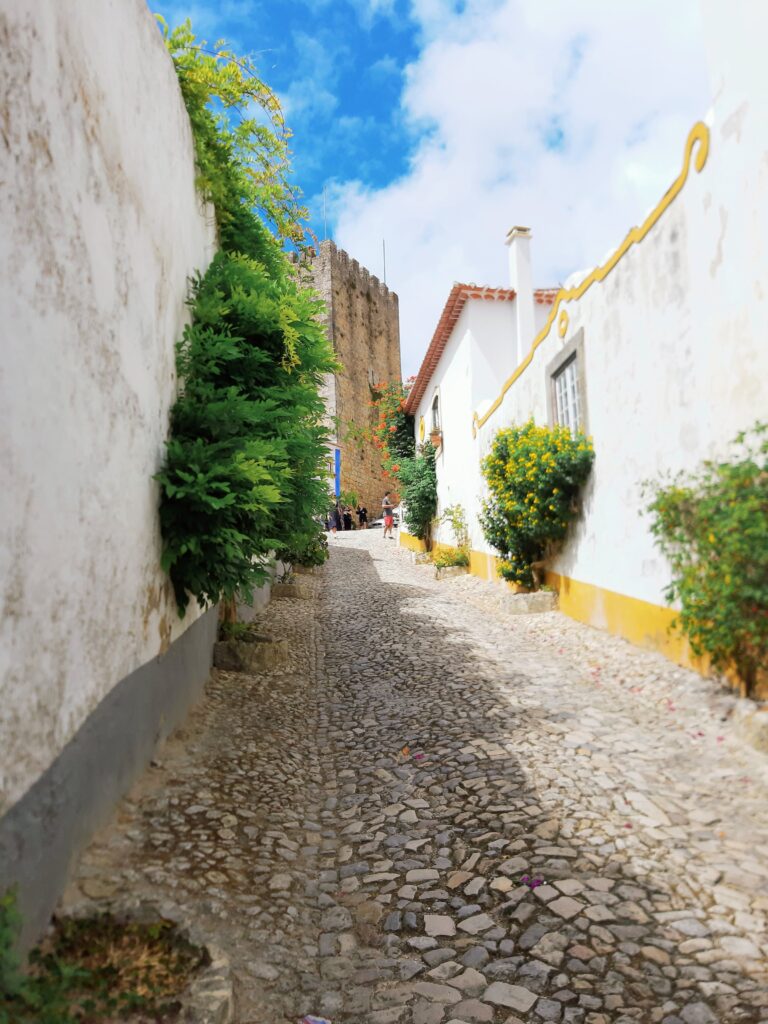
Óbidos is known for its chocolate products, including a local version of a cream-filled chocolate treat and plenty of chocolate cups filled with the town’s ginja cherry liqueur.
Every year, the town also hosts a chocolate festival that brings in small chocolate makers from across Portugal and from other European countries as well. Some of the chocolates made in Óbidos include:
- Chocolate bonbons filled with ginja cherry liqueur | Bombons com Ginja de Óbidos
- Chocolate cups used for serving Ginjinha liqueur | Copas de Chocolate
- Bomboka — the local cream-filled chocolate treat with a variety of coatings | Bomboka o Bomboca
- Many more types of chocolate bars and pralines
Ginja or Ginjinha
This is Óbidos’s distinctive local liqueur.
It is a sour cherry liqueur found throughout Portugal, but here in Óbidos it is considered one of the very best. In town, it also comes with a local twist.
In Óbidos, ginja is served in a small chocolate cup, which balances the liqueur’s tartness and bitterness in a perfect combination that gives you a little lift for the rest of the day.
Just remember: drink first, then eat the chocolate cup.
Click here for a day trip from Lisbon to Óbidos…
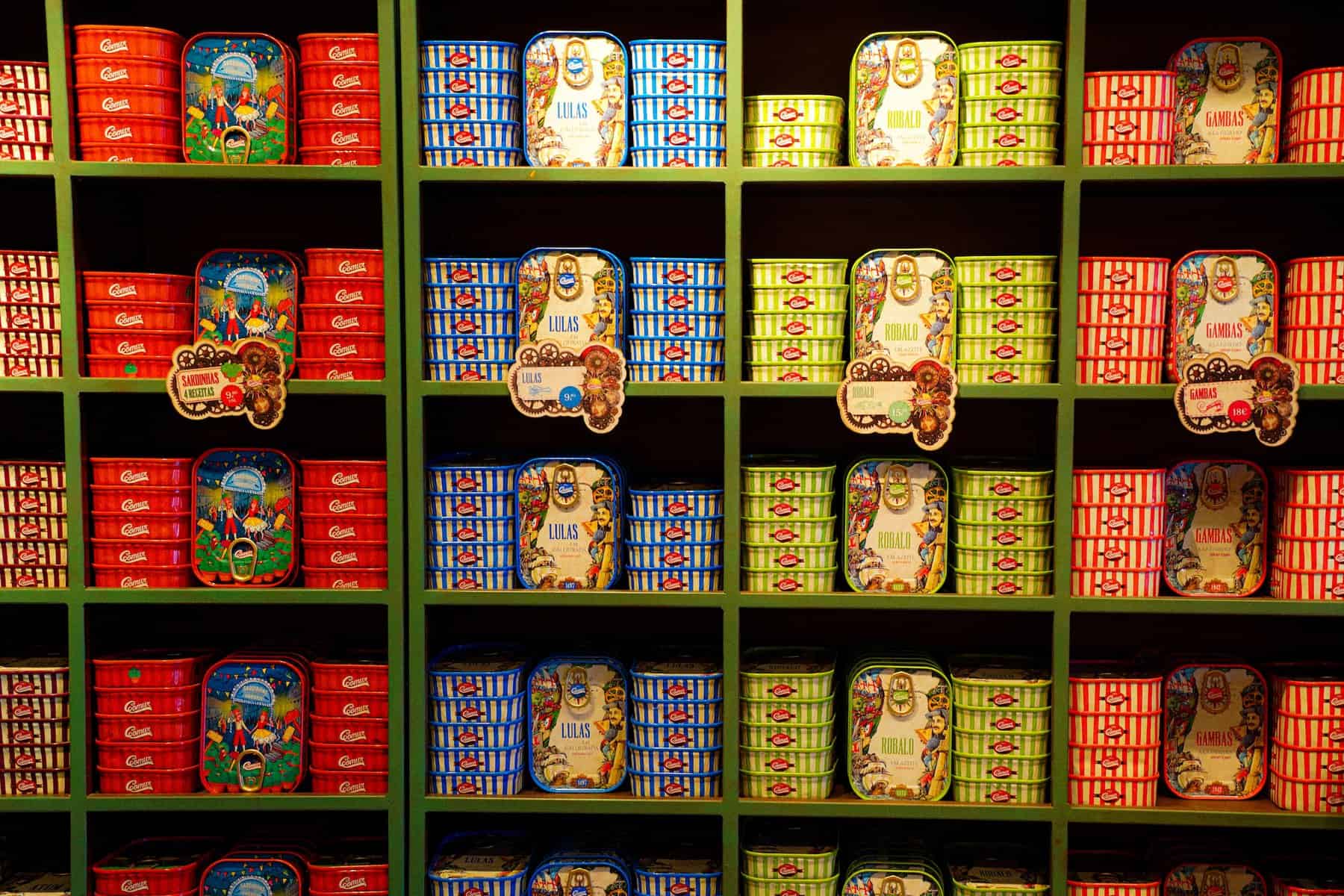
The Comur sardine shop in Óbidos
Comur is the company behind Portugal’s famous canned sardines. It has a network of shops where thousands of tins are displayed on shelves, arranged almost like books. In nearly every major tourist destination in Portugal, you’ll find a Comur shop.
Although the stores are all designed in a fairly similar style, here in Óbidos this one somehow feels like the prettiest of them all.
The shop in Óbidos is right at the end of Rua Direita near the castle. It’s worth peeking inside even if you’re not a sardine fan.
Events in Óbidos
Chocolate Festival | Óbidos Festival Internacional de Chocolate
Every spring, this town famous for its chocolate hosts a chocolate festival.
The festival runs over three weekends. The exact dates change each year, but it always takes place more or less at the start of spring, beginning in March.
During the festival, small chocolate makers come to town from all over Portugal as well as from other countries, and a competition is held to choose the best producer.
At the end of the festival, the year’s best chocolate maker is announced. Some producers also create chocolate sculptures, and there is a competition for chocolate sculpture as well.
Beyond the competition itself, the festival offers all kinds of chocolate-themed activities. Chief among them are chocolate-making sessions with experts for adults, along with many chocolate workshops for children. In fact, kids even have an entire area dedicated to them (Casa de Chocolate das Crianças), with activities happening almost constantly.
Óbidos is always worth a visit, and it’s only an hour from Lisbon. So if you happen to be in the capital while the festival is on, it’s absolutely worth setting aside a day to experience this walled town during its sweet chocolate celebration.
Do keep in mind that Óbidos is already crowded on most weekends, and festival days can be even busier. That’s not really a problem, but it helps to be prepared for lines and, whenever possible, to book tickets in advance for any activities you want to join.
Click here for more information about the Chocolate Festival and dates…
Click here to find a place to stay in Óbidos during the festival…

Medieval Festival | Mercado Medieval de Óbidos
Óbidos feels like a medieval celebration all year round, but in summer it becomes an official festival.
The festival is relatively new and has been held since 2002. It takes place every year during the last two weeks of July (the dates shift slightly from year to year depending on where the weekends fall, so it’s worth checking the exact dates through the link).
This major event takes place inside the old town within the walls, especially around the castle. Beyond the exhibitions, the whole town turns into a mix of market, food stalls, and fairground. The atmosphere is lively and joyful, with activities and decorations everywhere. At the same time, it can also get crowded.
Many people come to the festival dressed in medieval costume, though it is not required.
Official festival website with the latest information…

Christmas in Óbidos | Óbidos Vila Natal
From the first week of December through the first week of January, Óbidos is decorated for Christmas. The town is charming to begin with, but during this season it becomes even more inviting, and with the moody weather you could almost imagine yourself at a Christmas market in Germany.
In fact, this is a wonderful time to visit Óbidos despite the weather, because the town is less crowded than in summer and the holiday decorations are a lovely bonus.
There is also a Christmas fair area near the castle, active mainly on weekends during the holiday season.
Attractions and points of interest around Óbidos
The city of Caldas da Rainha
Caldas da Rainha is a hot-springs city that developed in the Middle Ages. It lies about ten minutes north of Óbidos by car and is the region’s main urban center.
The springs were especially beloved by Queen Leonor | Rainha Dona Leonor, wife of King João II of Portugal. Nearby Óbidos was always under the patronage of Portugal’s queens, and during Leonor’s time, Caldas da Rainha also began to develop in the late 15th century.
The springs had been known since Roman times, and until Queen Leonor came to them they were known as the springs of Óbidos. But the queen, who herself sought healing treatments in the waters, built a palace around them, and the town that developed there was eventually named for her — literally, “the queen’s springs.”
Caldas da Rainha is the largest city in the area, with more than thirty thousand residents. It lies about 8 kilometers north of Óbidos and provides the urban backbone for it and for the wider region.
Caldas, as it is commonly called, is also known as the “ceramics capital of Portugal,” an industry rooted here since Neolithic times thanks to the area’s abundant clay soils.
Caldas is also known for its many shopping options. The city has a lively farmers market | Praça da Fruta das Caldas da Rainha, a large mall | La Vie Caldas da Rainha, and many other shops and supermarkets in and around the old town.
Click here for a full-day trip from Lisbon to Óbidos and other sites along the way…
Sanctuary of the Lord of the Stone | Santuário do Senhor da Pedra
This sanctuary stands five minutes from town on a hill along the road from Óbidos to Caldas da Rainha. The fairly large building was constructed in 1747, and its name comes from a stone crucifix with the figure of Christ placed on the church altar.
A few miracles were associated with the stone cross, including the end of a long drought and links to the healing waters of nearby Caldas. As a result, it was decided to build a shrine for the holy cross. The small stone cross still stands at the very heart of the church altar.
The church, built in a distinctly Baroque style, is unusual in having the shape of a regular hexagon, with the altar and two chapels projecting from it.
That hexagonal form is also clearly visible inside the church’s tall interior.
Buddha Eden garden park | Jardim da Paz Buddha Eden
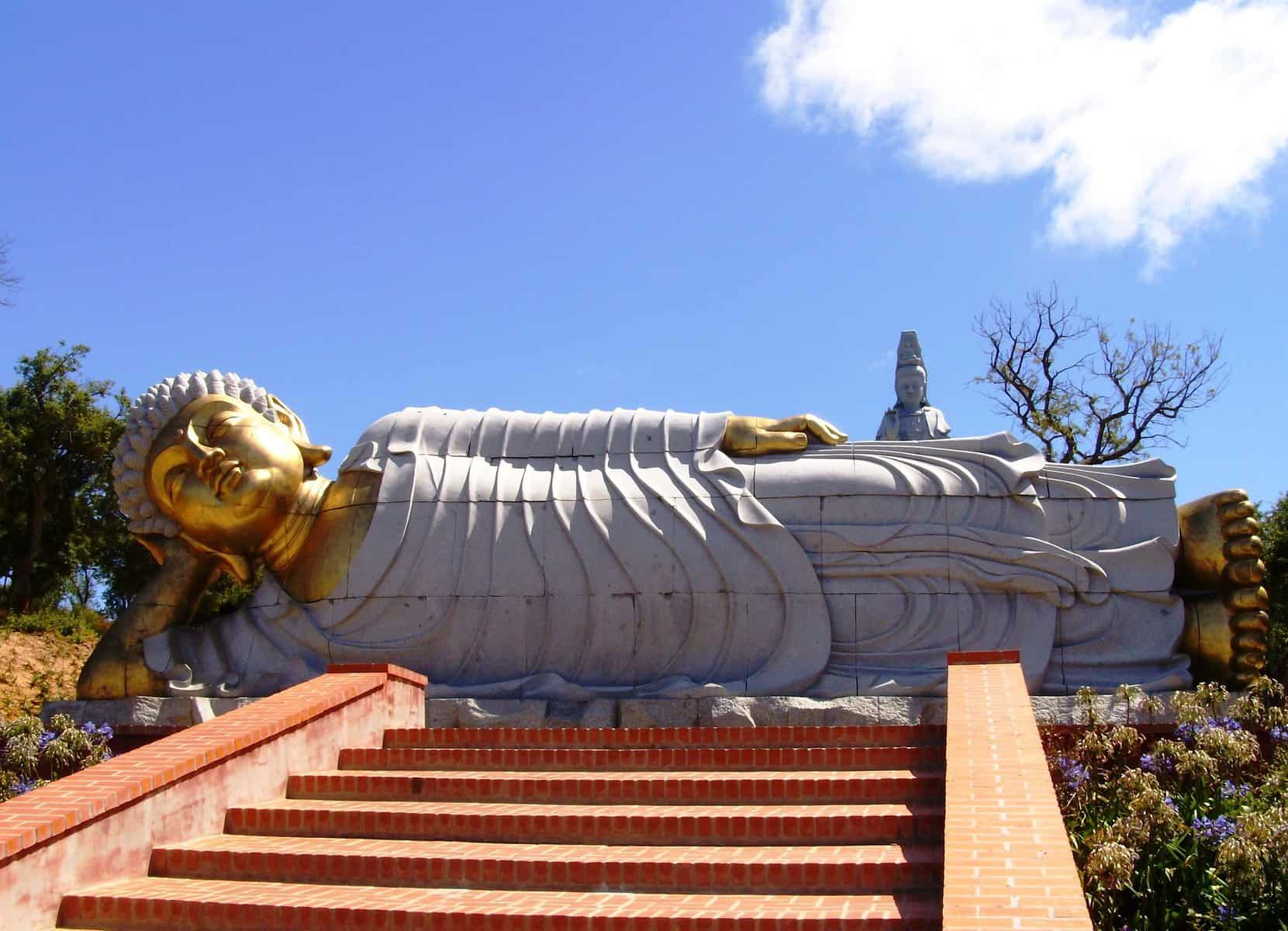
This enormous park, set in the heart of a rural agricultural landscape, was created as a large natural space for meditation and peace. It is also known as Bacalhôa Buddha Eden.
The park is about a 15-minute drive south of Óbidos, and it feels so unexpected that many people who visit end up wishing they had set aside more time for it.
It’s worth allowing at least two to three hours to explore this remarkable place. If you especially enjoy this kind of experience, half a day would not be too much, with time for meditation in one of the many corners of the park designed for exactly that. It’s also worth noting that speaking loudly during a visit is generally discouraged.
The park really is vast — nearly 400 acres — and filled with large Buddha statues and other decorative elements inspired by the Far East. Between them are flower gardens, groves, many kinds of trees, shallow pools with aquatic plants and fish, a lake lined with palm trees, and much more.
You can explore it on foot or, for an additional fee, take the train that carries visitors between different sections of the park.
The trigger for the park’s creation was the destruction of the giant Buddha statues in Afghanistan by the Taliban in 2001 (Buddhas of Bamiyan). Portuguese businessman and art lover Joe Berardo | Joe Berardo initiated the project in order to preserve and pass on the beauty of Eastern art to future generations. Since then, the park has continued to grow and now also includes themed sections devoted to Africa and other places.
This park is one of the most surprising sights you could imagine finding in Portugal. That’s exactly why it’s so worth visiting before or after Óbidos — the contrast between the Portuguese landscape and the design and sculpture of this park makes for a striking experience.
At the entrance to the park there is a large buffet restaurant, and almost everyone who visits seems to end up eating there. Most people do not expect the visit to be this enjoyable or to last longer than planned, so by the end they are hungry and ready to sit down for a meal.
More information and opening hours…
Golf Courses near Óbidos
The course is not in Óbidos itself, but it belongs to its municipal area and lies about twenty minutes from town on the coast.
The whole Óbidos area is full of distinctive attractions. Among them, local authorities wisely took advantage of the gentle plateau above the dramatic surfing beaches and built golf courses there to attract another segment of tourism. Here are a few nearby courses, all also relatively close to the surf town of Peniche:
- Praia D'El Rey | Praia D'El Rey Golf
- West Cliffs | West Cliffs Golf Course
- Royal Obidos | Royal Obidos Golf
Click here to find a place to stay within the walls of Óbidos…