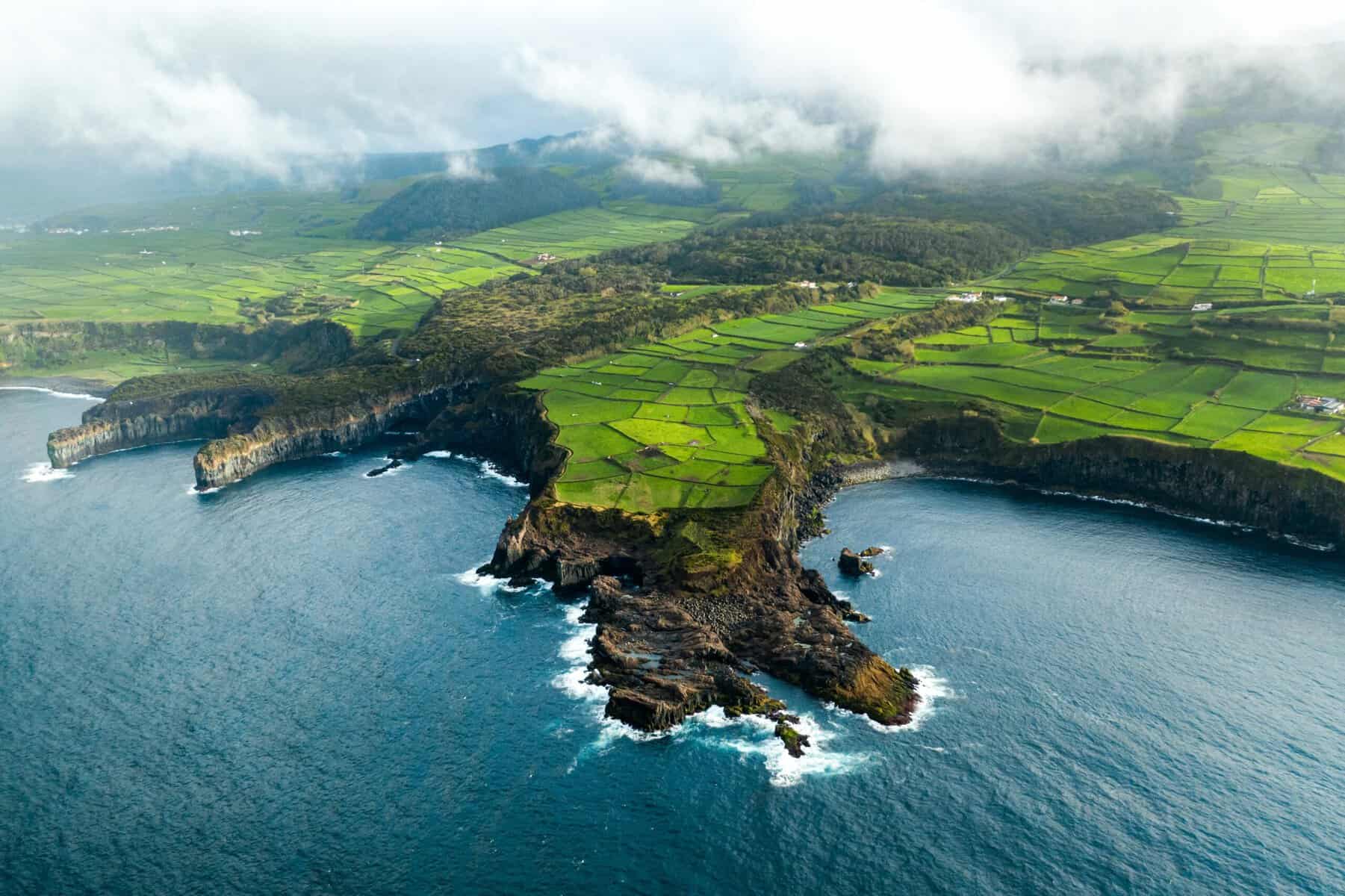
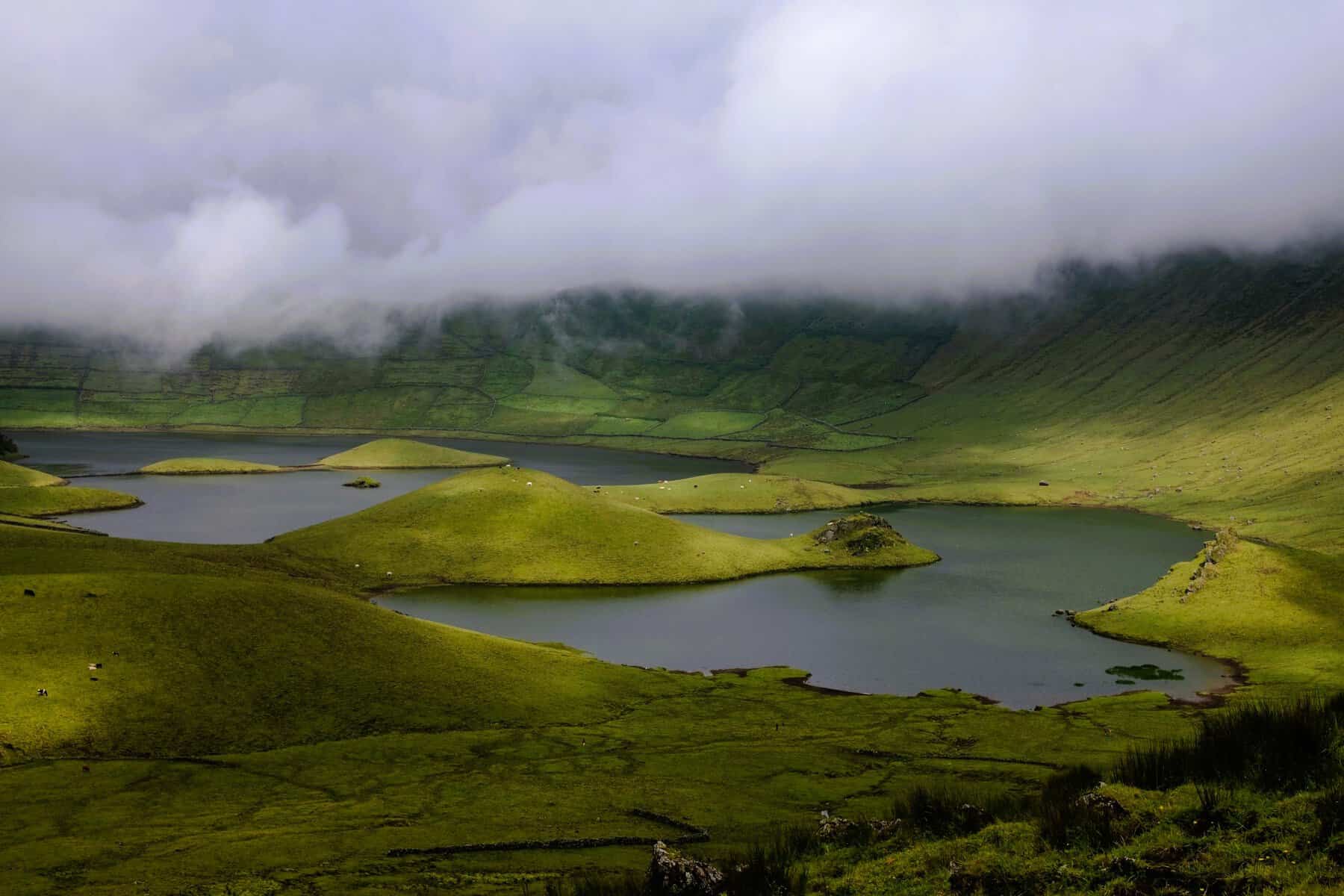
Flores — pronounced Floresh by the Portuguese — is the westernmost island in the Azores archipelago. If any place explains why the Azores are called the “Hawaii of Europe,” Flores comes closest to the real thing, just with cooler weather. The island is packed with nature and dramatic scenery: unusual rock formations, cliffs, volcanic craters, endless green, and above all, magnificent waterfalls. Corvo, about 24 kilometers north of Flores, is a tiny, barely inhabited island. It is essentially an extinct volcano whose ancient crater has turned into a green grassy basin with a lake at its center.
Flores and Corvo tend to attract more seasoned Azores travelers, since they are so remote and untouched — and that is exactly part of their appeal. Once you make it here, you really do feel like one of the few people on the islands, as flights and other transport options are limited. On both of these far-flung islands, you are often more likely to come across grazing cows than other people. That is why it is essential to book everything well in advance, especially for summer travel.
How many days do you need to visit Flores and Corvo?
In principle, one full day on Flores and half a day on Corvo is enough to see the main sights.
That said, the Azores are known for highly changeable weather that often forces you to adjust your plans. This is even more true on remote Flores and Corvo, far out in the open Atlantic. For that reason, it is well worth staying at least 3 days, especially if you are not visiting in the drier months of July and August. Otherwise, you could easily end up with rain and fog that make it hard to fully enjoy the islands’ extraordinary scenery. And if you have come all this way to islands that look like something out of Jurassic Park or Avatar, why rush?
Click here to find hotels and vacation rentals on Flores…
Five sights and experiences not to miss on Flores and Corvo
- Ribeira Falls | Cascata da Ribeira Grande
- The lakes above Ribeira Falls | Lagoa Negra and Lagoa Comprida
- Bordões Rock | Rocha dos Bordoes
- The natural pools of Santa Cruz | Piscinas naturais de Santa Cruz das Flores
- Caldeirão Crater on Corvo | Lagoa do Caldeirão
How to get to Flores?
Getting to Flores is almost exclusively by air. There is no regular ferry service between the other Azores islands and the remote islands of Flores and Corvo. The only ferry runs between the two islands themselves, departing from Santa Cruz to Vila do Corvo. The distance between them is 24 kilometers and can be covered by ferry or by private boats offering passenger service. More information about getting to Corvo appears at the bottom of the page.
Click here for our complete guide to the Azores Island…
Flights to Flores
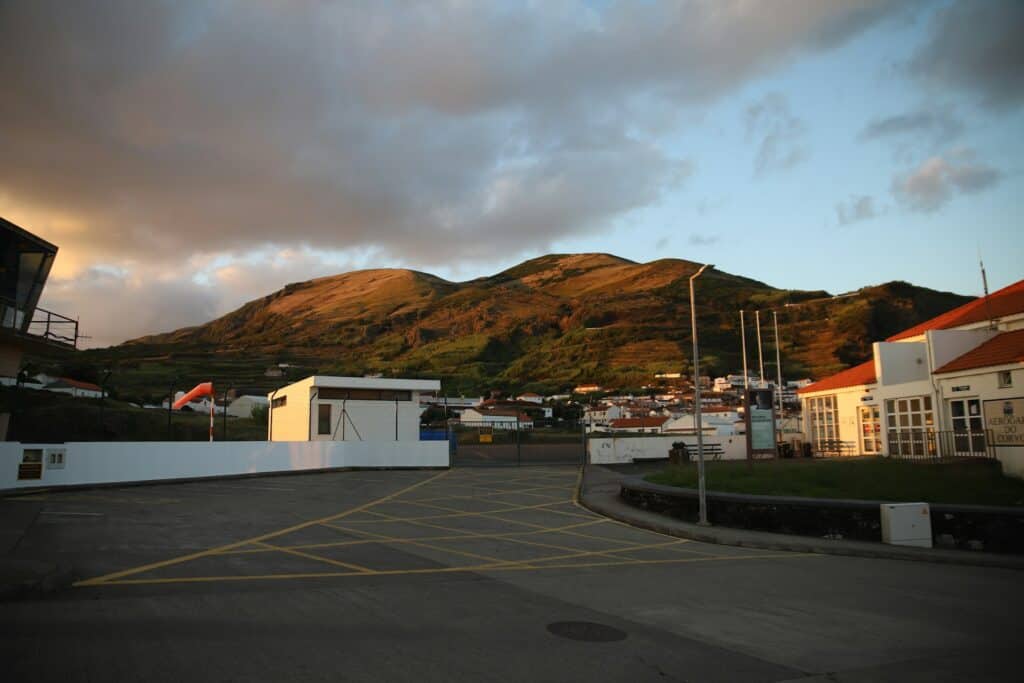
Flores Airport is in the capital, Santa Cruz, and is simply called Flores Airport | Aeroporto das Flores. The airport code is FLW.
There are flights to Flores from the larger island of São Miguel, from Terceira, and from Faial — all operated by the Azores airline. From Ponta Delgada on São Miguel to Santa Cruz das Flores, the flight takes 1 hour and 20 minutes. From the central islands of the archipelago, it is a little under an hour.
One option that is well worth checking when flying to the Azores — especially if you plan to visit the smaller islands — is a multi-city ticket. The multi-leg fare offered by the Azores airline (SATA – Azores Airlines) helps reduce costs, especially if you are traveling between several islands. In summer, however, it is essential to book far in advance, as seats on the small aircraft fill up quickly.
Flights to Corvo — Corvo can be reached by air from Flores. Corvo has a very small airport in the south of the island, right next to the little harbor from which the ferry to Flores departs.
Ferry to Flores
The regular Azores ferry service operated by Atlantico-line is active only between Flores and Corvo. There is no regular ferry service between the other Azores islands and Flores or Corvo.
Click here for a boat trip from Flores to Corvo…
Getting around Flores and Corvo
Renting a car on Flores
Weather on Flores is often foggy, rainy, and not especially convenient for sightseeing. At the same time, conditions in the Azores change quickly, so even if the morning starts wet, the skies may clear before noon. Renting a car gives you the flexibility you need to reach the island’s sights and attractions as the weather shifts. Because of the conditions, you sometimes need to double back and change your route during what is usually a short stay on the island.
For example, if you arrive at Ribeira Falls in the morning and it is wrapped in fog, you can head down to Fajã Grande to watch Poço do Bacalhau waterfall pouring into the sea, have something to eat in the lovely village, and return to Ribeira Falls around midday once it has cleared.
That is why, especially outside the summer months, renting a car is the ideal solution for anyone who does not want to miss any of the island’s highlights.
The roads on Flores are narrow and winding, but they are also very quiet and peaceful, so even if driving is a bit more demanding than usual, it still feels fairly relaxed.
Click here for car rental deals…
Tours on Flores
On the small island of Flores, renting a car is often expensive, and in many cases it is cheaper to use transfer services or organized tours to explore the island. That said, for a traveling family, a rental car will probably work out cheaper and, as noted, gives you the flexibility you need.
Click here for an excellent comprehensive tour of Flores’ main sights…
Rental car on Corvo
There is really no point in renting a car on Corvo, and there is not much opportunity to do so anyway. The island is very small and has one main attraction, located 6 kilometers from town — about a 10-minute drive — making a taxi the simplest and most efficient option.
About Flores
Flores Island — or more accurately, Florsh in local pronunciation — lives up to its name, filled with flowers growing among its ravines and valleys. The island is defined by ridges and deep valleys, and its highest point is Morro Alto at 915 meters. Those deep valleys create ideal conditions for the many flowers that bloom here, helping earn Flores UNESCO Biosphere Reserve status.
Around 3,500 people live on the island year-round, most of them in the east, while the west — and especially the southwest — is where you find the island’s most striking and unusual landscapes.
Permanent settlement only began in the 16th century, and despite its isolation, the island suffered heavily from pirate raids, which were common in the Atlantic after the discovery of gold in the Americas.
Only in the 20th century, with modernization and especially improved communications, did the island begin to emerge from its isolation and become more populated.
Flores has the coolest climate of all the Azores, with stormy, cold winters and exceptionally pleasant summers. The island’s defining climate feature is its heavy rainfall — nearly 1,700 mm a year on average. In fact, apart from June, July, and August, Flores sees significant rainfall in every month of the year. It does still rain in summer, just less often, which makes it the ideal season to visit Flores.
Many travelers come to Flores for hiking trails that feel as though they belong in the world of Avatar. The island also offers several excellent and challenging canoeing routes.
Click here to find places to stay on Flores…
Attractions and interesting places on Flores
Flores may be a small island, but it has two main focal points. The first is the island capital, Santa Cruz, where flights arrive. This small town has two museums and a stretch of coastline with natural sea pools. Anyone not put off by cool water is welcome to take a dip on sunny summer days.
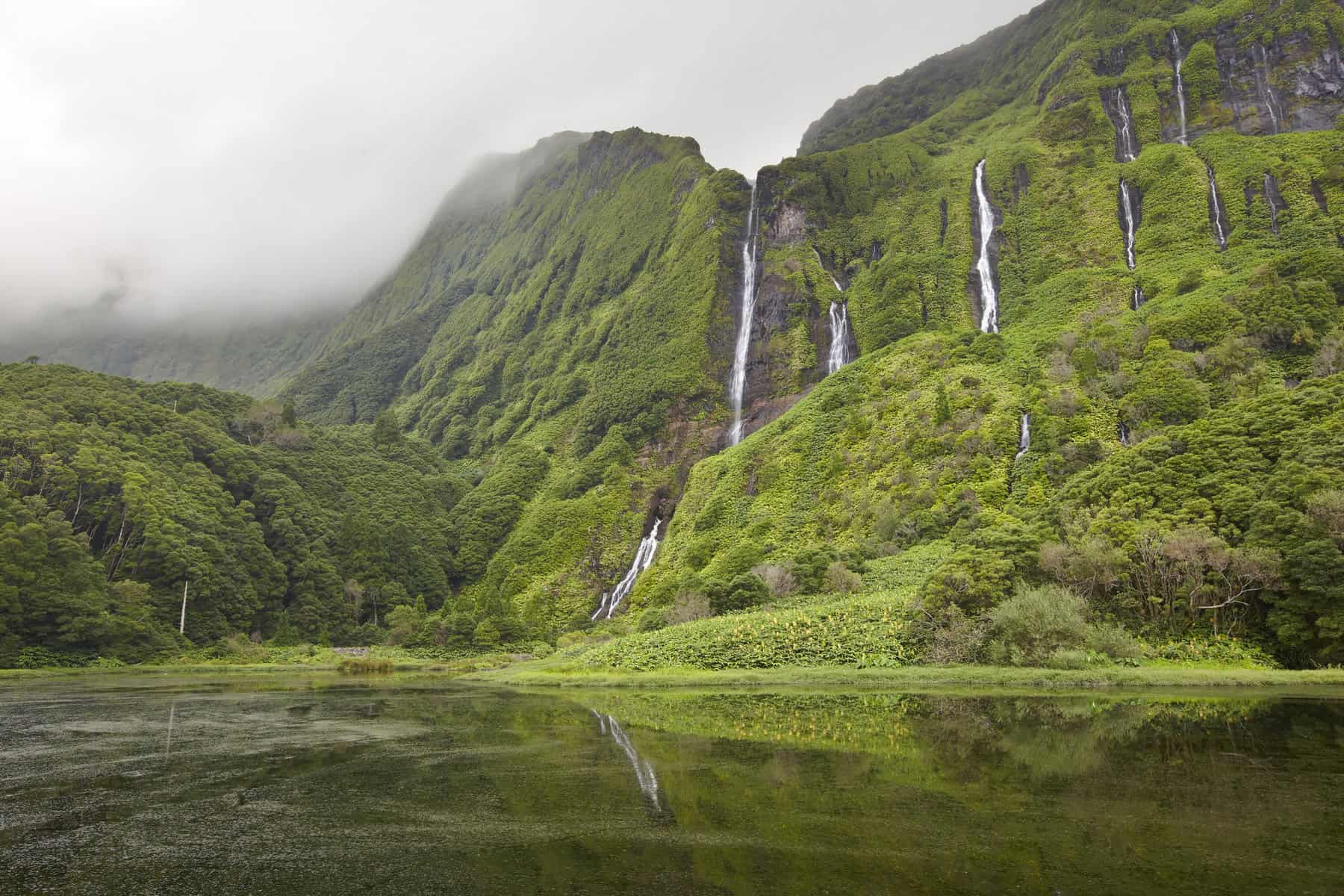
The second area — and the main reason most travelers come here — lies in the west of the island, especially the southwest. This is where you find the waterfalls and dramatic scenery that earned Flores the nickname “the Hawaii of Europe.”
The island capital — Santa Cruz das Flores
It sits on a narrow stretch of land in the northwest of the island and is home to both the airport and the ferry terminal for Corvo. It is a very small town, really more of a village, with a few attractions but above all the transport links and visitor services travelers need.
1. Flores Whaling Museum | Fábrica da Baleia do Boqueirão
Please note that there is a similar museum on Pico Island as well.
The museum on Flores is at the northern edge of Santa Cruz. In front of the building stands a slightly creepy sculpture of a cut-open whale, so it is easy to spot.
Set inside the old whale-processing factory, the museum presents the history of whaling in the region. Whaling on Flores was dominated by American whalers from the 18th century until it was outlawed in the 20th. As mentioned, the Azores in general — and Flores in particular — lie relatively close to the American continent and have served as a stop between Europe and the Americas since the discovery of the New World. The museum offers more insight into the islands’ special ties with America.
Address: R. do Boqueirão, Santa Cruz das Flores
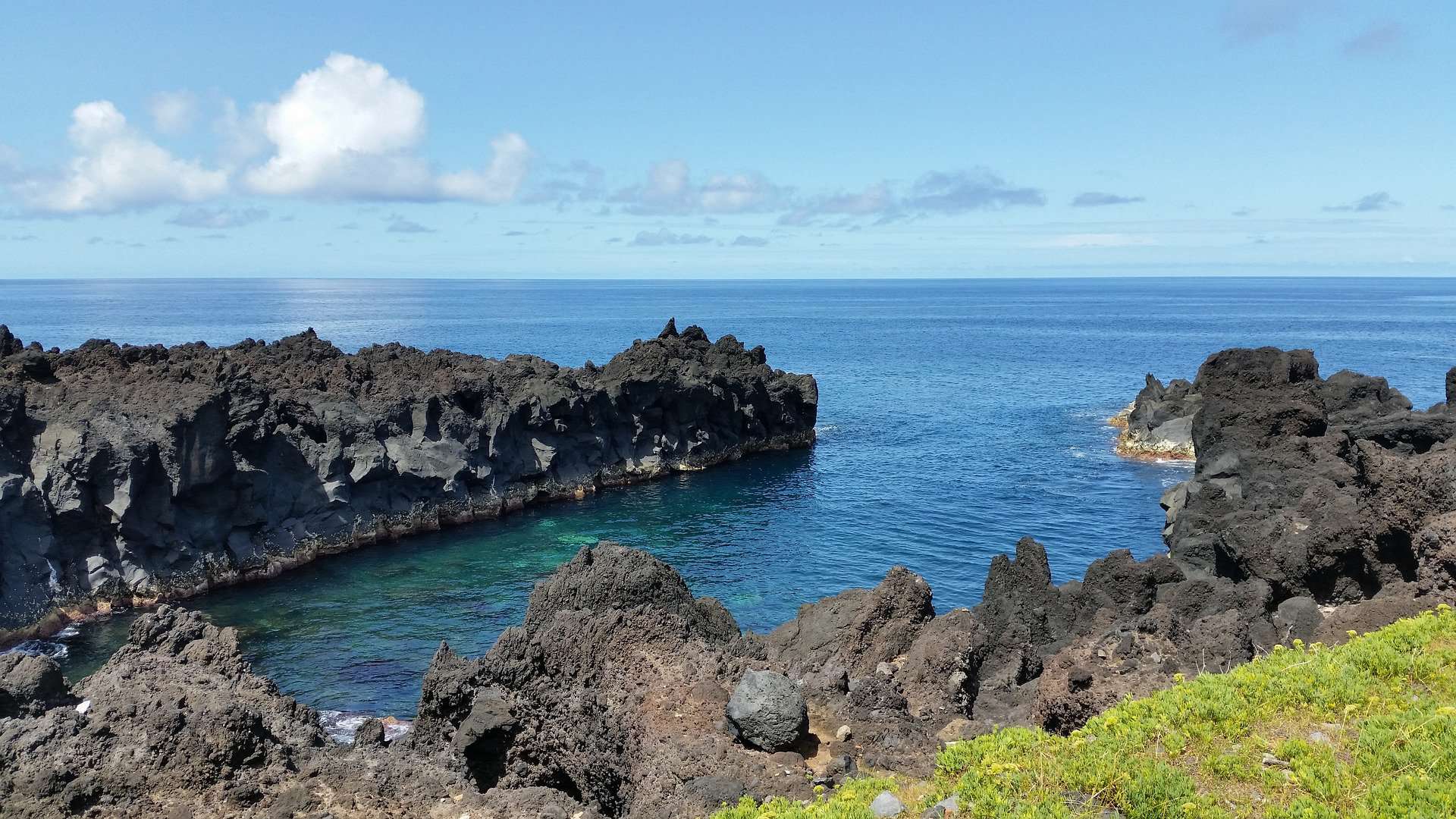
2. The natural pools of Santa Cruz | Piscinas naturais de Santa Cruz das Flores
There are several areas with natural pools along Santa Cruz’s short coastline. The best pools for swimming, however — and only on sunny days — are in the central waterfront area of Santa Cruz.
Above the pools, on the other side of the parking area, there is a remarkably well-organized picnic zone, where each table is covered by a shelter for protection mainly from the rain, which can arrive at any moment in the Azores. The area is also set up as a campsite.
3. Flores Island Museum | Museu das Flores
The island museum is housed in an old Franciscan convent building | Convento Franciscano de São Boaventura.
Inside are objects connected to the sea and sailing, as well as local agriculture. You will also find antique furniture, local ceramic works, and even a guitar made from whale bones.
Click here for more information and opening hours…
Nature sights and attractions in western Flores
These sites are very close to one another, and on a clear day you can even see some of them from others.
Click here for an excellent full-day guided tour of Flores’ main sights…
1. Ribeira Grande and Ribeira do Ferreiro Falls | Cascata da Ribeira Grande / Ribeira do Ferreiro
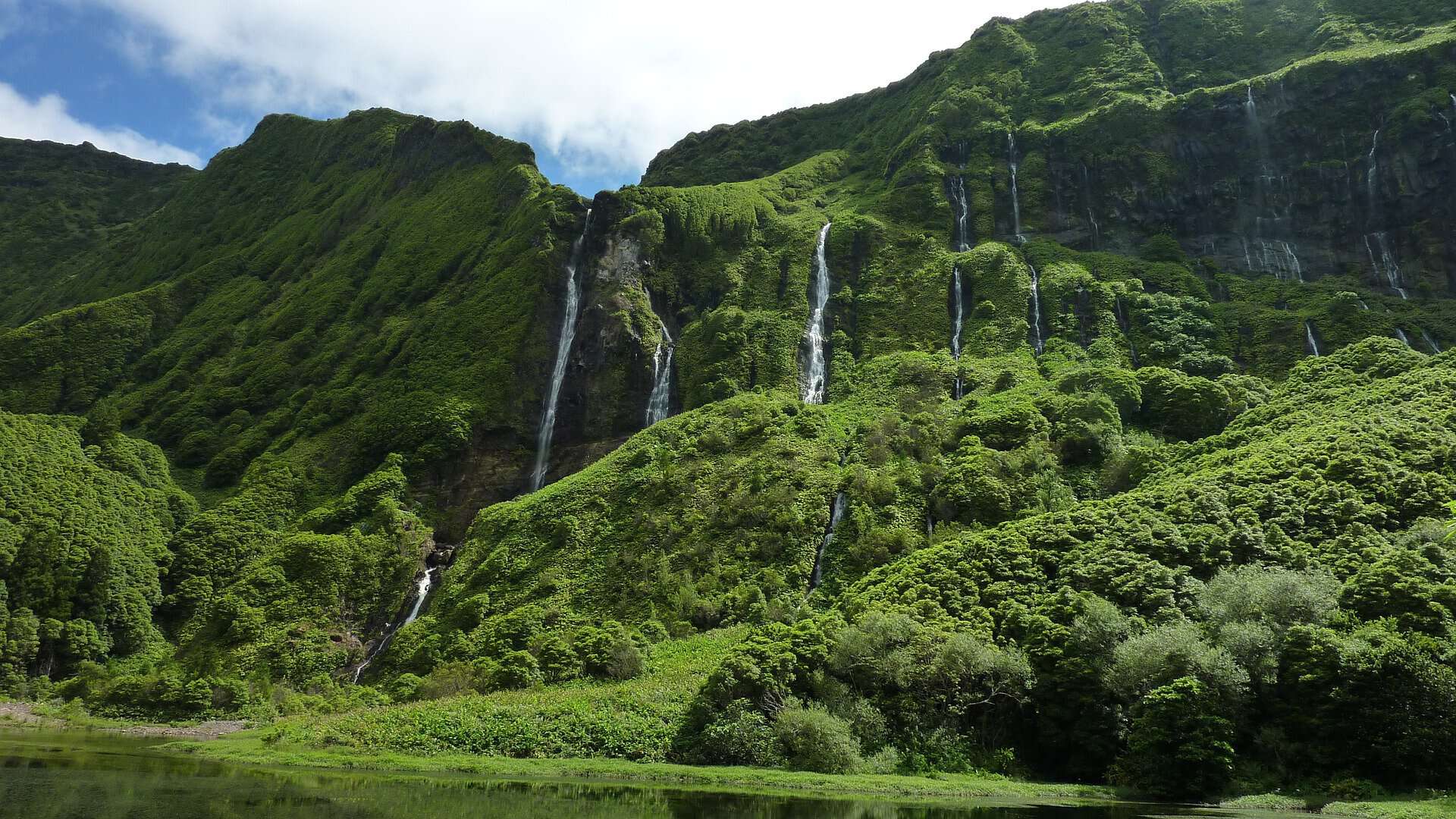
Ribeira Falls are the island’s most coveted sight. Here, narrow white waterfalls spill down a green-covered cliff into a large, still pool below. This popular spot is often shrouded in fog, so if you are coming to Flores — especially outside summer — it is wise to plan more than one possible time to visit. Sometimes you return a few hours later, and sometimes the next day. Still, no one wants to leave the island without seeing this wonder. Flores is small and distances are short, so it is not too much trouble, and hotel staff can usually tell you when the weather is expected to clear.
2. Bordoes Rock | Rocha dos Bordoes
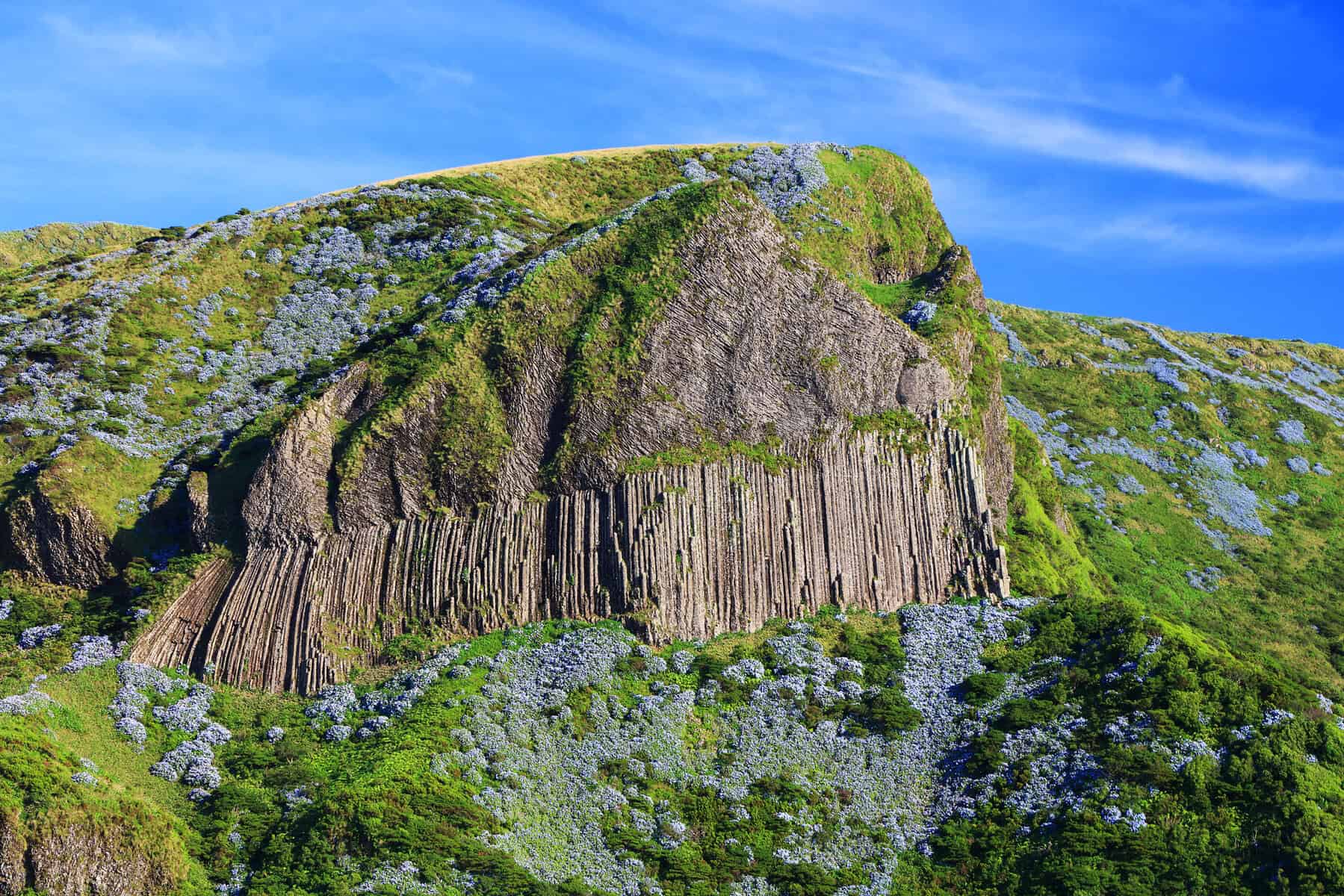
Not far from Ribeira Falls, this striking rock formation suddenly appears amid all the greenery and flowers. Located midway between the villages of Lajedo and Mosteiro, it was formed by the cooling of volcanic lava. The remarkable rock columns within it reach heights of up to 20 meters.
3. The lakes (volcanic craters) above Ribeira Falls
The lakes sit relatively close to one another, and it is common to drive up to the viewpoints between them. In fact, these are volcanic craters filled with rainwater. In the first pair, one is deeper than the other, so when water levels are lower, Lagoa Comprida takes on a green hue while the other remains darker, which is why it is known as “the black one.” The roads between the lakes are narrow but the scenery is superb, with vivid green in every direction.
- Lagoa Negra and Lagoa Comprida | Lagoa Negra and Lagoa Comprida – lakes inside a volcanic crater, located just above the famous Ribeira Grande waterfalls. They are separated only by a narrow ridge with a viewpoint over both.
- Caldeira Rasa and Caldeira Funda | Caldeira Rasa and Caldeira Funda – about 1 kilometer south of the second lake pair. These are slightly larger and also lie side by side, with a wonderful viewpoint between them.
4. The village of Fajãzinha
The road to the village is one of the prettiest drives in all the Azores. It passes by the famous waterfalls. In the village there is a hotel popular with travelers who come here to hike the trails leading to the falls.
Click here for an excellent full-day guided tour of Flores’ main sights…
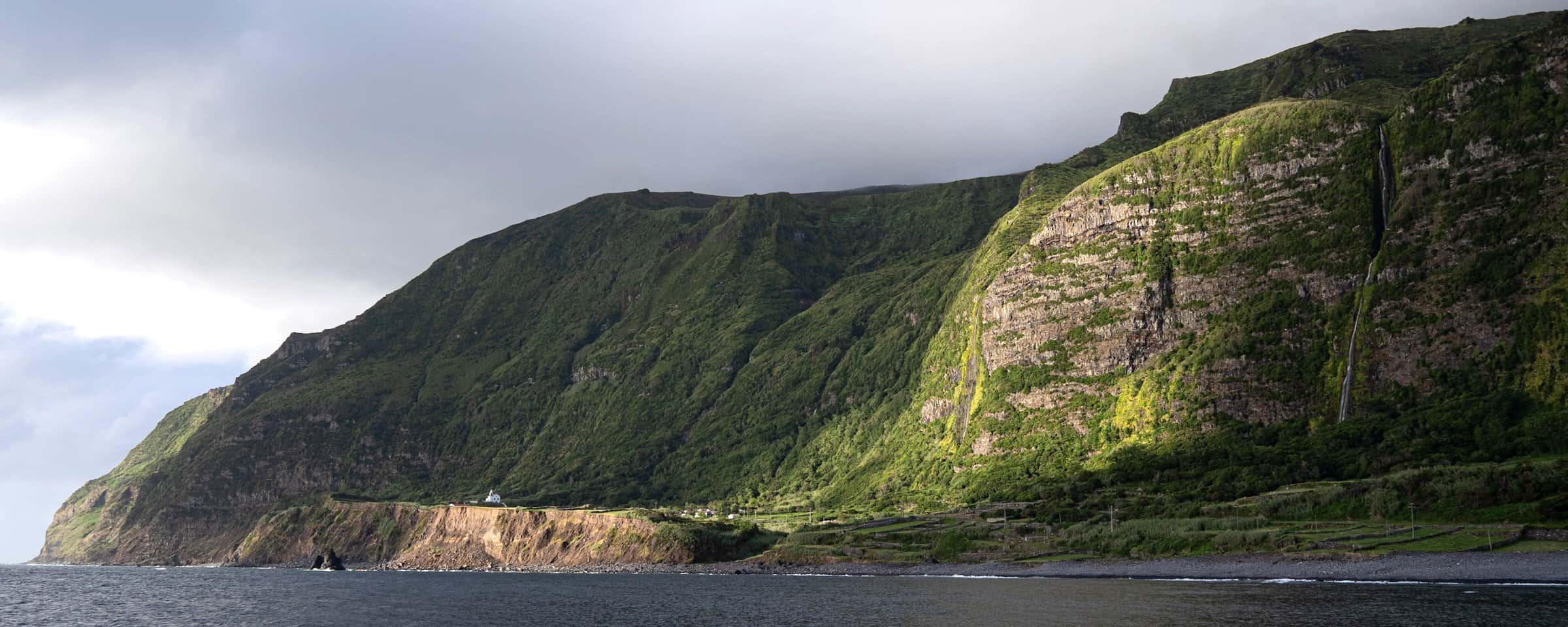
5. Poço do Bacalhau Waterfall | Cascata do Poço do Bacalhau
Few sights are as surprising and mesmerizing at once as a freshwater waterfall pouring into the sea. Poço do Bacalhau heightens that feeling, streaming in a slender white ribbon down the high cliff for a truly captivating view.
It can be seen from the tiny settlement near Fajã Grande, during one of the boat trips around the island, or on a private cruise. The site is very close to Ribeira Grande Falls, so you can stop by or simply admire it from afar as you descend toward town for a meal or supplies.
Naturally, right after rain the flow is much stronger and more dramatic.
6. Quebrada dos Fanais Viewpoint
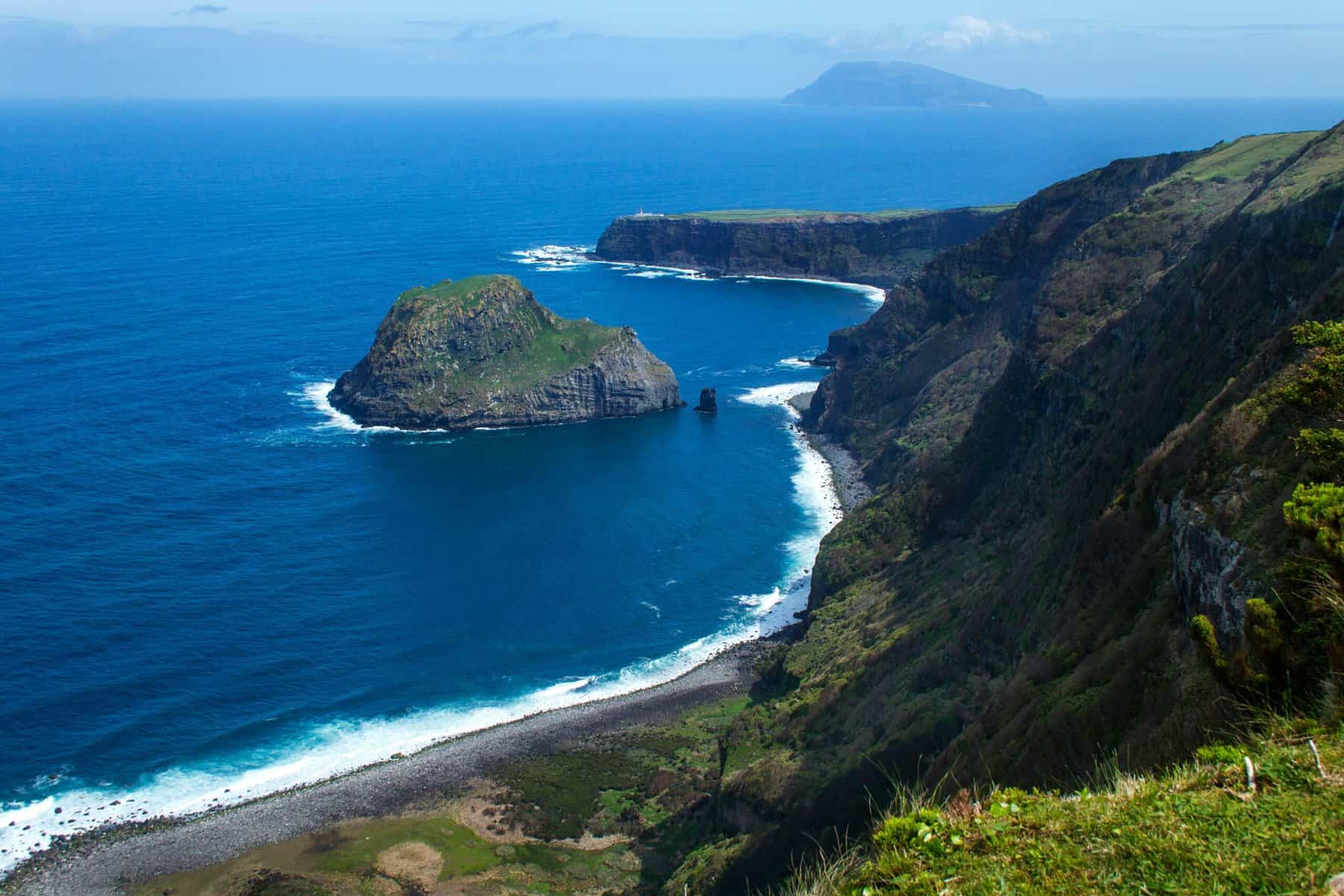
This viewpoint is at the northwestern edge of Flores. From here you can see one of the rocky islets off Flores, and on the horizon the island of Corvo, shaped like a truncated cone. Farther along the narrow road heading north are additional viewpoints, including one overlooking the large lighthouse at the tip of Flores — Farol de Albarnaz | Farol de Albarnaz.
Corvo Island
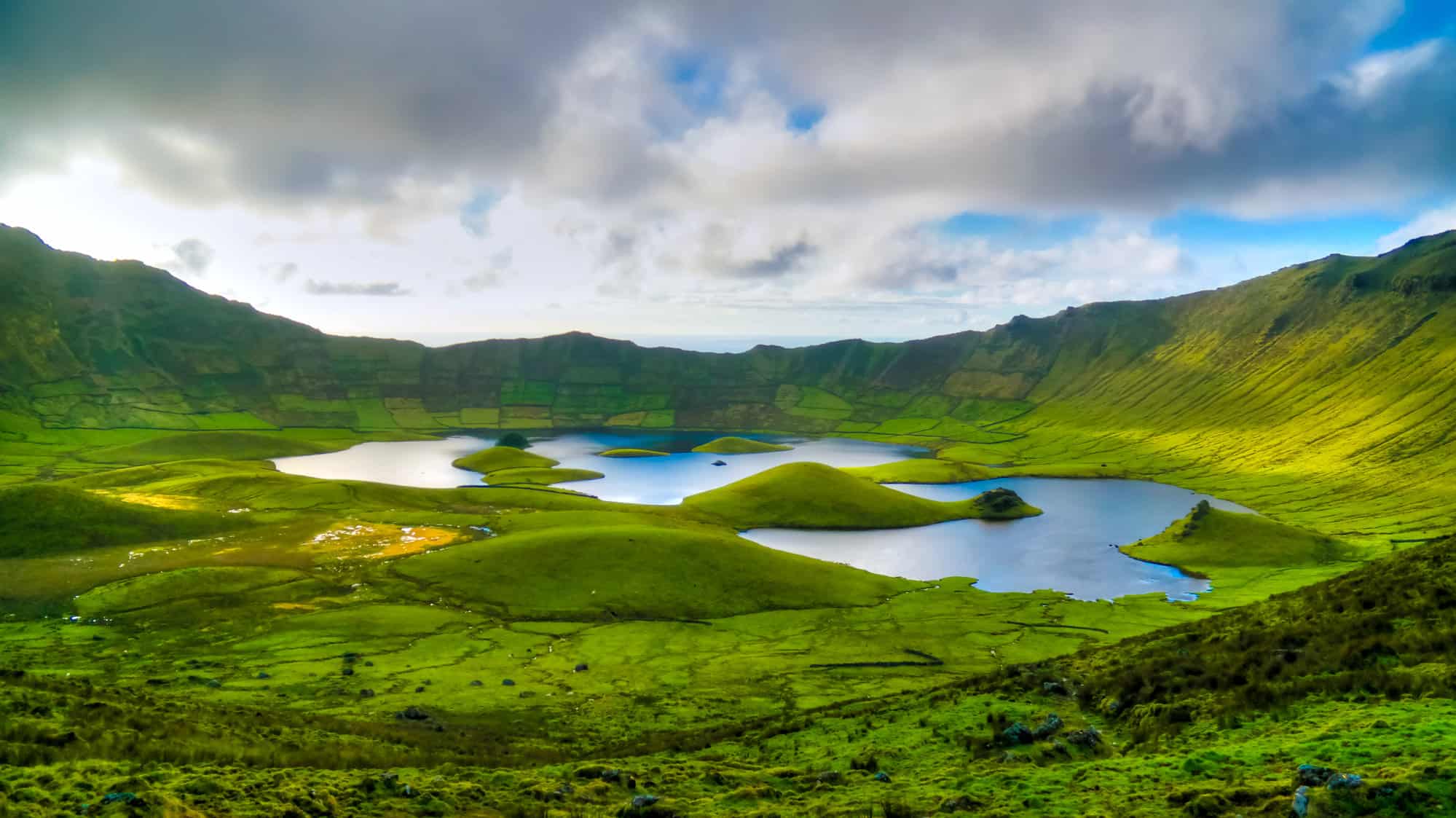
Corvo is the smallest of all the Azores islands, and also the northernmost. It is essentially a volcano with a huge green crater at its center, which is also the island’s main attraction. The mountain, called Caldeirão | Caldeirão (literally “cauldron,” or more precisely “large crater” in Portuguese), is more than enough reason to dedicate a day trip to this tiny island. It is the kind of outing where you climb up to the mountain to see the crater formed in its mouth — a view that feels straight out of a fairy tale.
Like Flores, Corvo was discovered by the Portuguese in 1452, roughly twenty years after the expedition financed by Prince Henry the Navigator (Infante Dom Henrique, o Navegador) found the easternmost islands of the Azores. Permanent settlement on tiny Corvo, however, was only established toward the end of the 17th century. As for the name, Corvo means “crow” in Portuguese, though it likely referred to a cormorant, the magnificent seabird known in Portuguese as a “sea crow.”
Click here for an amazing guided boat trip from Flores to Corvo…
Click here to find accommodations in one of the few guesthouses on tiny Corvo…
How do you get to Corvo?
Corvo lies 24 kilometers from Flores and is usually visited on a day trip from the larger island. Corvo has just one settlement — Vila do Corvo — with around 350 permanent residents. That makes it the least populated municipality in all of Portugal.
Corvo is the least accessible island in the Azores archipelago. That has its advantages too, since it remains deeply isolated and only a small number of tourists are there at any given time. As a result, the sense of nature and sheer remoteness feels even stronger on Corvo. The usual ways of reaching Corvo all begin on neighboring Flores, and they are:
1. Flights to Corvo
There is one very short, regular, and rather unique flight between Flores and Corvo. It is operated on a tiny propeller aircraft with very few seats. Actual flying time is just over 5 minutes!!!
It is extremely important to book tickets several months in advance if you are planning a Flores and Corvo trip in summer, as flights fill up quickly. There are still flights in winter, but fewer of them, so if you fly then, you will usually need to stay on Corvo for two or three days or return by another means of transportation.
2. Ferry to Corvo
There is a small ferry operated by Atlantico Lines — the Azores ferry company — departing from Flores twice a week. It leaves from Santa Cruz das Flores and reaches Vila do Corvo in the morning and again in the evening of the same day. In other words, there are two round trips on the same day, one in the morning and one in the early evening, which makes a day trip from Flores to Corvo possible. Booking tickets in advance is essential, because the ferry is small and seating is limited.
The 24-kilometer crossing takes about 45 minutes and is not always the most comfortable because of the waves. The upside is that it is the cheapest way to reach Corvo, and along the way you almost always spot dolphins, so there is no need to pay extra for a dedicated wildlife cruise when a public boat ride often does the job.
3. Commercial boat trips to Corvo
It is also possible to sail from Flores to Corvo on small commercial boats. Naturally, these trips cost more, but they are a great experience and fully justify the price. Most boats are essentially large speedboats, where you travel in groups of about 20 people wearing life jackets and skimming quickly over the water. This kind of trip is not available in winter due to weather conditions.
Click here for a lovely and enjoyable boat trip from Flores to Corvo…
Attractions and sights on Corvo
Caldeirão Crater | Lagoa do Caldeirão
This is the dormant crater of the underwater volcano that is, in fact, the island of Corvo. After an ancient eruption, the collapsed cone left behind a vast crater with steep rims covered in soft green grass. At the heart of the crater are blue freshwater lakes, with the usually rough Atlantic Ocean beyond. Together they create a scene that seems almost impossible for Earth — more like something from another planet.
Normally, a place like this would have become an Instagram sensation and triggered overtourism. But because Corvo is so remote and isolated, the number of visitors on the island at any one time rarely rises beyond a few hundred at most. That means the view before you is not only spectacular, but one you can experience in peace, with a real sense of separation from the noisy world beyond. More than anything, Corvo is defined by its quiet.
How do you get to Caldeirão?
The crater is in the north of the island, and you can drive all the way to its rim. From there, a steep descent drops 300 meters into the heart of the crater. Most visitors do not go all the way down, instead stopping halfway for a few spectacular photos that make it look as though you have the island almost entirely to yourself, apart from perhaps a few grazing cows in the background.
The two main ways to reach Caldeirão are on foot or by taxi. Both follow more or less the same route leading to the Caldeirão viewpoint (Miradouro Caldeirão).
- Hiking route – the trail starts in Vila do Corvo and is 6 kilometers long. The average hiker can complete the climb in 2 to 2.5 hours. It is somewhat demanding because of the ascent. It generally suits those staying at least one night on Corvo rather than day-trippers.
- Taxi – for those coming over from Flores on a day trip, this is probably the only practical option. The walking route is not especially long, but given the departure times of ferries and boats back to Flores in the afternoon, it would be a very tight schedule. Usually, as soon as you step off the ferry, boat, or plane, drivers will already be waiting outside, ready to take you to the viewpoint. The ride takes about 10 minutes.
Vila do Corvo – the small and only village on Corvo
The tiny town — or village — at the southern tip of the island is very small indeed. It has a handful of restaurants, one hotel, and a few guesthouses. This is also where you will find the tiny airport and the small harbor.
In the village itself, there are two main sights: the windmills (Moinhos do Corvo), which stand near the airport alongside a small lighthouse, and the village church — the little Church of Our Lady of Miracles (Igreja de Nossa Senhora dos Milagres).
Corvo also has a fairly organized camping option. The campsite is at the edge of the airport grounds (Campismo do Corvo), and it can be a memorable option, especially in summer. In winter, the wind and rain make camping much less pleasant.