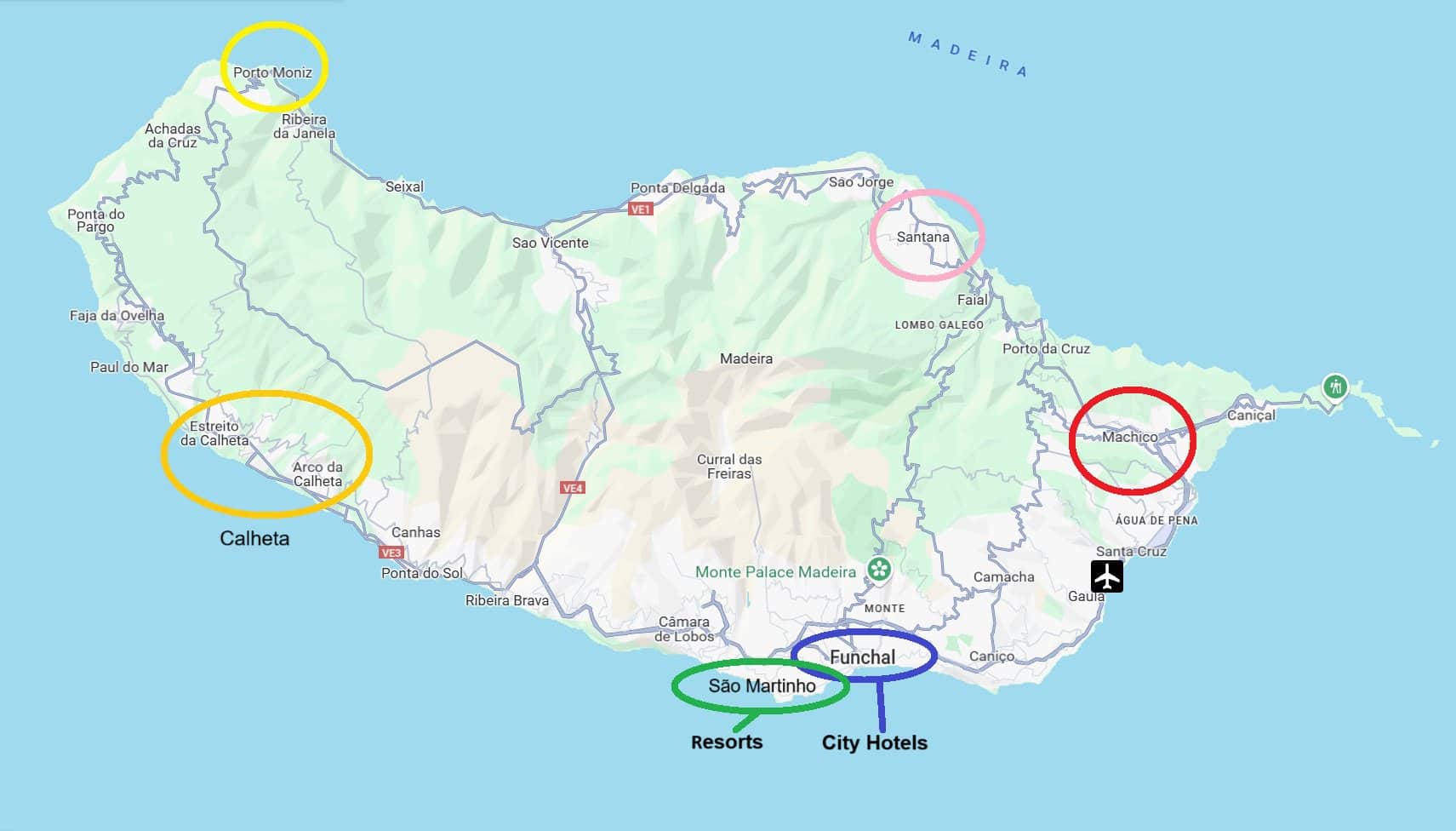
Here are our recommended places to stay on Madeira Island:
- Funchal – the capital and largest city
- West Funchal – São Martinho – the city’s resort strip
- Calheta – a town with a pleasant beach on the south coast of the island
- Machico – a relatively large town in a great location in the east of the island
- Porto Moniz – a town at the far northwestern tip with famous sea pools
- Santana – a town with several charming attractions in the north of the island
Every trip to Madeira passes through Funchal, the capital and largest city, which also has the island’s biggest concentration of hotels. Still, there are several other good places to stay on the island, whether for your whole trip or just part of it. If you’re spending more than 4 to 5 days in Madeira, it’s worth considering splitting your stay and spending a few nights somewhere besides Funchal, mainly for the variety and the experience.
Click here to search for accommodations in Madeira…
Map of the Best Areas to Stay in Madeira
What should you know about Madeira before booking accommodations?
In Madeira, four days is the minimum, and more than a week is already too much. Madeira isn’t cheap, but it’s not especially expensive either. It’s almost always a final destination, so if you’re making the journey, you’ll want to see as much as possible. Since the island isn’t very large, it’s absolutely possible to experience it fully in just a handful of days.
Madeira is known as the Island of Eternal Spring thanks to its wonderful weather almost all year round. Summer is peak season, and prices also rise around events like Christmas, Carnival, and the Flower Festival. Madeira is reached by plane from Lisbon, Porto, and dozens of other cities across Europe. It’s especially popular with travelers from northern Europe thanks to the warmer climate. Many visitors to Madeira choose to stay at the island’s wonderful resorts, pairing a bit of relaxation with days out to viewpoints and attractions around the island.
We’ve put together an accommodation guide that aims to answer the key questions before booking a hotel on this lush island. We’ve also added a map and a detailed description of every area where we think it makes sense to stay in Madeira. So let’s begin the overview:
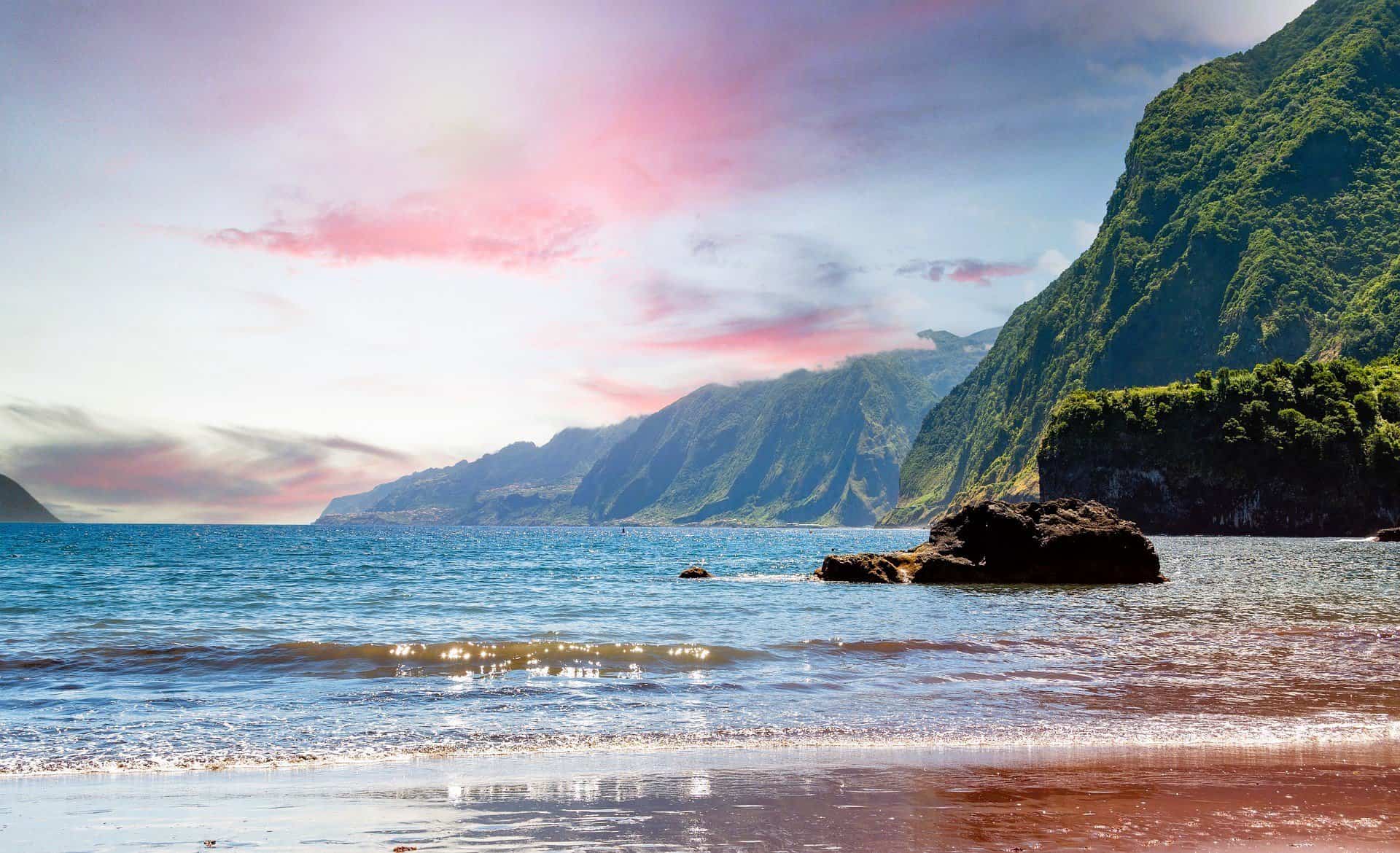
Which areas and towns are best for staying in Madeira?
1. Funchal
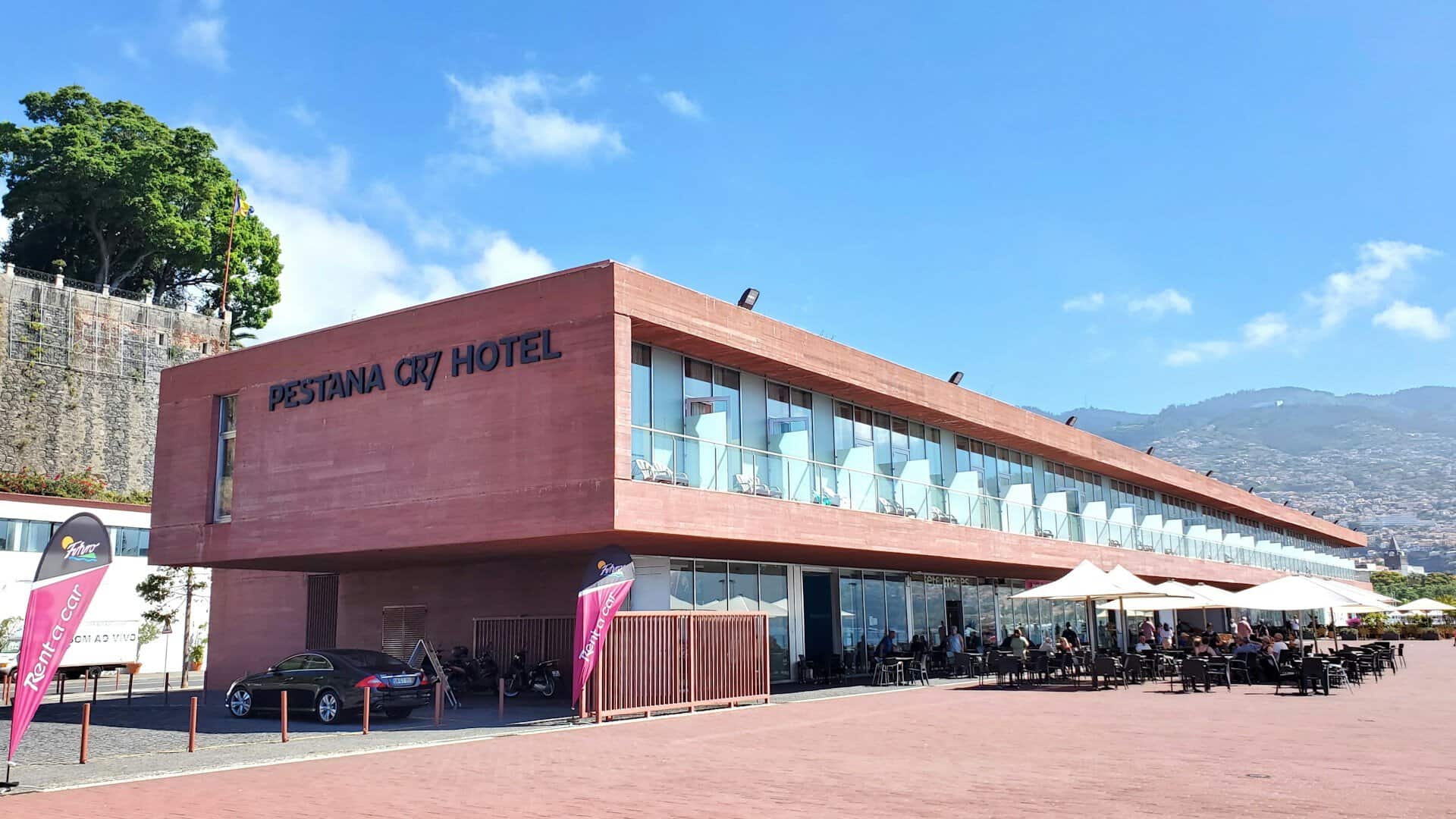
Funchal, Madeira’s capital, is the largest city on the island and its economic, commercial, transportation, and tourism hub. Funchal has just about everything you could want from a city: lively urban energy, gorgeous scenery, warm weather, and lush greenery with parks and gardens all around. Every Madeira trip includes Funchal, and very often the city itself, along with the attractions in and around it, makes up a major part of the journey. For visitors, there’s also no shortage of hotels, restaurants, bars, and shops. On top of all that, it’s the birthplace of Cristiano Ronaldo, home to his museum, and even the island’s airport was named after him during his lifetime.
Style: A true city, with all the perks Madeira has to offer: stunning scenery, near-perfect weather, nightlife, great food, and plenty more.
Best for: Everyone. In fact, many travelers choose to stay in Funchal and take day trips from there to different parts of the island, since distances on this small island are never very long.
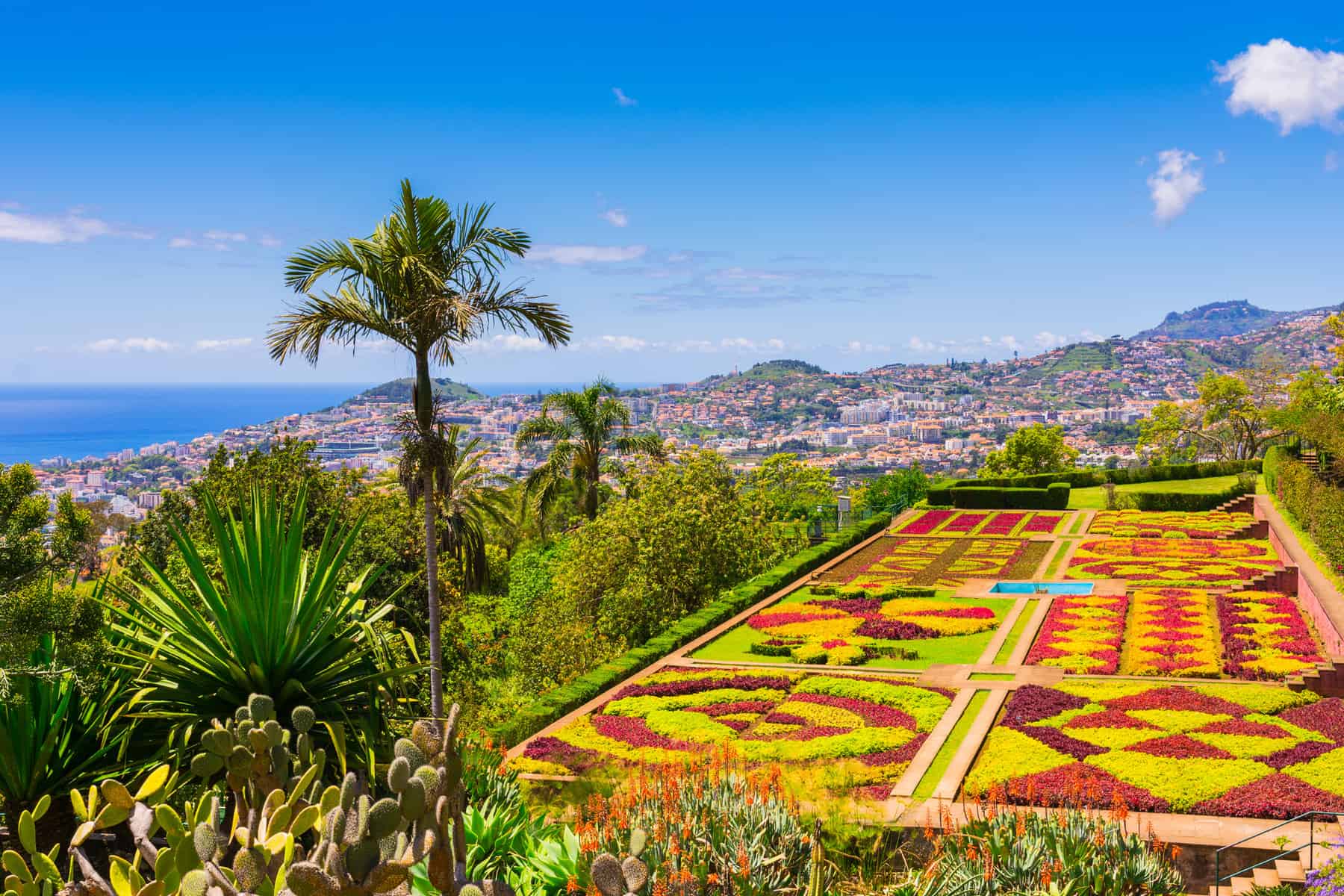
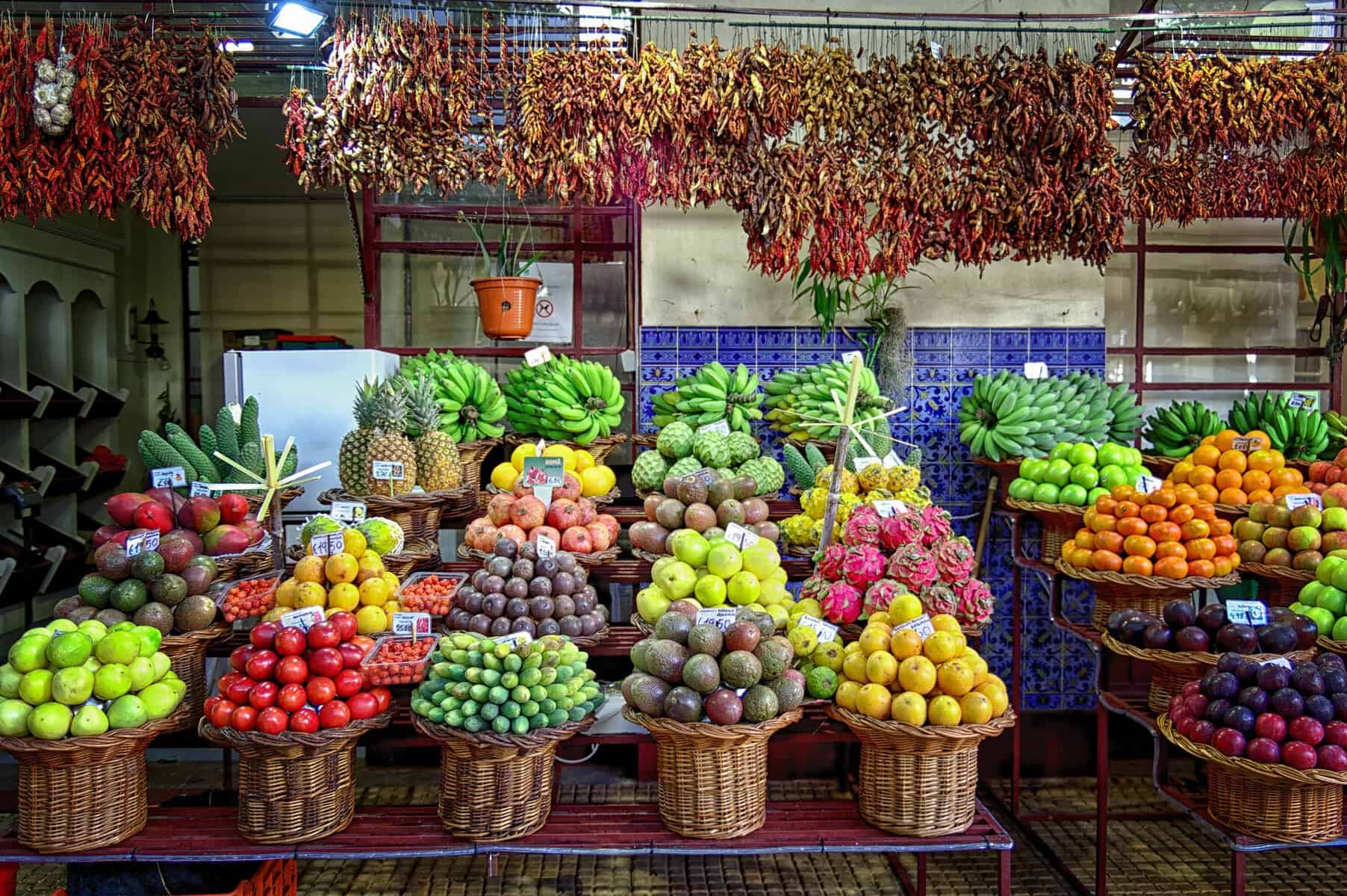
Nearby attractions: Farmers’ Market (Mercado dos Lavradores), the cable car up the mountain, the botanical gardens, the wicker toboggans, Funchal’s old town and cathedral, the Quinta das Cruzes Museum, and dolphin- and whale-watching cruises from the marina.
Tip – Try some of the island’s signature dishes in Funchal’s restaurants, especially those featuring tropical fruit: espetada (meat skewers), espada com banana – a fish unique to the island served with banana, and fresh tuna steak. Naturally, pair it with fortified Madeira wine or poncha.
Click here to find accommodations in lively, vibrant Funchal…
2. The resort strip in western Funchal | Funchal – São Martinho
São Martinho is essentially a neighborhood of Funchal, located west of the historic center. In other words, it’s a substantial part of Funchal just a few minutes’ drive from Funchal’s attractions, including the marina, the cathedral, and the cable car station. In our view, this is the best place to stay on the island overall. For one thing, the hotels here tend to be larger and more spacious, and for another, most of the resorts offer parking either on-site or nearby. That makes it especially easy to head out on day trips across the island, then return in the evening and still be just minutes away from Funchal’s restaurants, bars, busy streets, and lively atmosphere. Resorts right on the waterfront will be pricier, but there are plenty of options, and it’s still possible to find a good place at a lower price point.
Style: An area built entirely around vacation comfort, with shops, restaurants, a casino, parking, and everything else you need within a 5 to 10 minute drive of the city center.
Best for: Especially families, though the variety is broad enough that everyone can find something that suits them.
Nearby attractions: Funchal’s old town, Forum Madeira shopping mall, the Lido promenade, the Cristiano Ronaldo CR7 Museum, the glass skywalk at Cabo Girão, and the small harbor town of Câmara de Lobos.
Tip – In Funchal, it’s common to get around by taxi, ride-share services (Bolt), or the yellow buses. If you’ve returned in the evening and already parked near your resort, don’t bother driving into the city – parking downtown is hard to find and not cheap either.
Click here to find accommodations in Funchal’s resort strip…
Check out our list of top-rated resorts in Madeira…
3. Calheta
Calheta is a relatively large town on the south side of the island, about 40 minutes west of Funchal by car. It was once a major center for growing and processing sugarcane, the island’s main crop in its early years. Sugar and rum are still produced here today, and on some mornings a sweet scent lingers over town. Calheta has an artificial sandy beach and a marina beside it, with several hotels nearby. Higher up in town, you’ll find a small museum, a lovely church, and of course beautiful views over the endless ocean.
Town style: A fairly large town with warm, sunny weather.
Best for: Families and older couples.
Nearby attractions: The syrup and rum production factory uphill from town, the Anjos Waterfall that you can drive beneath, the Risco waterfall and hiking trail | Cascata do Risco, and Ponta do Pargo with its lighthouse – the westernmost point on the island.
Tip – Up in the hills above town, there are plenty of guesthouses, cottages, and rental homes. If you’re after total peace, sweeping ocean views, and crystal-clear air, this area delivers. Unlike the north side of the island, the south is sunny and warm.
Click here to find accommodations in sunny Calheta…
4. Machico
Machico sits on the eastern side of Madeira and is usually the jumping-off point for heading to São Lourenço Point and the trails along the eastern peninsula. Machico is also less than a 10-minute drive from Madeira Airport in the suburb of Santa Cruz. The town itself stretches along a slope rising toward the mountains, with a small stream running through its center – around it, the settlement first developed in the early 15th century. Down by the water, there’s a small beach, a promenade, and a handful of hotels that give the area the feel of a relaxed little seaside resort.
Town style: Suburban, with a convenient location for reaching many of Madeira’s attractions and sights.
Best for: Travelers planning to explore a lot who want somewhere different – and cheaper – than Funchal, while still having easy access to most of the island’s major sights.
Nearby attractions: Machico Beach – the town’s small beach, Capela dos Milagres where Madeira’s first church once stood, the Portela viewpoint high above town, the village of Caniçal where whale-watching boats depart, São Lourenço Peninsula, and the trails at the easternmost edge of the island.
Tip – Especially if you’re traveling with kids, don’t miss the Whale Museum in nearby Caniçal, and in season, head out on a boat trip to spot the world’s largest mammal.
Click here to find accommodations in Machico in the east of the island…
Click here for a list of recommended resorts in Madeira…
Click here for a list of sites and attractions on Madeira, the Island of Eternal Spring…
Click here for our list of 12 hotels we loved in Madeira…
Click here to search for accommodations across Madeira Island…
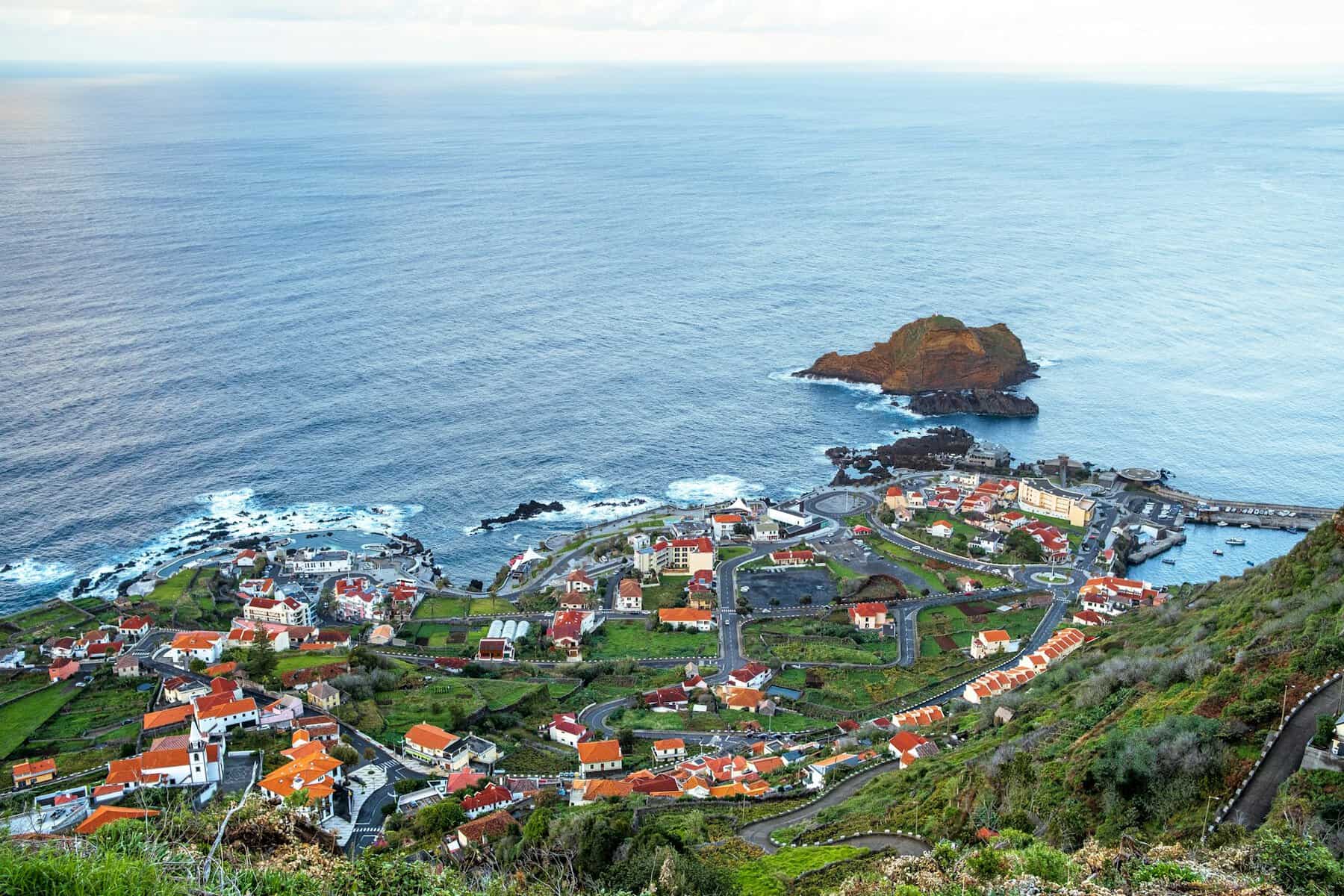
5. Porto Moniz
Porto Moniz sits at the far northwestern edge of Madeira. The town begins at the waterfront and climbs steeply up the mountainside. Along the coast are large natural sea pools that have become its signature attraction. Swimming here is both unique and wonderful. While you float in calm water, powerful Atlantic waves crash against the rocks just beyond, and above you – as so often in Madeira – rise cliffs and mountains blanketed in thick green vegetation. Several hotels have been built around the complex, and the area is very popular.
Town style: A small, quiet town with a real end-of-the-world feel.
Best for: Mainly couples, though families with slightly older children will enjoy it here too.
Nearby attractions: The ancient Fanal forest, Ponta do Pargo and its lighthouse, the narrow rocky islets at Ribeira da Janela, the town of Seixal beneath dramatic green cliffs, and mountain-ringed São Vicente.
Tip – Porto Moniz, like the rest of the north coast, gets strong winds and occasional rain. Come prepared with a windbreaker or rain jacket and you’ll be rewarded with some of the most beautiful scenery in the world.
Click here to find accommodations in Porto Moniz at Madeira’s far northwestern tip…
6. Santana
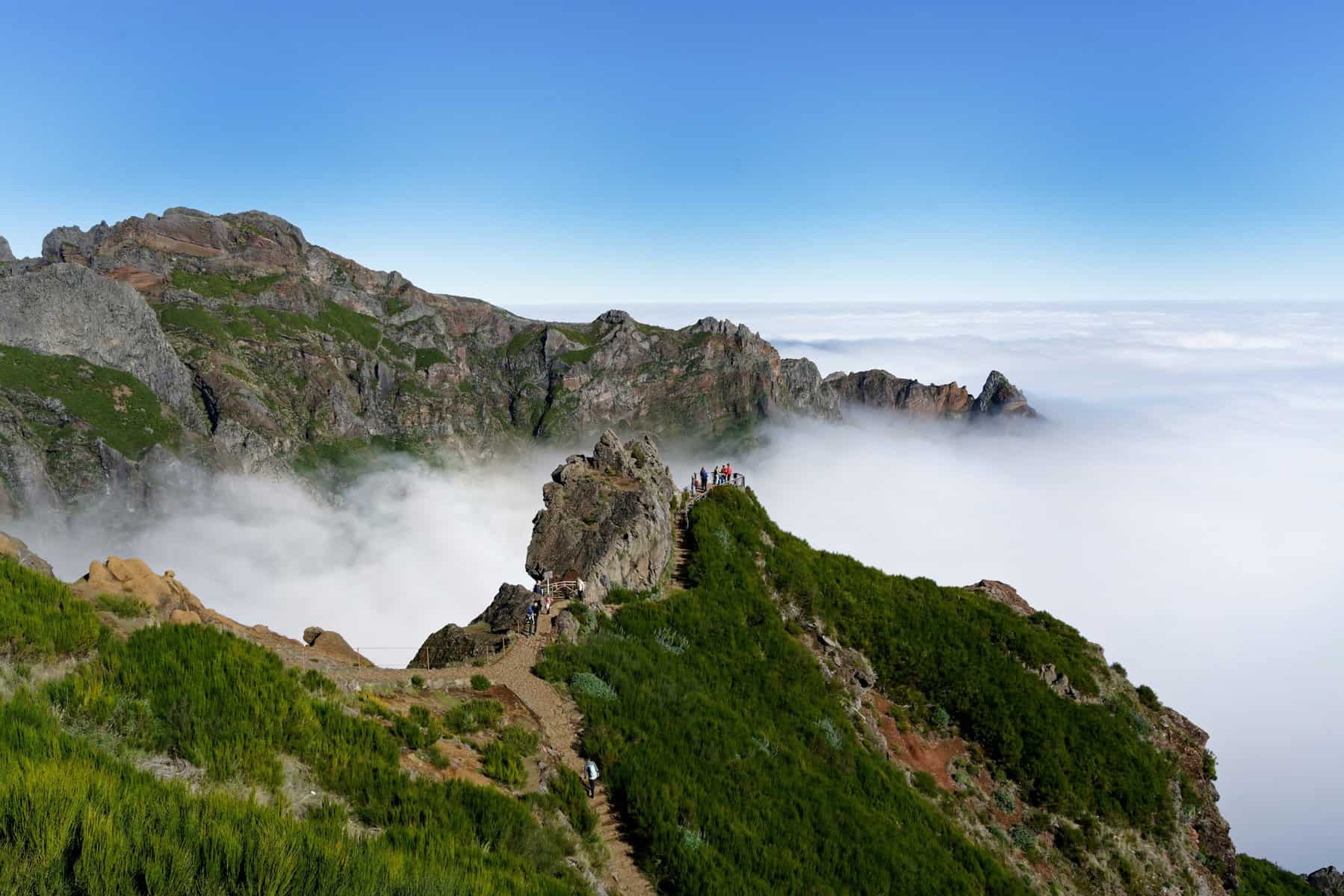
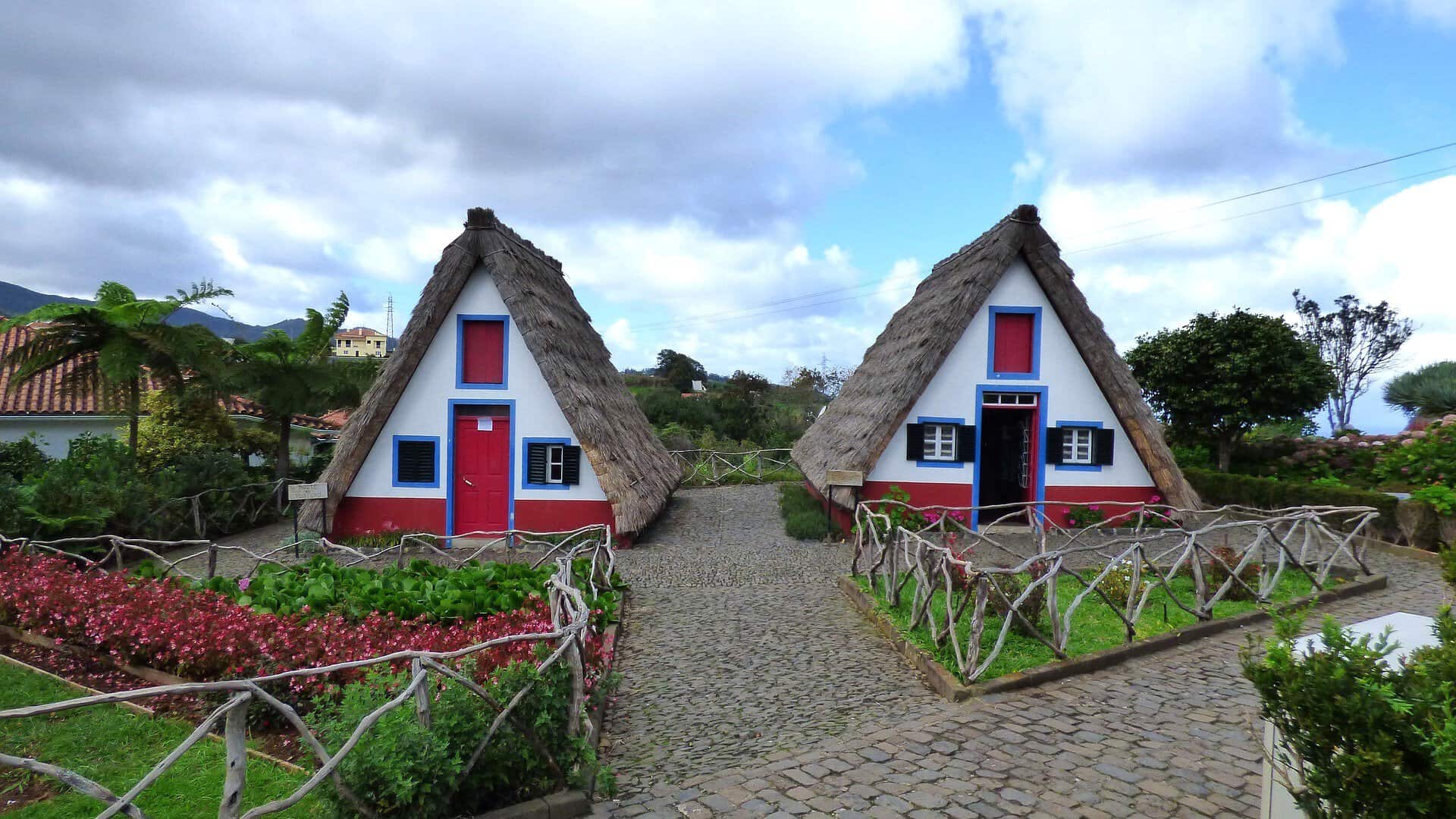
Santana is a town in the northeast of the island, best known for its triangular thatched-roof houses, which have become one of the green island’s most beloved sights. The houses are in the town center, next to Parque Temático da Madeira, a theme park whose pavilions present the island’s history, arts, people, and plant life. Santana is also one of the gateways from the north coast to Madeira’s famous high peaks and hiking routes, including Ruivo and Arieiro, which rise above the clouds.
Town style: A pleasant and very green town, with quick access to many of the island’s natural attractions.
Best for: Everyone, and especially travelers planning to spend plenty of time outdoors.
Nearby attractions: The triangular thatched-roof houses, Parque Temático da Madeira, Pico Ruivo – Madeira’s highest peak, Faial – a town with wonderful views, and the Levada do Rei hiking trail.
Tip – Santana is home to one of the island’s most distinctive hotels – Hotel Quinta Do Furao. Perched on a cliff above the sea and surrounded by vineyards, it offers an ultimate Madeiran experience. If you have the chance to stay for a night or two, you won’t regret it.
Click here to find accommodations in Santana with its colorful thatched houses…
Click here for 12 hotels with great views in Madeira…
Click here to search for hotels and vacation rentals in Madeira…
Click here for a list of 12 hotels with breathtaking views in Madeira…
Click here for a list of selected attractions and sights on Madeira Island…
Click here for a list of 12 recommended resorts in Madeira…
What else should you know about Madeira before you start looking for accommodations?
1. The season in Madeira – Warm Madeira is a year-round destination, and that’s a big part of its appeal. There are few places in Europe, if any, with near-tropical weather and sunshine for most of the year. So the answer to “When should you go to Madeira?” will usually be: whenever you can.
That said, the best time to visit is spring (late March through early June). Summer, as Europe’s main vacation period, is both the busiest and hottest season on the island. Carnival celebrations in late February to early March also draw large crowds. Autumn, meanwhile, is the quieter season and also the rainier one. That’s why prices tend to drop from mid-September until the holiday period in December and January, which also brings many visitors to Madeira.
2. Madeira’s weather: north vs. south: The island lies about 500 kilometers off the coast of Morocco and is one of the southernmost points in Europe. Unlike the Azores, Madeira never really gets cold – it stays mild to warm year-round. Only in July and August can the weather become quite hot, though even then the winds, sea, and mountains help moderate it. What matters most is that, because of the prevailing winds, there’s a very big difference between the north and west of the island and its south and east. The north gets stronger winds, more rainfall, and usually some fog during part of the day, while the south – and especially the east – is much sunnier and significantly warmer.
3. Stay in one place or split your trip? If you’re visiting for a week or more, it makes sense to divide your stay between two locations. One of them will almost always be Funchal and its surroundings, while the second is usually in the west or north of the island, which are greener and cooler than the south. If you’re staying just 4 to 5 days, it’s better to base yourself around Funchal and head out each day to a different part of the island.
Check out our guide to traveling in Maderia with kids…
4. The terrain: Madeira is essentially the peak of a mountain rising out of the water, far from everything in the Atlantic Ocean. Nearly all of its coastline is made up of cliffs towering above the sea. Beyond the waterfront, the land climbs quickly, with steep inclines almost everywhere. Fortunately, the volcanic ground makes tunnel construction relatively easy, so Madeira’s road system handles the steep terrain remarkably well and lets you get around the island quickly and easily.
5. Beaches – or rather, the lack of them: Even though it’s an island with near-tropical weather, Madeira is not really a beach island. On this volcanic island, almost the entire coastline rises in cliffs above the water, with no natural sandy beaches. Hotels make up for it with pools, and there are also natural sea pools. In the end, Madeira offers a unique experience and a wealth of attractions – just not a classic beach vacation.
6. Transportation on the island: The best way to explore Madeira is by rental car. The island is very small, and almost everywhere is within about an hour’s drive. Public transportation (the yellow buses) mainly connects town centers and is less useful for reaching attractions. In Funchal, taxis and Bolt – a ride-sharing app – are commonly used. If you don’t drive or prefer not to rent a car, there are plenty of options for day trips by bus, jeep, or private vehicle.
7. Attraction costs on the island: Attractions in Madeira are not cheap. Still, the walking trails (levadas), some waterfalls, and dozens of viewpoints are completely free. Spend a little time researching and keep an eye out for hidden gems – some hotels may offer free activities or complimentary shuttles, which can help cut costs.
Click here for a list of 12 wonderful resorts in Madeira…
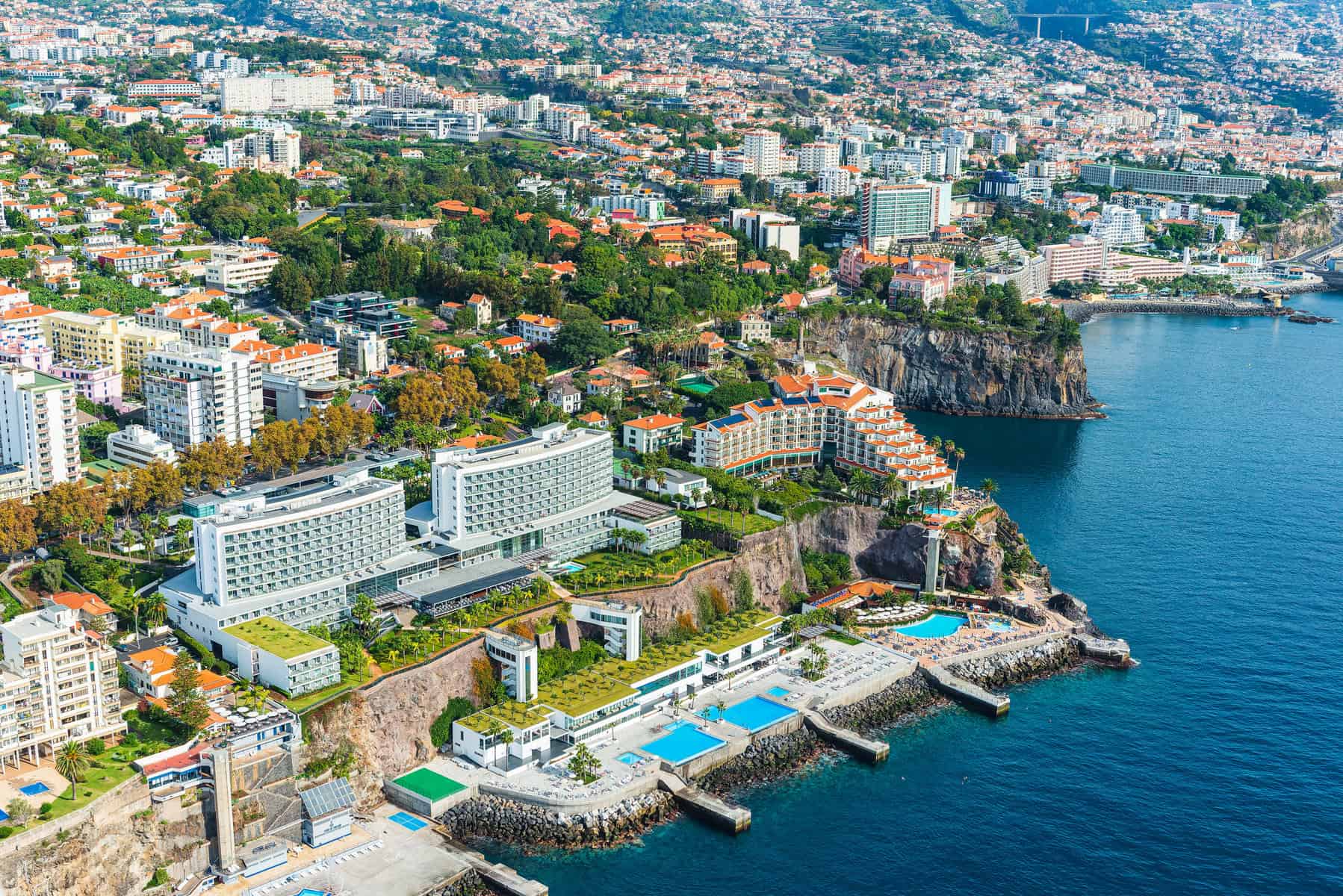
What is the luxury area to stay in Madeira?
The luxury area for staying in Madeira is west of central Funchal, in the São Martinho neighborhood. This is where most of Madeira’s luxury hotels are perched above the cliffs along the waterfront. In our opinion, it’s the best area to stay during a vacation on the island. Among the luxury hotels in São Martinho, you’ll find:
The Cliff Bay, one of the island’s best-known and most celebrated hotels | The Cliff Bay
Reid's Palace from the ultra-luxury Belmond collection | Reid's Palace
The long-established and classic Royal Savoy | Royal Savoy
In the hills above Funchal, there are also several luxury hotels in the “quinta” style – meaning estate properties with gorgeous green gardens, and in some cases magnificent views over the ocean and city from above. These are especially well suited to couples who appreciate vintage charm and classic elegance. Hotels such as:
The classic Quinta Jardins do Lago | Quinta Jardins do Lago
Quinta Funchal Gardens with its panoramic views | Quinta Funchal Gardens
The spa hotel in the historic manor house Quintinha Sao Joao | Quintinha Sao Joao Hotel & Spa
Outside Funchal, a small handful of luxury hotels are scattered around the island, mainly near the airport and the São Lourenço Peninsula in the east. But the heart of Madeira’s luxury scene is in Funchal. Since the 19th century, the city has been a retreat for Europe’s aristocracy – especially the English upper classes, who have long been fond of the island’s warm climate and excellent wine.
What types of accommodations are most popular in Madeira?
Hotels: This is the most popular way to stay in Madeira. Funchal in particular offers hundreds of hotel options across every comfort level. The rest of the island, which relies heavily on tourism, also has plenty of hotels. If you’re traveling around Madeira by rental car and want to stay in a specific place, it’s best to book ahead, since the towns outside Funchal are small and usually have only a limited number of hotels.
Resorts: In our opinion, this is the best way to experience Madeira – especially for families. Resorts in Madeira are concentrated mainly along Funchal’s Lido strip west of the city center, and they make an excellent base for an island vacation. Resorts allow you to combine an active trip with some downtime by the pool, while also enjoying dining rooms with a wide variety of food.
Apartments: Staying in apartments is less common in Madeira, since most trips here are relatively short – up to a week – and usually involve a lot of sightseeing. As mentioned, although Madeira is an island, vacations here tend to be active, focused on nature and attractions rather than beach time like in the Algarve in southern Portugal, for example. Even so, anyone looking for an apartment will find all kinds of options in Funchal, especially above the city center. Outside Funchal there are also plenty of choices, mainly between Funchal and Machico, which is the island’s most urbanized zone.
Guesthouses/cottages – Cozy vacation homes and cabins can be found almost everywhere outside Funchal. This is a good choice if you’re traveling around Madeira by rental car and want a taste of life in the island’s rural areas. Many residents in the more remote parts of the island have opened guesthouses – sometimes referred to here as cottages – on their farm properties. For a true sense of remoteness and endless peace, look along the north coast. In the southwest, especially around Calheta, you’ll find similar stays with spectacular views and warmer weather. The east and southeast are more urban, so hotels are usually the better bet there.
Camping: In Madeira, glamping is much more common than traditional camping. A few sites that have gained popularity are mainly found around Calheta in the southwest. There are also glamping complexes in Porto Moniz in the northwest and in Seixal on the north coast.
Staying on the nearby island of Porto Santo
Porto Santo Island is part of the Madeira archipelago. It lies about 40 kilometers northeast of the main island of Madeira and was, historically, actually the first to be discovered. The explorers Zarco and Teixeira were blown there in 1418 from the coast of Africa during a storm, and they named it the “holy port” after realizing it had saved their lives.
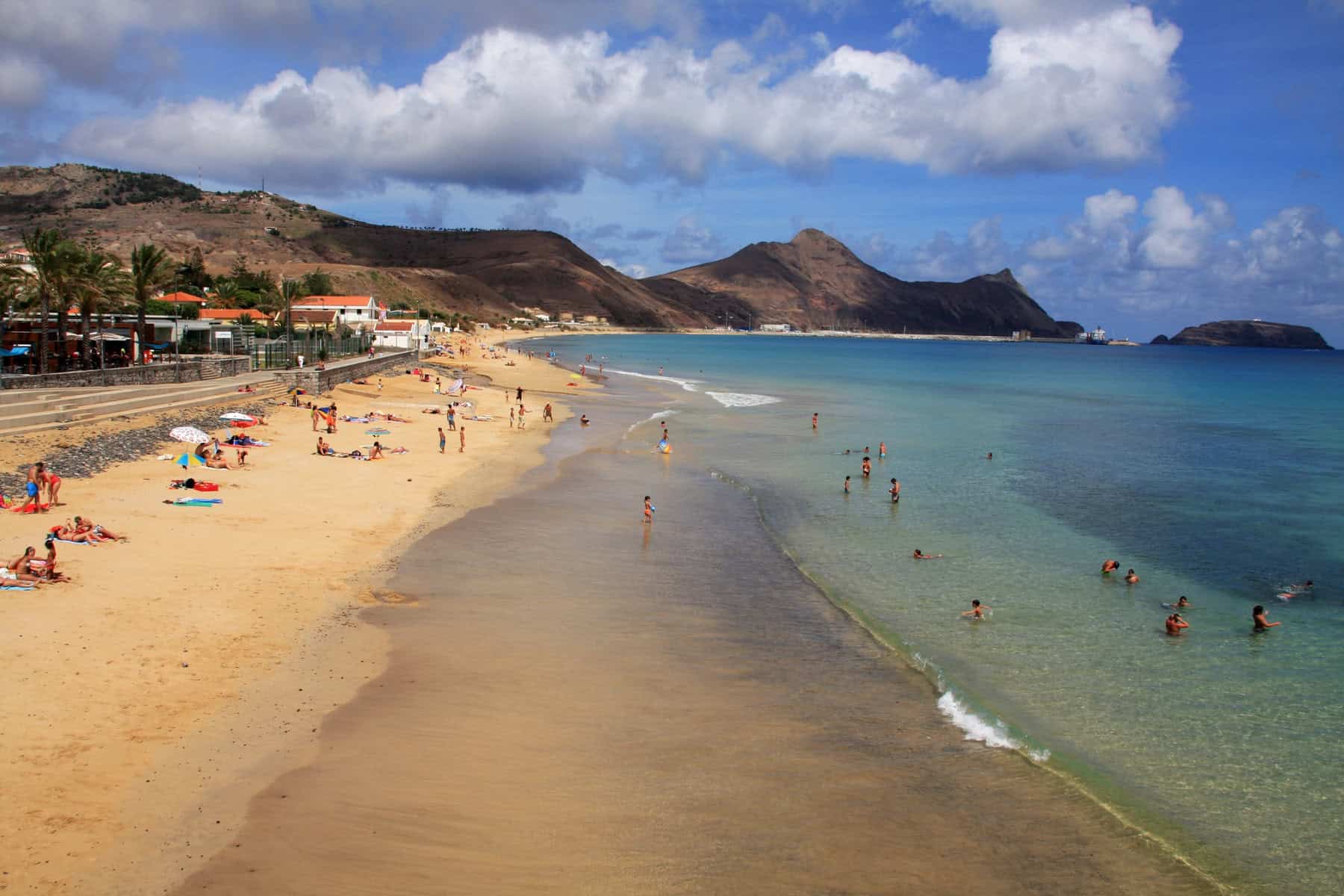
Porto Santo’s beach is the only sandy beach in the Madeira archipelago. Surprisingly, it’s also considered one of the best swimming beaches in all of Portugal. On mainland Portugal, Atlantic waters are usually cool and often windy, so beaches are generally better suited to surfing. Here on Porto Santo, you can swim in the sea year-round, aside from perhaps rainy days. Its southern exposure also makes the beach especially calm and pleasant.
There are two kinds of trips and vacations in Porto Santo. The first is a one-day trip: arrive by plane, spend one night, and then return to Madeira to continue your journey. The second is for travelers who, after three or four intense days in Madeira, want a peaceful break on a warm, pleasant sandy beach. These visitors stay for two or three days, or even longer, on this remote and relaxing island. Beyond the beach, Porto Santo also has a few hiking and cycling routes, mainly toward the mountain and forest at its summit, Pico do Facho. In the town of Vila Baleira, you’ll find several historic buildings, including the house of Christopher Columbus, who lived on the island for several years.
You can reach Porto Santo on a short 15-minute flight from Funchal, or by ferry from Funchal’s marina, which takes about two and a half hours.
This small island is best for travelers looking for an old-fashioned beach town atmosphere. Families will enjoy it, and so will couples wanting a break from the pressure of everyday life. With only about 5,000 permanent residents, the island doesn’t have many hotels. Most are located along the waterfront on both sides of Vila Baleira.
Click here to search for accommodations on Porto Santo Island in the Madeira archipelago…
What are accommodation prices like in Madeira?
Accommodation prices in Madeira vary depending on location, property standard, and of course the season. Overall, Madeira isn’t a cheap destination, but you can still find more reasonably priced options.
Location: Funchal is the most expensive area to stay in Madeira. Nearly anywhere outside the city will be cheaper, though with far fewer options.
High season: July and August, with additional peaks during the December holidays, Carnival in late February to early March, and the Flower Festival in May.
Low season: Mid-September to mid-December – though this is also when it can be rainiest.
Star rating and facilities: Naturally, upscale accommodations with higher star ratings and more extensive amenities will cost more than lower-rated hotels.
Here’s a general price range updated for 2026:
Budget hotels: 90 – 110 euros per night.
Mid-range hotels and resorts: 130 – 180 euros per night.
Luxury hotels and resorts: expect to pay at least 240 euros per night.
Cottages/guesthouses: prices vary widely depending on size, location, and amenities, but they usually start around 80 euros and can go up to 300 euros per night for large multi-room villas.
Click here for a list of 12 hotels with wonderful views in Madeira…
Click here to search for accommodations across Madeira Island…